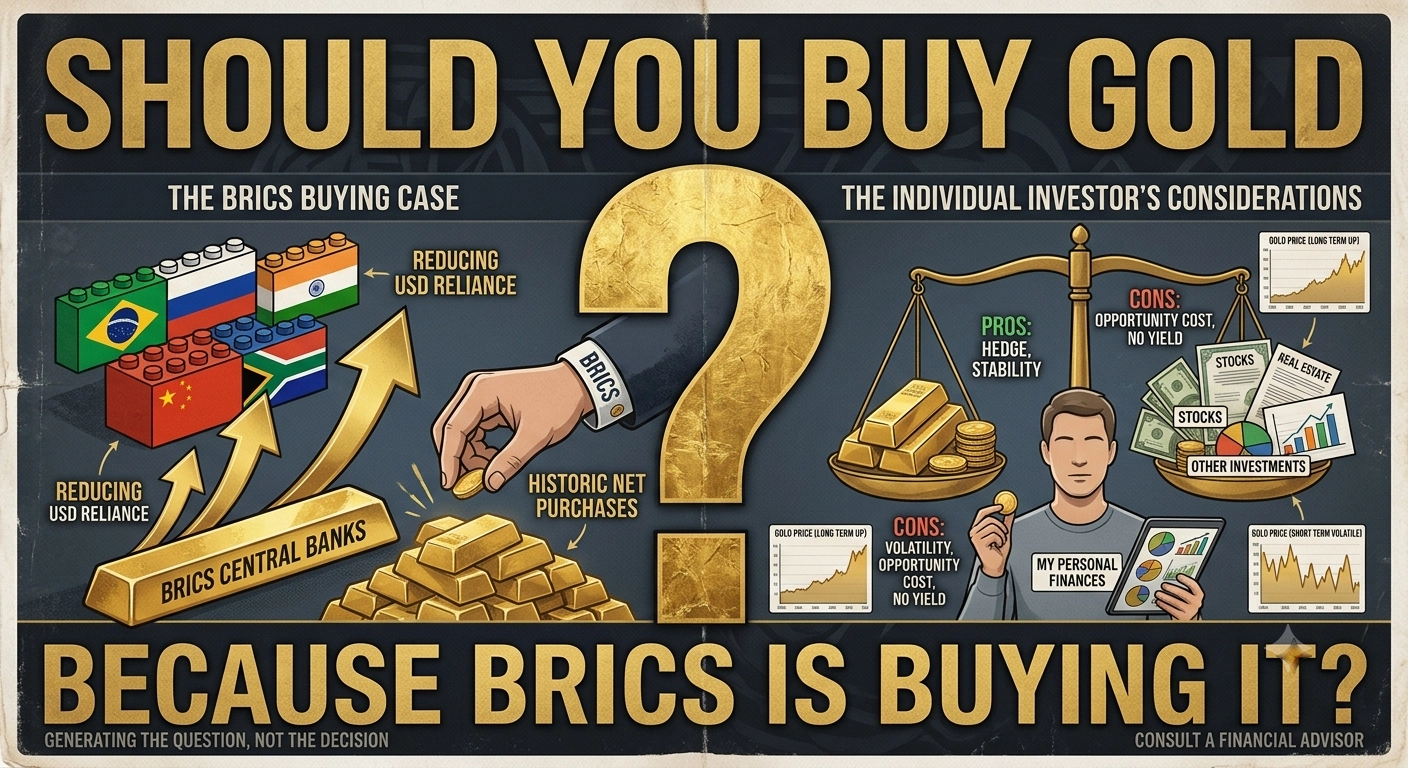
Central banks are accumulating gold. BRICS countries are discussing alternatives to dollar dependence. Gold has risen dramatically. Does it follow that an individual investor should buy gold? Not necessarily.
Gold has once again become part of a much larger debate about money.
Russia and China hold substantial gold reserves. India has steadily accumulated gold. Central banks around the world have increased their interest in the metal. At the same time, geopolitical tensions, sanctions, government debt and discussions about de-dollarisation have strengthened a powerful narrative:
If governments are losing confidence in fiat currencies and buying gold, ordinary investors should do the same.
It sounds persuasive. But sounding persuasive is precisely why we should examine it carefully.
Instead of asking, “Why should I buy gold?”, I want to ask a more difficult question:
What evidence would prove the gold thesis wrong?
That takes us from financial storytelling toward the thinking of Daniel Kahneman and Amos Tversky, Karl Popper – and, ultimately, Nassim Nicholas Taleb.
The first mistake: a good story is not necessarily a good forecast
Consider this chain of reasoning:
BRICS buys gold -> de-dollarisation accelerates -> confidence in fiat currency declines -> gold becomes more valuable -> therefore I should buy gold.
Every individual step sounds plausible. Put them together and the argument becomes extremely compelling. But Kahneman and Tversky’s work gives us a reason to be suspicious.
Human beings are exceptionally good at constructing coherent explanations from incomplete evidence. Once events fit into a convincing narrative, we tend to underestimate how much uncertainty remains.
Availability heuristic: geopolitical conflicts, sanctions, inflation and de-dollarisation seem especially probable because they are prominent in our information environment.
Recency bias: recent gold performance can encourage us to extrapolate that performance into the future.
Social proof: if sophisticated central banks are buying gold, surely I should buy it too.
Confirmation bias: someone already skeptical about fiat money will naturally notice evidence supporting gold while paying less attention to contrary evidence.
Loss aversion and FOMO: the possibility of gold rising dramatically while we own none can psychologically hurt more than the possibility of buying gold and watching it fall.
Popper asks a much better question
Karl Popper argued that scientific propositions should expose themselves to the possibility of being falsified. Instead of repeatedly searching for confirmation, we should deliberately look for evidence capable of proving our hypothesis wrong.
Suppose my hypothesis is:
“I should buy gold because central banks are accumulating it and de-dollarisation will increase its value.”
What observations could weaken that hypothesis?
Central banks could keep buying while gold performs poorly
This is entirely possible. Central banks do not have the same objectives as households or investors. Therefore: central-bank demand does not equal guaranteed investment return.
De-dollarisation could occur without gold replacing the dollar
Countries could diversify reserves into other currencies, bilateral settlement arrangements, government securities or new financial structures. Therefore: de-dollarisation does not automatically mean remonetisation of gold.
BRICS countries could accumulate gold without creating gold-backed currencies
Holding more gold is not equivalent to promising currency convertibility into gold. The accumulation may simply represent reserve diversification.
Real interest rates could remain attractive
Gold generates no interest. When inflation-adjusted yields on relatively safe assets become attractive, the opportunity cost of holding gold increases.
Productive assets could outperform gold
Gold could rise substantially and still be a mediocre investment relative to productive businesses. Gold preserving purchasing power and gold maximising wealth are two different propositions.
What does the central-bank evidence actually tell us?
There is nevertheless something important happening. Central banks have demonstrated substantial demand for gold in recent years. That should not simply be dismissed.
Gold possesses an unusual monetary characteristic: it is not somebody else’s liability.
A bank deposit is a liability of a bank. A government bond is a liability of a government. Corporate debt is a liability of a company. Gold bullion is simply gold.
That characteristic becomes particularly interesting when governments worry about sanctions, counterparty exposure, geopolitical fragmentation or the possibility that foreign reserves could become inaccessible.
You are not a central bank
A central bank’s objectives may include reserve liquidity, geopolitical resilience, monetary confidence, diversification and independence from foreign counterparties.
An individual investor usually wants something different: long-term wealth creation, retirement income, liquidity, purchasing-power preservation and protection against catastrophic loss.
A productive company can manufacture products, innovate, reinvest profits and generate cash flows. Property can generate rent. Bonds can generate interest. Gold generates none of these.
Its economic usefulness inside a portfolio comes from different characteristics. That suggests a more useful way of thinking about gold:
Gold may be better understood as insurance than as a wealth-producing machine
Enter Nassim Nicholas Taleb
Taleb’s thinking changes the question again.
World A: Things mostly work. Financial institutions remain functional, currencies retain reasonable purchasing power, businesses continue producing, capital markets remain open and inflation remains manageable. Under these conditions, productive assets may generate substantially more wealth than gold over long periods.
World B: Something unexpectedly breaks. Extreme inflation, sovereign-credit stress, financial sanctions, capital controls, banking instability, severe geopolitical fragmentation, currency disorder or another monetary event we failed to anticipate occurs. Gold could behave very differently.
The crucial Talebian insight is not: “I know World B is coming.” It is:
“I don’t know whether World B is coming, and my inability to predict it is itself relevant.”
That creates a legitimate reason for owning some gold without requiring us to forecast economic catastrophe. This is robustness rather than prediction.
The gold standard argument deserves the same skepticism
Some Austrian-school arguments suggest that restoring some form of gold standard could constrain government expenditure, strengthen monetary discipline and improve long-term price stability.
But Popper requires us to separate an argument about how a monetary system should work from an empirical prediction about what will happen.
Western gold standard -> greater saving -> lower consumption -> reduced imports -> BRICS manufacturing suffers -> Western capital investment rises -> Western reindustrialisation accelerates.
This is an interesting hypothesis, not an established law. Every arrow contains assumptions about human behaviour, prices, productivity, exchange rates, technological change, capital flows and political reactions.
Gold can be right and still be bought for the wrong reason
Imagine gold rises substantially after you purchase it. Does that prove your reasoning was correct? No.
You might have made a poor decision based on weak reasoning and still obtained a profitable outcome. Likewise, you could make a rational decision under uncertainty and experience a temporary loss.
Kahneman repeatedly warned against outcome bias – judging the quality of a decision solely by its eventual result. A disciplined investor should evaluate the quality of the decision process separately from the outcome.
Don’t ask: “Will gold reach $5,000?”
Forecasting a particular gold price creates an illusion of precision. A more useful question is:
“What role should gold perform inside my portfolio?”
A person holding zero gold is effectively placing greater reliance on productive financial assets and the existing monetary system. A modest allocation might function primarily as diversification and monetary insurance. A somewhat larger allocation could represent stronger protection against geopolitical and monetary uncertainty.
But eventually the allocation becomes sufficiently large that it is no longer merely insurance. It becomes a macroeconomic bet. You insure your house against fire; you do not normally invest most of your wealth in fire insurance because you believe fires are possible.
Statement 1 – My hypothesis:
“Gold deserves % of my assets because .”
Statement 2 – My falsification condition:
“I will reconsider this allocation if .”
If I cannot imagine any evidence that would cause me to change my position, I no longer have an investment hypothesis. I have an unfalsifiable belief. And markets are particularly expensive places to maintain unfalsifiable beliefs.
So, must we buy gold?
My conclusion is more nuanced.
BRICS accumulation strengthens the argument that gold retains strategic monetary importance. It does not prove that gold is currently undervalued. It does not prove that the dollar is about to collapse. It does not prove that a BRICS gold-backed currency is inevitable. It does not prove that an individual investor should copy a central bank. And it certainly does not prove that gold should dominate one’s portfolio.
Gold can deserve a place in a diversified portfolio not because we know exactly what will happen, but because we recognise that we don’t.
Kahneman and Tversky warn us against trusting compelling narratives. Popper asks us what evidence would prove our narrative wrong. Taleb reminds us that the most damaging events may be precisely those our models fail to anticipate.
Don’t buy gold because you are certain the monetary system will fail. Consider owning some gold because you should be skeptical of your ability to know that it won’t.
That, to me, is a much stronger argument for gold than any prediction about the next gold price.
Disclaimer: This article is an exploration of decision-making under uncertainty and is not personalised investment advice. Investment decisions should consider individual financial circumstances, liquidity requirements, taxation, time horizon and risk tolerance.