The Loss of an Intellectual Bridge
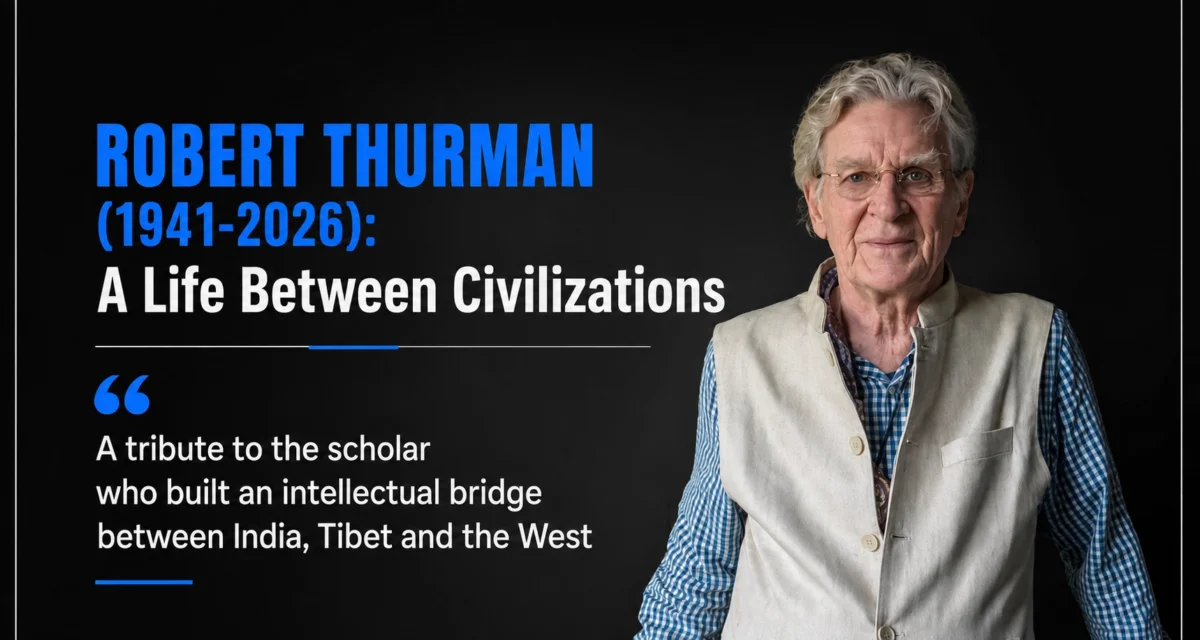
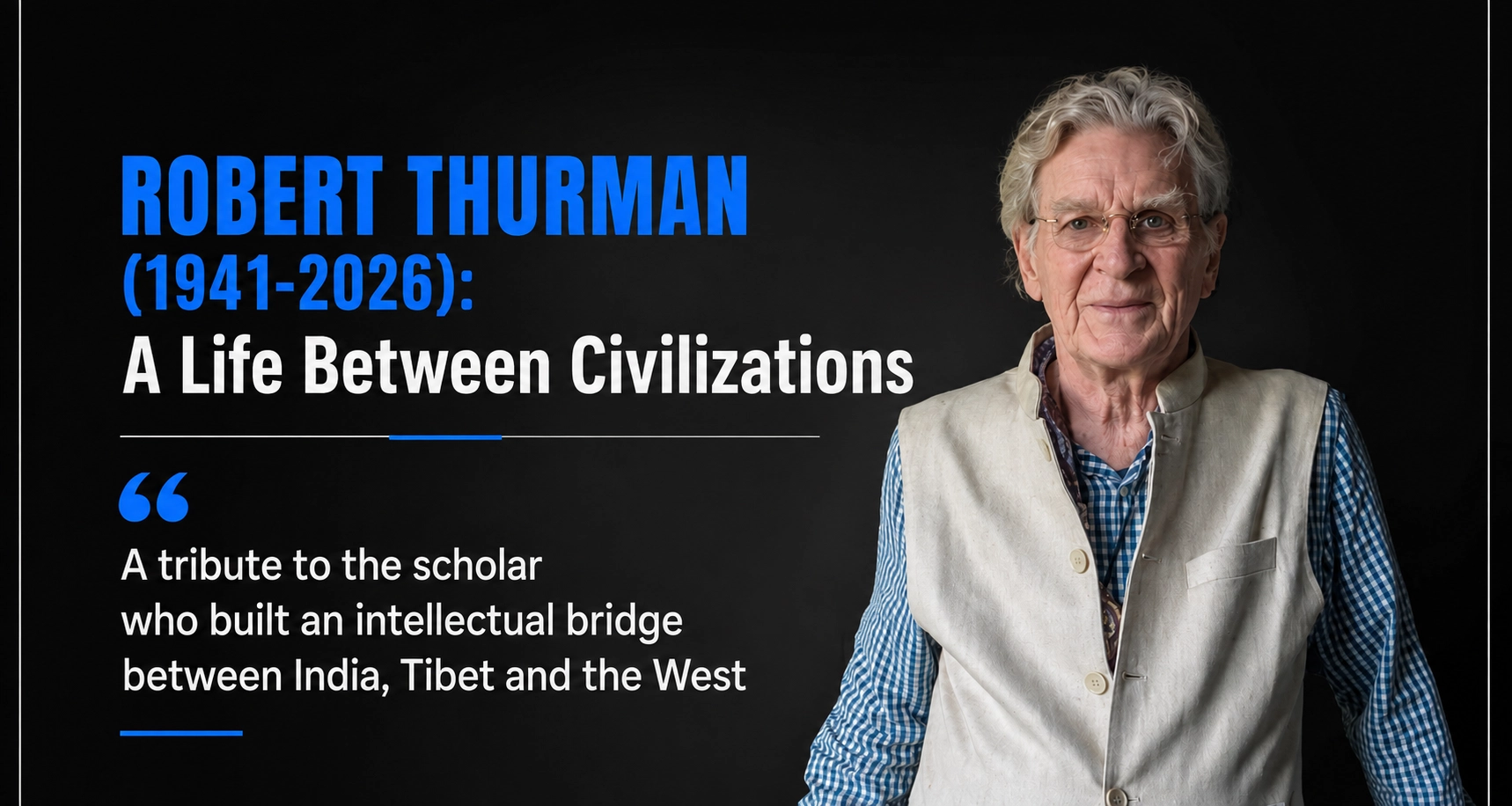
Robert Thurman’s passing feels like the loss of one of those rare intellectual bridges between civilizations. He was not merely an American academic who studied Tibetan Buddhism from a comfortable distance. He entered another philosophical world deeply enough to allow it to challenge his own assumptions about consciousness, suffering, attachment, compassion and what constitutes a meaningful human life.
His journey was extraordinary. As a young man, an accident cost him his left eye. He subsequently travelled to India, immersed himself in Tibetan Buddhist thought and eventually became the first American ordained as a Tibetan Buddhist monk by His Holiness the Dalai Lama. He later returned to academia, earned a doctorate at Harvard in Sanskrit and Indian studies, taught at Amherst and Columbia, and became one of the most influential Western interpreters of Tibetan Buddhist philosophy.
India, Tibet and the West
What fascinates me most about Thurman is the intellectual bridge he represented between India, Tibet and the West. Buddhism itself emerged from the Indian intellectual tradition, travelled across Asia, developed extraordinary philosophical traditions in Tibet, and centuries later encountered the modern West. Thurman’s life seemed to retrace part of that civilizational journey in reverse.
There is also a beautiful Indian connection in his family. Thurman is reported to have named his daughter Uma after reading Kalidasa’s Kumarasambhava. The association is particularly evocative because Uma is another name for Parvati, whose tapas, determination and union with Shiva stand at the heart of Kalidasa’s great Sanskrit poem.
There is something wonderfully symbolic about an American scholar becoming so immersed in Indic civilization that Kalidasa could find his way into something as intimate as the naming of his daughter – and decades later the world would know that daughter as actress Uma Thurman.
More Than ‘Uma Thurman’s Father’
Yet Robert Thurman should never merely be remembered as Uma Thurman’s father. His own intellectual legacy deserves far greater attention. He helped establish the American Institute of Buddhist Studies and later co-founded Tibet House US. He became an important figure in bringing Tibetan Buddhist philosophy into sustained conversation with Western academia and public life.
More importantly, he attempted something exceedingly difficult: translating ideas across civilizations without completely stripping them of the philosophical traditions from which they emerged. Translation between civilizations is not simply a matter of substituting one word for another. Concepts such as suffering, emptiness, compassion, attachment and liberation carry entire intellectual histories behind them.
A Popperian Reading of Thurman’s Life
There is something deeply Popperian that I find in Thurman’s journey. We inherit assumptions about what constitutes a successful existence – career, wealth, status, possessions, certainty and social approval. But what happens when those assumptions are exposed to radically different civilizations and philosophies? Do they survive criticism, or do some deserve to be discarded?
Karl Popper’s great intellectual contribution was not to tell us what we must believe, but to remind us that knowledge advances when our explanations remain open to criticism. Thurman, in a very different domain, demonstrated something similar through his life: he allowed another civilization’s philosophy to challenge the worldview into which he had been born.
Randomness, Narrative and Agency
At the same time, Kahneman and Tversky would caution us against constructing too neat a story around Thurman’s life. It is tempting, retrospectively, to say that losing his eye led him towards Buddhism and therefore everything happened for a reason. But the human mind is extraordinarily skilled at constructing coherent narratives after events have already occurred.
Thousands of people experience accidents without becoming Buddhist monks, Sanskrit scholars or interpreters of Tibetan philosophy. The causal chain is never as inevitable as hindsight makes it appear.
The accident was randomness.
What Thurman did afterwards was agency.
That distinction makes his life more remarkable, not less. He transformed an unpredictable event into decades of scholarship, teaching, preservation of Tibetan intellectual traditions and advocacy for compassion.
Compassion Without Sentimentality
Compassion, in Thurman’s intellectual world, was not merely sentimentality. It was something that could be cultivated through discipline, reflection and an understanding of our interdependence. This distinction matters in a world where kindness is sometimes mistaken for weakness and certainty is frequently mistaken for knowledge.
One does not need to accept every metaphysical proposition within Buddhism to take its psychological observations seriously. Attachment, craving, fear, ego and our tendency to construct stories about ourselves are subjects that modern psychology continues to investigate through entirely different methods and vocabularies.
Science, Philosophy and Meaning
A Popperian worldview does not require us to dismiss everything that cannot be scientifically falsified. It requires us to distinguish between different kinds of claims. A proposition about the physical universe may demand empirical testing. A philosophical insight about suffering, compassion or the meaning we construct from our experiences belongs to a different category.
Not every meaningful human experience needs to pretend to be a scientific theory. The danger begins when metaphysical, spiritual or philosophical claims demand the authority of empirical science without accepting its burden of testing and possible refutation.
Thurman’s life occupied this fascinating frontier between rigorous scholarship and questions human beings have been asking for thousands of years.
What is consciousness?
Why do we suffer?
What does attachment do to us?
Can compassion actually be learned?
Can another civilization reveal assumptions in our own thinking that we did not even know we possessed?
The Question He Leaves Behind
Perhaps the question I find most interesting is this: Can encountering another civilization’s ideas change the way we choose to live our own lives? Robert Thurman spent more than half a century suggesting that it can.
From New York to India and Tibet. From the Dalai Lama to Columbia University. From Sanskrit scholarship to Kalidasa’s Uma unexpectedly becoming part of modern American cultural history. His was an extraordinary journey across civilizations.
Perhaps that is the legacy worth remembering. Not that Robert Thurman found all the answers, but that he spent a lifetime being willing to question the assumptions behind the questions.
Om Mani Padme Hum.
Rest in peace, Professor Robert A. F. Thurman.
1941-2026