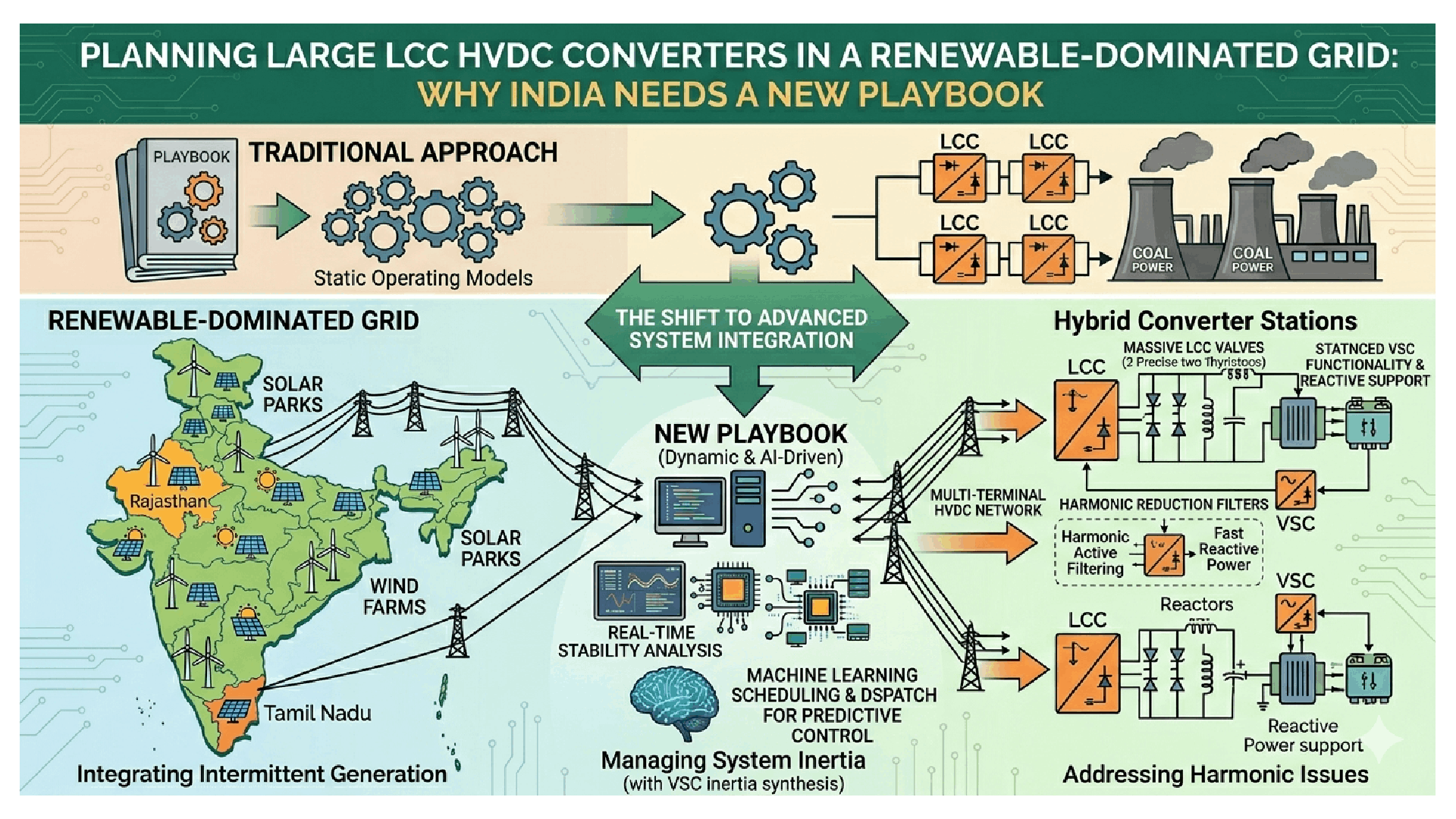
As India accelerates toward an ambitious clean energy future, the grid is entering a fundamentally different operating regime. With nearly 900 GW of renewable energy targeted by 2036–37, the traditional assumptions underpinning transmission planning, grid stability, and HVDC deployment can no longer be taken for granted.
Among the most urgent questions is this: Can legacy planning philosophies for large LCC HVDC systems survive in a weak, inverter-dominated grid?
The short answer is: not without major changes.
A recent technical position paper, Planning of 4×1500 MW, ±800 kV, Long Distance LCC HVDC in a RE-Dominated, Weak Grid: A Collective Wake-Up Call, argues that the industry must urgently rethink how large Line Commutated Converter (LCC) HVDC systems are planned, tested, and regulated in India’s rapidly evolving power system. The message is clear: the danger is not weak grids themselves, but continuing to design with strong-grid assumptions in a weak-grid future.
India’s Grid Is Changing Faster Than Our Planning Philosophy
India’s future power system will increasingly be dominated by inverter-based resources (IBRs) such as solar PV, wind power, and battery systems. Unlike conventional synchronous generation, IBRs contribute:
- Lower system inertia
- Reduced fault current levels
- Lower effective system strength
- Higher sensitivity to dynamic disturbances
This matters enormously for large HVDC systems. In conventional strong grids, large LCC HVDC links have historically delivered bulk power transfer efficiently over long distances. But in weak grids, their behavior becomes far more fragile.
The paper highlights that in low Effective Short Circuit Ratio (ESCR) environments, nearby LCC HVDC converters can interact in dangerous ways. A commutation failure (CF) in one converter may propagate to another, especially during recovery, leading to cascading disturbances and widespread outages.
That is not a niche technical concern. It is a system-level risk.
Why Large LCC HVDC Links Become Riskier in Weak Grids
The issue becomes particularly acute when planners consider very large configurations such as 4 × 1500 MW, ±800 kV long-distance LCC HVDC schemes.
In a weak receiving system, even a single pole outage can trigger a sequence of escalating problems:
- Severe voltage stress on valve arresters and associated valve components
- Significant voltage distortion during commutation failure
- Repeated failed recovery attempts after CF events
- Eventual tripping of the entire HVDC link if recovery cannot be achieved
The paper notes that typical recovery logic may attempt multiple recoveries at the set power level before a final attempt at reduced power. But in a weak grid, these attempts may still fail because the system simply does not provide the strength needed for reliable commutation recovery.
This is the key insight: transfer capability is no longer the only design constraint—system strength becomes equally, if not more, important.
The Hidden Technical Penalties of Weak-Grid LCC Operation
Weak-grid operation does not just increase the probability of commutation failure. It also changes the electrical environment around the converter in several subtle but serious ways.
According to the paper, lower fault levels in IBR-heavy systems can lead to:
- Longer commutation overlap periods
- Higher reactive power demand
- Higher inverter extension angles
- Increased stress on valve arresters and grading circuits
- Greater harmonic filtering requirements
To address the harmonics, additional AC filters may be needed. But this creates a paradox: reactive compensation itself can further reduce ESCR, making the grid effectively weaker from the converter’s perspective.
In other words, some of the conventional remedies can unintentionally worsen the very problem they are meant to solve.
The Current Planning Model May Be Creating Concentrated Risk
Today’s common approach to renewable evacuation often follows a familiar pattern:
- Aggregate large renewable power from dispersed sites
- Move it via long AC corridors to centralized pooling stations
- Evacuate bulk power using massive LCC HVDC links (~6000 MW class) into receiving systems that may already be weak
This architecture is attractive on paper for capacity aggregation—but the paper argues it may be structurally vulnerable in the future grid. It can:
- Consume significant right-of-way due to extensive AC infeed corridors
- Increase transmission losses because of large AC collection systems
- Create high systemic risk under contingencies
- Expose the grid to single-event, large-area outages if commutation failure recovery fails across multiple converters
In short, bigger is not always better when the surrounding AC system is weak.
A Better Direction: Smaller, Smarter, More Distributed HVDC Planning
One of the strongest takeaways from the paper is that future-ready transmission planning should move away from pure capacity maximization and toward survivability and resilience.
That means considering alternatives such as:
- Lower pole ratings for improved fault tolerance
- Medium-sized VSC HVDC systems located closer to renewable generation zones
- Reduced dependence on long AC collection corridors
- Explicit study of multi-infeed interactions
- Planning based on dynamic control interactions, not just steady-state transfer
The paper even suggests revisiting conventional LCC pole sizing in weak systems, pointing toward a more conservative range of approximately 500–750 MW per pole, rather than pushing very high pole capacities into weak receiving networks.
This is a significant recommendation. It challenges the long-standing instinct to maximize per-pole transfer wherever possible.
Why VSC HVDC Is No Longer Just an Alternative—It’s Becoming Strategic
The paper does not argue that LCC HVDC has no future. Rather, it argues that technology neutrality should be embraced, and that planners and regulators must allow greater room for Voltage Source Converter (VSC) HVDC and hybrid architectures where they make technical sense.
Why? Because in renewable-dominated weak grids, VSC-based systems can offer advantages that are increasingly valuable:
- Better controllability in weak networks
- More effective dynamic reactive support
- Easier integration with grid-forming behavior
- Potentially lower sensitivity to the classical commutation failure mechanisms of LCC
- Greater suitability for distributed, modular transmission architectures
The paper also emphasizes the importance of grid-forming with AVI capabilities and dynamic reactive support as core design principles, not optional enhancements.
For India’s next-generation transmission corridors, this could be a decisive shift in mindset.
OEMs Must Move Beyond Isolated Simulation Studies
Perhaps the most important operational recommendation in the paper is directed at OEMs and technology providers.
In low-ESCR systems, traditional EMT simulation studies—even detailed ones—may not be enough if each HVDC project is evaluated in isolation. The paper argues for:
- Hardware-in-the-loop (HIL) validation
- Joint interaction studies across multiple HVDC systems
- Cross-vendor or multi-project testing using actual control hardware
- Development of enhanced recovery algorithms
- Better coordination of controls across neighboring converter stations
This is crucial because control interactions between nearby LCC systems may only become fully visible when real control hardware is tested together under realistic weak-grid disturbances. A disturbance in one converter’s AC system can quickly influence another converter’s behavior—especially during recovery from commutation failure.
That means the future of HVDC assurance cannot be based solely on “my project in my sandbox.”
It has to become ecosystem-level validation.
Synchronous Condensers and Dynamic Support Will Be Essential
Another practical point the paper raises is that large LCC stations in weak grids will likely need supporting infrastructure, not just standalone converter design improvements.
Specifically, it calls for:
- A distributed network of synchronous condensers
- Dynamic reactive support, both inductive and capacitive
- Grid-supportive solutions such as STATCOMs
- More disciplined harmonic filter switching strategies
- Avoidance of abrupt or binary switching where voltage change must be tightly controlled
This is an important reminder for planners: the converter station cannot be viewed as a self-contained asset. In weak grids, the surrounding support ecosystem is part of the converter design.
What Regulators Need to Do Now
For policymakers and regulators, the paper makes a compelling case that existing grid codes were largely written for a world dominated by synchronous generation. That world is disappearing.
Regulatory evolution should now consider:
- Reassessing HVDC pole rating limits in weak systems
- Mandating joint control interaction and recovery studies
- Updating planning criteria to explicitly include weak-grid behavior
- Supporting technology-neutral frameworks that do not bias against VSC or hybrid solutions
- Institutionalizing shared accountability across planners, OEMs, and operators
If regulation continues to evaluate projects primarily on transfer capability and steady-state compliance, it may unintentionally approve architectures that are efficient in normal conditions but fragile during disturbances.
And in a renewable-dominated system, disturbance performance is the real test.
The Real Shift: From Efficiency to Resilience
The most powerful line of thinking in the paper is that the industry must move:
- From capacity maximization → to system survivability
- From isolated project design → to coordinated, multi-infeed-aware planning
- From simulation-led confidence → to hardware-backed validation
- From strong-grid assumptions → to weak-grid-first design
This is more than a technical recommendation. It is a strategic planning philosophy for India’s energy transition.
Because the energy transition is not simply about adding renewable megawatts. It is about building a grid that can withstand, absorb, and recover from disturbances in a fundamentally different electrical environment.
Final Thoughts
India’s transmission system is entering a historic phase. The scale of renewable integration ahead is unprecedented, and HVDC will remain a central enabler of long-distance power transfer. But the paper rightly sounds a warning: the future grid cannot be treated as a scaled-up version of the past.
Large LCC HVDC links still have a role—but only if they are planned with full awareness of:
- weak-grid dynamics,
- multi-infeed interactions,
- recovery security,
- dynamic reactive support needs,
- and cross-system control coordination.
References
The real wake-up call is not that weak grids are coming.
It is that they are already shaping the constraints of tomorrow’s transmission decisions today.
- Planning of 4×1500 MW, ±800 kV, Long Distance LCC HVDC in a RE-Dominated, Weak Grid: A Collective Wake-Up Call. Unpublished technical position paper.