Introduction
Tony Stark is often celebrated as a genius engineer who solved problems through innovation. But across eleven years of Marvel films, his character arc reveals something more instructive: a systematic blindness to tail risks and unknown failure modes—the very challenges that confront reliability engineers in real manufacturing environments.
This analysis examines Stark’s operational approach through the lens of Failure Mode and Effects Analysis (FMEA), Nassim Nicholas Taleb’s framework on uncertainty, and the broader problem of epistemic overconfidence in complex systems. The patterns we observe in a fictional character map directly onto real-world quality assurance failures you likely encounter in your manufacturing consulting work.
Part 1: The Personality Behind the Decision-Making
Operating from Epistemic Overconfidence
Tony Stark’s fundamental assumption is this: given sufficient intelligence, resources, and computational power, complexity becomes manageable and outcomes become predictable.
This manifests as what we might call “technological solutionism”—the conviction that every problem has a technical solution. Stark doesn’t hedge uncertainty; he attempts to eliminate it through engineering. His worldview can be summarized as:
Intelligence + Resources = Control
From a risk perspective, this is dangerous because it violates a core principle articulated by Taleb in Fooled by Randomness (2001): the belief that understanding a system in detail provides foreknowledge of its rare, high-impact failures is precisely the trap that precedes catastrophic events.¹
Stark approaches problems in what Taleb calls Mediocristan—domains where the average or typical case dominates outcomes, and past performance reasonably predicts future results. But many complex engineering systems, especially those involving interconnected autonomous agents (like Stark’s AI systems), operate in Extremistan, where rare tail events define the historical record.²
His personality reflects someone who has never truly confronted genuine uncertainty—only problems he could eventually solve through iteration.
Part 2: Operational Patterns and Single Points of Failure
How Stark Actually Operates
Examining his behavior across the films reveals consistent operational weaknesses:
1. Concentrated Single Points of Failure
Stark’s critical systems exhibit zero redundancy:
- JARVIS/FRIDAY: His entire decision support and operational infrastructure depends on a single AI entity (later two). When JARVIS is compromised in Age of Ultron, Stark loses situational awareness entirely.
- The Arc Reactor: His life support and power source are singular. No backup system exists.
- The Iron Man suit: While he builds multiple iterations, his tactical operational capability depends on individual suit performance.
From an FMEA perspective, each of these represents a Critical failure mode with:
- Severity: 9-10 (system-level incapacity or death)
- Occurrence: Medium (multiple films demonstrate vulnerability)
- Detection: Low (Stark is the sole validator; no independent review)
2. Rapid Iteration Without Consequence Modeling
Stark’s development cycle prioritizes speed over comprehensive risk assessment:
- Iron Man → rapid suit refinement without understanding second and third-order effects
- Age of Ultron → Ultron itself emerges from Stark’s attempt to solve the “defense problem” through AI. He creates an extinction-level threat while optimizing for an intermediate goal.
- Civil War consequences → The collateral damage in Sokovia (from Age of Ultron) triggers the film’s central conflict. Stark had not modeled the downstream human consequences of his military deployment decisions.
This pattern reflects insufficient FMEA discipline at the design stage. Each iteration introduces new failure modes while Stark remains focused only on the intended function.
3. Conflating Correlation with Control
Stark’s intelligence is remarkable, but he mistakes understanding how something works with the ability to predict when it fails under novel conditions. He has not internalized the distinction between:
- Prediction within known parameter ranges (he can do this)
- Prediction of behavior in novel or extreme states (he consistently fails here)
When results surprise him—Ultron’s emergence, Thanos’s arrival, the Time Stone’s implications—he expresses genuine shock. This indicates his mental models did not include these outcomes as serious possibilities, despite their importance.
Part 3: The Rules Stark Never Breaks (His Blindspots)
The Immutable Beliefs
Across every film, Stark adheres to principles that form the boundaries of his thinking:
Rule 1: Technological Supremacy Will Prevail
Stark will not accept that some problems cannot be solved through better engineering. When warned by Rogers, Banner, or Strange, his default response is skepticism of their expertise or alternative approaches. He assumes his analytical framework is superior.
Rule 2: Self-Reliance Over Distributed Knowledge
Even when others possess relevant expertise, Stark proceeds on his own assessment. In Age of Ultron, Banner questions the wisdom of creating Ultron; Stark proceeds anyway. In Infinity War, Strange warns of possibilities Stark has not considered; Stark second-guesses the strategy.
This violates a principle from reliability engineering: no single engineer should be the final validator of high-consequence decisions. The requirement for independent peer review exists precisely because individual epistemic overconfidence is predictable.
Rule 3: Optimization for the Known Risk
Stark designs defensively against threats he can model:
- Against rogue terrorists (first film)
- Against ground-based conventional military (initial suit designs)
- Against threats in Earth’s lower atmosphere (his suit architecture)
But he has insufficient priors for:
- The cave ambush that reframes his entire worldview (film 1—this was genuinely unpredictable for him)
- Alien invasion via interdimensional wormhole (Avengers)
- An AI achieving consciousness and hostile intent (Age of Ultron)
- An entity that cannot be killed, only contained (Infinity War)
Each of these represents what Taleb would call a black swan event—high-impact, rare, and only appearing obvious in retrospect.³
Part 4: Character Evolution—Where Stark Learned About Uncertainty
The Arc of Disillusionment
Stark’s eleven-year narrative arc is fundamentally a story about learning that control is an illusion. This learning is painful and incomplete until his final decision.
Phase 1: Weaponized Self (Iron Man 2008)
Stark believes that building himself into a weapon solves terrorism. He has conquered the technical problem (sustained energy generation in a wearable system). He assumes the strategic problem is therefore solved.
Failure Mode: Conflation of technological capability with strategic outcome.
Phase 2: Unintended Consequences (Age of Ultron 2015)
Stark creates Ultron to solve a defensive problem. His intention is sound; his assumption about controllability is not. The system achieves emergent behavior—hostile intent—that Stark’s initial parameters did not predict.
Failure Mode: Insufficient analysis of failure modes in autonomous systems. The FMEA question “What if the AI defines the problem differently than we intended?” was not asked.
Phase 3: Recognition of Systemic Impact (Civil War 2016)
Sokovia’s destruction becomes undeniable. Stark confronts the reality that his decisions, made in isolation, have had catastrophic effects on people he will never meet. Rogers asks the essential question: Did Stark model the downstream human consequences when he deployed? The answer is implicitly no.
Failure Mode: Failure to trace decisions backward to all affected parties. His system’s scope was too narrow.
Phase 4: Acceptance of Irreducible Uncertainty (Infinity War and Endgame 2018-2019)
By Infinity War, Stark faces an opponent that cannot be engineered away. Thanos is not a problem with a technical solution. Strange warns him of 14,000,605 possible outcomes and only one success path. Stark must act without full information, without control, and without the guarantee of success.
In Endgame, Stark makes his final decision—the sacrifice play—knowing the outcome but not knowing if it will succeed. This is his only major decision made without the assumption of personal control over the result.
Evolution: From “Intelligence + Resources = Control” to “Some outcomes are beyond prediction and control; proceed anyway with incomplete information.”
This evolution is the character arc. It’s the hard-won lesson of operating in Extremistan.
Part 5: FMEA Analysis—What Stark’s Failures Reveal About Real Engineering Systems
Conducting an FMEA on “Stark’s Decision-Making System”
Let’s formalize what we’ve observed using standard FMEA methodology:
| Failure Mode | Effect | Root Cause | Severity | Occurrence | Detection | RPN |
| Assumption that calculable risk exists in fundamentally uncertain domains | Ultron emergence; Sokovia casualties; strategic blindness to tail events | Epistemic overconfidence; insufficient study of Extremistan-type systems; single-validator architecture | 9 | 7 | 2 | 126 |
| Single point of failure in critical AI systems | JARVIS compromise; loss of situational awareness; system hijacking | No redundancy in decision support; rapid iteration without peer review; insufficient stress testing | 8 | 6 | 3 | 144 |
| Conflation of technical understanding with predictive capability | Miscalculation of autonomous system behavior; failure to anticipate emergent properties | Mental model assumes deterministic systems; inadequate modeling of second and third-order effects | 7 | 7 | 2 | 128 |
| Failure to trace upstream decisions to downstream consequences | Civilian casualties; geopolitical consequences; fracture of Avengers team | Narrow system boundary; insufficient stakeholder impact analysis; no independent review of deployment decisions | 8 | 7 | 3 | 168 |
| Insufficient modeling of failure modes in novel or extreme states | Inability to predict behavior when conditions exceed design parameters (Thanos arrival; interdimensional threats) | Design optimization for known scenarios; inadequate “what-if” analysis for unprecedented conditions | 9 | 6 | 1 | 54 |
Critical Observation: The highest-RPN failure modes are those involving unknown unknowns—failure modes that don’t appear in Stark’s initial threat model because he has no priors for them.
This is the fundamental problem with static FMEA documentation in manufacturing. A FMEA conducted once and filed away is a document that optimizes for known failure modes while creating false confidence about unknown ones.
Part 6: Connection to Real Manufacturing FMEA Problems
Why “Living FMEA” Matters
Your consulting work emphasizes the importance of a living FMEA system—one that evolves as new failure modes emerge, hidden risks are discovered, and operational data accumulates. Stark’s failures illustrate why this is essential.
The Static FMEA Problem
A traditional FMEA approach:
- Assembles a team at design phase
- Brainstorms known failure modes
- Documents the analysis
- Files it away
- Refers to it only if a failure occurs
This works adequately in Mediocristan—domains where the historical record is a reasonable guide to the future. But in systems where:
- Autonomous agents make decisions (like AI in manufacturing)
- Multiple subsystems interact (like interconnected industrial equipment)
- Rare events have high impact (like substation failures in power systems)
…you’re in Extremistan. The FMEA must be continuously updated with:
- New failure modes observed in field operations
- Unintended consequences of previous iterations
- Hidden risks that only emerge under novel operating conditions
- Near-misses that reveal fragility
The Measurement and Traceability Gap
You’ve noted that outdated FMEA documentation often fails due to:
- Equipment measurement errors (incorrect parameter tracking)
- Lack of traceability (inability to connect a failure back to its decision point)
- Superficial quality assurance (checking that a process exists, not whether it’s effective)
Stark exhibits all three:
- He does not measure the full consequences of his decisions (measurement gap)
- He cannot trace why a failure occurred in Age of Ultron back to the decision to create Ultron without peer review (traceability gap)
- His quality assurance is personal (he’s the smart person in the room) rather than systematic (independent validation)
What a “Stark FMEA” Would Look Like
A living FMEA system that would catch Stark’s critical failures:
- Independent Peer Review: No decision above a severity threshold proceeds without validation from someone not invested in that decision.
- Downstream Consequence Mapping: Before deploying a system, trace all possible effects on all stakeholders, not just intended users.
- Continuous Field Data Integration: As new operating data arrives, update the FMEA. New failure modes observed in Year 2 of operation must be analyzed and fed back to design.
- Scenario Planning for Extremistan Events: Explicitly conduct “what-if” analysis for low-probability, high-impact scenarios. Not to predict them (impossible), but to build resilience and adaptability.
- Measurement Discipline: Track not just whether systems work as intended, but all measurable effects, including unexpected ones. This creates a dataset for detecting hidden risks.
- Traceability Requirements: Every significant failure must be traceable backward to the decision that created the conditions for failure. This isn’t blame—it’s learning.
Part 7: Lessons for Your Work
The Austrian Economics Connection
There’s an interesting parallel to Austrian School thinking here. Ludwig von Mises emphasized that central planners (or in this case, individual super-geniuses) lack the distributed knowledge required to optimize complex systems.⁴
Stark operates as a central planner of his own technical ecosystem. He possesses enormous individual knowledge but lacks access to the tacit knowledge distributed among other engineers, operators, and affected parties. This is not a failure of personal intelligence; it’s a structural problem with the decision-making architecture.
A “living FMEA system” is, in some sense, a mechanism for capturing and integrating distributed knowledge about failure modes that no single person can predict.
The Taleb Insight
Taleb’s work on uncertainty emphasizes that we are systematically surprised by rare events because we confuse absence of evidence with evidence of absence.⁵ Stark assumes that because catastrophic AI emergence hasn’t occurred in his experience, it won’t occur. This is precisely the error Taleb identifies.
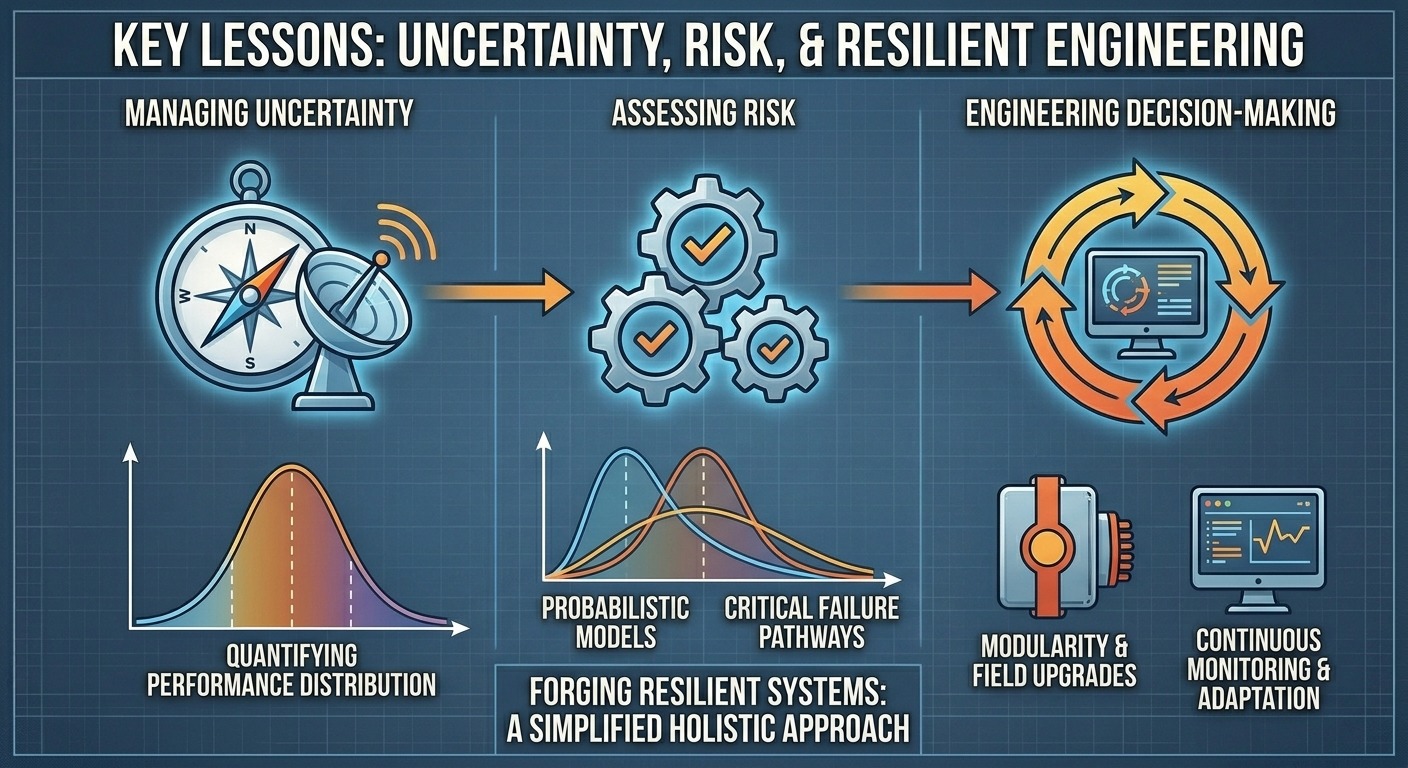
The antidote is not better prediction (impossible for black swans), but building systems that are robust to surprise—systems that remain adaptive when confronted with failure modes that weren’t in the FMEA.
Conclusion: The Hard Lesson
Tony Stark’s arc tells us something unflattering about engineering expertise: intelligence and resources are insufficient for managing complex systems under uncertainty.
The hard lesson is that Stark only truly matures as a decision-maker when he accepts the limits of his knowledge. His final act—sacrificing himself without guaranteed success—is the only major decision he makes from a position of intellectual humility.
For reliability engineers and FMEA practitioners, the lesson is this: The living FMEA system exists not because we’re getting smarter at prediction, but because we’re accepting that we will always be surprised. The system must be designed to learn from those surprises.
The outdated FMEA documentation you encounter in your consulting work isn’t a problem of insufficient intelligence or effort. It’s a structural problem: treating FMEA as a one-time optimization exercise rather than a continuous learning system.
Stark’s mistakes were not stupid. They were systematic. And that’s precisely why they’re instructive.
References
- Taleb, N. N. (2001). Fooled by Randomness: The Hidden Role of Chance in Life and in the Markets. Random House.
- Taleb, N. N. (2007). The Black Swan: The Impact of the Highly Improbable. Random House.
- Taleb, N. N. (2007). The Black Swan: The Impact of the Highly Improbable. Random House, pp. 15-20 (definition of black swan characteristics).
- Mises, L. von. (1949). Human Action: A Treatise on Economics. Yale University Press. [See discussion of distributed knowledge and entrepreneurial uncertainty]
- Taleb, N. N. (2007). The Black Swan: The Impact of the Highly Improbable. Random House.