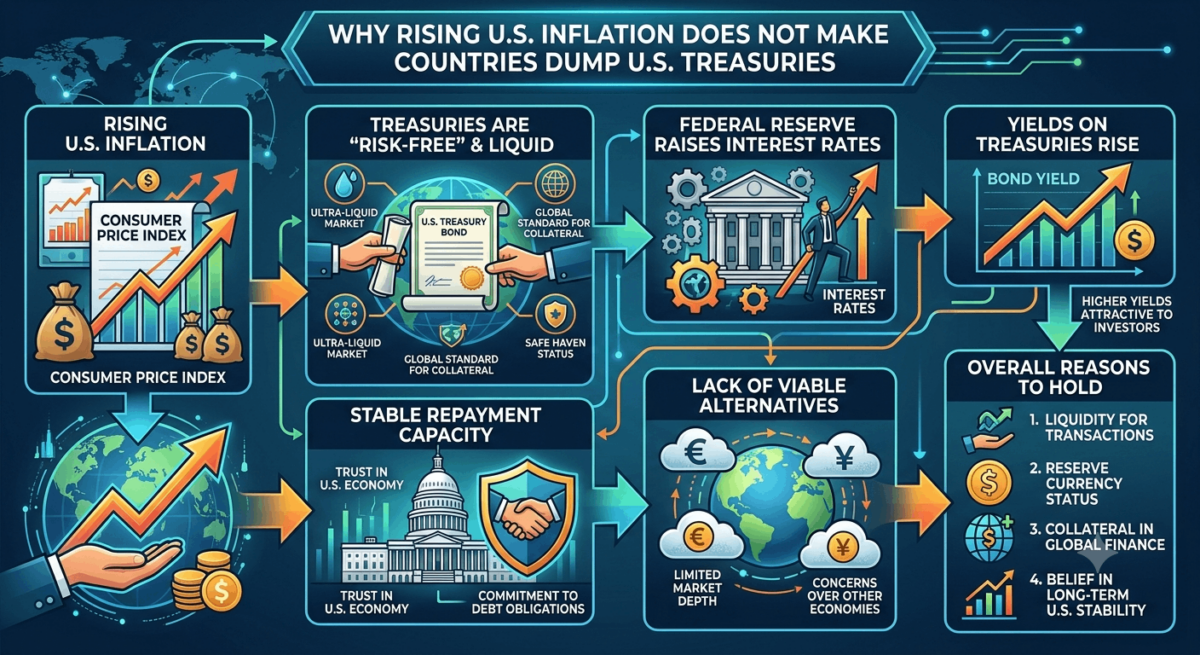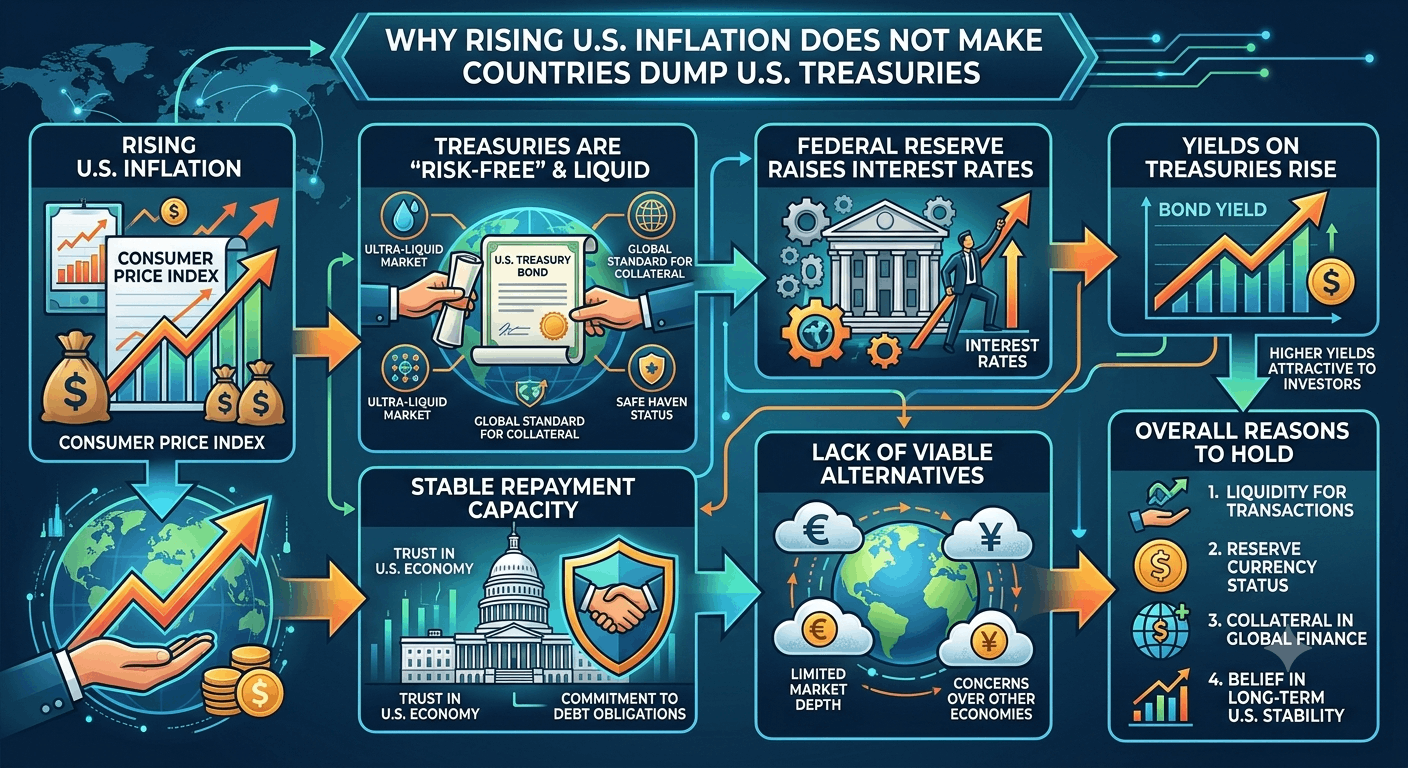
When U.S. inflation rises, a natural question follows: if inflation reduces the purchasing power of dollars, why do foreign governments and central banks continue to hold U.S. Treasury bonds? Why not simply sell them?
The answer is that inflation can push Treasury yields higher, and those higher yields partly compensate investors for inflation and risk. More importantly, reserve managers must compare Treasuries with the available alternatives – not with an imaginary risk-free asset.
1. Inflation and long-term Treasury yields
A useful simplified framework is:
10-year Treasury yield » expected inflation + expected real interest rate + term premium
If an investor wants a 2% real return and expects 2% inflation, a bond yield around 4% may be adequate. If expected inflation rises to 4%, that same investor may demand something closer to 6% to preserve the desired real return.
The third component – the term premium – is especially important. Investors require additional compensation for committing money for ten years when future inflation, government borrowing, fiscal policy and interest rates are unusually uncertain.
Therefore, a 5% or 6% 10-year Treasury yield does not mean investors necessarily expect 5% or 6% inflation for an entire decade. Part of the yield can represent a high real rate and a larger premium for uncertainty.
2. Inflation initially hurts existing bondholders
There is an important distinction between an existing Treasury bond and a newly issued one. If market yields rise from 3% to 5%, the price of an older 3% bond generally falls because investors can now buy new bonds offering the higher yield. Long-duration bonds can therefore suffer substantial mark-to-market losses when inflation and yields rise.
But the repricing also makes new Treasuries more attractive. At some sufficiently high yield, investors are being paid more to accept inflation and duration risk. Rising yields can therefore become part of the market’s self-correcting mechanism.s.
3. Why foreign central banks do not simply dump Treasuries
A reserve manager does not ask only whether the United States has inflation. The practical question is: where else can hundreds of billions of dollars be placed with comparable liquidity, depth, convertibility and collateral usefulness?
| Asset | Potential advantage | Constraint for very large reserves |
| U.S. Treasuries | Huge, liquid dollar market; broad maturity range | Inflation, duration and U.S. fiscal risk |
| Gold | No sovereign credit risk; diversification | No contractual yield; storage; market much smaller tha |
| German / euro bonds | High-quality alternative reserve assets | Smaller market; euro currency exposure |
| Japanese bonds | Large developed sovereign market | Yen exposure and different yield profile |
| Emerging-market bonds | Potentially higher returns | Liquidity, currency and credit risks |
The Treasury market is difficult to replace because it combines scale, liquidity, dollar denomination, a deep repo market and widespread acceptance as collateral. A central bank cannot shift $100 billion into gold or a much smaller sovereign-bond market without creating price, liquidity and currency consequences of its own.
4. The dollar is both a currency and an operating system
The dollar’s advantage is not based solely on faith in U.S. economic policy. International trade invoices, commodity contracts, bank funding, derivatives, corporate borrowing, foreign-exchange reserves and collateral markets are heavily interconnected with dollars.
This creates network effects. Even a central bank that wants greater diversification may still need substantial dollar reserves because its country’s banks, importers and corporations may need dollars during periods of market stress.
5. Why diversification can occur without a Treasury ‘dump’
Reserve diversification is better understood as a gradual portfolio shift than an all-or-nothing decision. A country can reduce the dollar share of new reserves, buy more gold, increase euro or other currency assets, shorten Treasury duration, or allow existing bonds to mature without reinvesting all the proceeds.
That matters because a disorderly mass sale of Treasuries could push bond prices down and yields up, inflicting losses on the seller’s remaining holdings while potentially strengthening the yield advantage available to new buyers.
6. When should Treasury yields genuinely worry us?
A high Treasury yield is not automatically evidence that the dollar system is failing. It becomes more concerning if yields rise while long-term inflation expectations become unanchored, foreign demand persistently weakens, Treasury auctions deteriorate, term premiums surge, the dollar falls rather than strengthens, and investors demand substantially higher compensation for U.S. sovereign risk.
Conversely, if Treasury yields rise while the dollar remains sought after and auctions continue to clear, the market may be repricing inflation, real rates, fiscal supply and duration risk rather than rejecting U.S. government debt altogether.
7. The paradox
The apparent paradox can therefore be summarised simply:
Higher U.S. inflation can make existing Treasury bonds less attractive and push their prices down. But that very price decline raises their yields, eventually making them more attractive to investors willing to accept the risks.
This is why the more useful question is not, “Why aren’t countries dumping U.S. bonds?” It is: “At what yield do Treasuries adequately compensate global investors for expected inflation, duration, fiscal and currency risks compared with every realistic alternative?”
Conclusion
U.S. inflation certainly matters for Treasury investors. Persistent inflation reduces the real value of fixed payments and can force bond yields higher. But foreign reserve managers face constraints that ordinary investors do not. They need scale, liquidity, collateral quality and currencies that can be mobilised during crises.
For that reason, de-dollarisation is more likely to appear as gradual diversification – particularly toward gold and other reserve currencies – than as every major country suddenly selling its Treasury portfolio. The crucial indicators to watch are therefore long-term inflation expectations, real yields, the term premium, Treasury auction demand, foreign official holdings and the dollar itself.