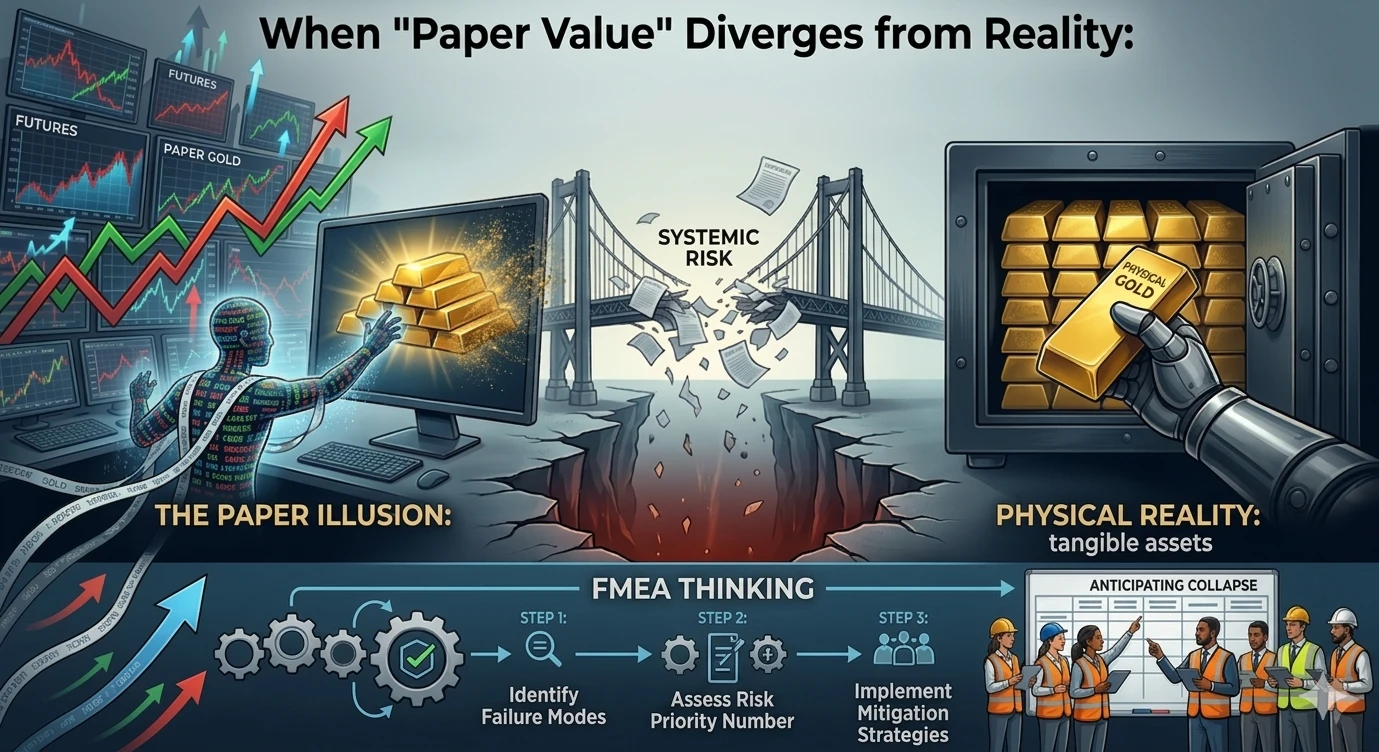
In global financial systems, few signals are as quietly disruptive as a divergence between paper value and physical reality.
The recent analysis by Mises Institute on Western bullion markets highlights exactly that: a growing disconnect between paper gold (derivatives, ETFs, futures) and physical bullion availability.
At first glance, this looks like a financial nuance.
In reality, it is a classic system risk failure—one that echoes far beyond commodities.
The Core Problem: When Representation Replaces Reality
Modern bullion markets increasingly rely on “paper claims” to gold rather than actual physical ownership.
This creates a layered system:
- Multiple claims on the same underlying asset
- Settlement mechanisms that may not require physical delivery
- Liquidity built on trust, not verification
The concern raised is simple but powerful:
👉What happens when too many participants demand physical settlement at once?
This is not just a pricing issue.
It is a failure mode embedded in the system design itself.
This Is Not New—It’s Just Unmanaged Risk
From an engineering lens, this resembles a familiar pattern:
- Assumed availability without validation
- Over-leveraging of a constrained resource
- Detection mechanisms that trigger too late
In other words, a textbook case for Failure Mode and Effects Analysis thinking.
Yet financial systems rarely apply structured failure analysis with the same rigor as manufacturing or aerospace.
If This Were an FMEA, What Would It Reveal?
Let’s translate the bullion market into an FMEA structure:
Function
Ensure reliable settlement of gold-backed financial instruments.
Potential Failure Modes
- Inability to deliver physical gold
- Liquidity freeze during high demand
- Loss of trust in paper instruments
Effects
- Market panic
- Price dislocation between paper and physical gold
- Systemic financial instability
Causes
- Excessive paper leverage
- Lack of physical reserve backing
- Misaligned incentives between issuers and holders
Current Controls
- Reporting standards
- Exchange regulations
- Central clearing mechanisms
Gap (Critical Insight)
👉 Controls are reactive and opacity-driven, not preventive and transparency-driven
Severity Without Visibility: The Most Dangerous Combination
In FMEA terms:
- Severity = High (system-wide financial impact)
- Occurrence = Increasing (growing reliance on derivatives)
- Detection = Weak (limited transparency in real reserves)
This combination would trigger a High Action Priority (AP) in any AIAG-VDA aligned system.
Yet, in financial markets, this risk is often normalized.
What This Means for Government Contracts and Credit Systems
Now extend this thinking to future government-backed contracts and credit systems:
Governments increasingly rely on:
- Infrastructure financing models
- Sovereign guarantees
- Credit-backed project execution
- Public-private partnerships
If these systems:
- Over-rely on paper assurances (credit, guarantees, ratings)
- Without validating real asset backing or execution capability
They risk replicating the same failure pattern seen in bullion markets.
Where FMEA Can Change the Game
Applying FMEA to government contracting and credit systems introduces discipline:
1. Failure Mode Identification Before Funding
- What if the contractor cannot deliver despite financial closure?
- What if collateral is overvalued or illiquid?
2. Severity-Driven Decision Making
- Prioritize risks that impact public safety, financial stability, or systemic trust
3. Occurrence Control Through Qualification
- Strengthen vendor validation, not just lowest-bid selection
4. Detection Through Real-Time Monitoring
- Move from static audits to live performance tracking systems
5. Ownership of Risk
- Define a single closure owner for each critical risk—not distributed accountability
The Real Lesson: Systems Fail Long Before They Collapse
The bullion market divergence is not a sudden crisis.
It is the result of years of unaddressed, low-visibility risks accumulating.
This is exactly how:
- Infrastructure projects stall
- Financial systems freeze
- Supply chains collapse
Not due to one event—but due to ignored failure modes.
Conclusion: From Financial Abstraction to Engineering Discipline
The world is becoming increasingly complex:
- Financial systems are abstract
- Energy systems are decentralized
- Infrastructure systems are interconnected
In such environments, intuition is not enough.
What is needed is:
👉 Structured risk thinking
👉 Continuous validation of assumptions
👉 Systems that evolve with real-world feedback
That is precisely what FMEA was designed to do.
Because whether it is gold markets or government contracts
—
the real risk is never the failure itself.
It is the failure we chose not to see early enough.