The world is racing to build AI infrastructure.
Hyperscale data centres are emerging across India, the United States, Europe, and the Middle East at unprecedented speed. Governments and corporations are celebrating investments worth billions of dollars. The conversation is dominated by compute capacity, semiconductor access, AI models, cloud sovereignty, and renewable energy integration.
But one of the most important engineering realities remains largely ignored:
Data centres are not just digital infrastructure. They are massive heat-generation systems.
And unless this thermal output is managed intelligently, the next wave of AI expansion could create a hidden layer of energy inefficiency, grid stress, and infrastructure risk.
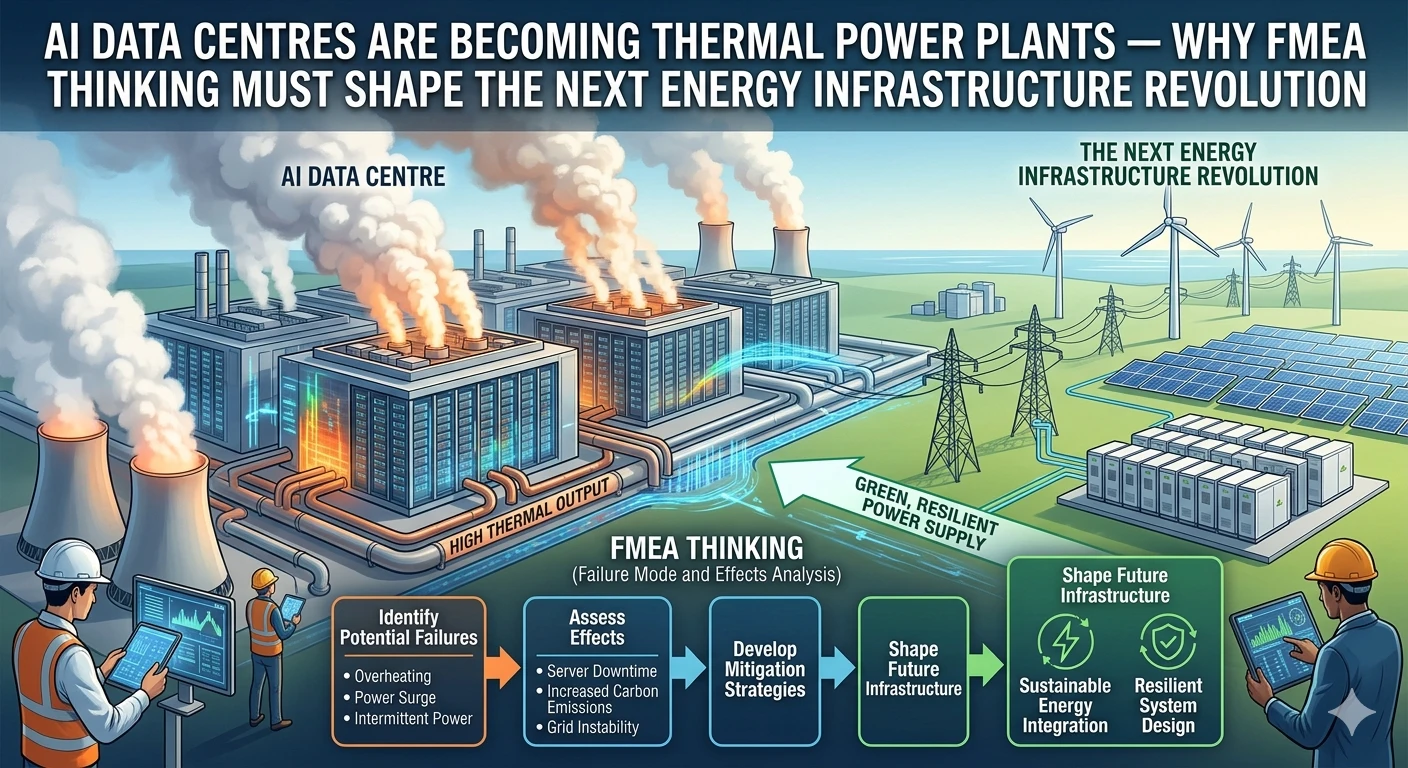
This is where FMEA thinking becomes critically relevant.
Every AI Query Eventually Becomes Heat
A data centre consumes electricity to:
- Power processors
- Run GPUs
- Operate cooling systems
- Maintain networking infrastructure
- Support backup systems
Almost all of this electrical energy eventually converts into heat.
A hyperscale AI data centre operating at:
- 100 MW
- releases nearly 100 MW of thermal energy continuously
Over one year, that becomes:
100,\text{MW} \times 24 \times 365 \approx 876{,}000,\text{MWh thermal/year}
This is not a minor by-product.
It is an industrial-scale thermal stream.
The problem?
Most facilities still treat this heat as waste.
AI Is Dramatically Increasing Thermal Density
Traditional enterprise servers historically operated around:
- 5–15 kW per rack
Modern AI clusters now operate at:
- 50–150+ kW per rack
This changes everything:
- Cooling requirements surge
- Power demand spikes
- Grid dependency intensifies
- Water consumption increases
- Thermal rejection becomes a regional infrastructure issue
In simple terms:
AI growth is no longer only a computing challenge.
It is rapidly becoming:
- an energy challenge,
- a cooling challenge,
- and a systems resilience challenge.
The Hidden Opportunity: Waste Heat Recovery
Ironically, the “problem” itself contains the solution.
Low-grade waste heat from data centres can support:
- Cold-storage operations
- District cooling systems
- Agricultural refrigeration
- Industrial thermal processes
- Absorption refrigeration systems
This creates a circular infrastructure model:
Instead of rejecting heat into the atmosphere, thermal energy is reused nearby.
Why Cold Storage Is the Ideal Partner
Cold-storage infrastructure requires enormous amounts of energy.
Typical refrigerated warehouses consume:
- 2–20 MW continuous cooling loads
India’s agricultural supply chain already faces:
- high refrigeration costs,
- diesel backup dependence,
- and post-harvest losses exceeding ₹90,000 crore annually.
Now imagine:
A hyperscale data centre cluster located near:
- food logistics hubs,
- pharma cold chains,
- fisheries,
- or agricultural storage parks.
The rejected heat from the data centre could partially power:
- absorption chillers,
- thermal storage systems,
- and hybrid cooling networks.
This reduces:
- electrical demand,
- refrigeration operating costs,
- and grid stress.
The “waste” becomes infrastructure fuel.
This Is Already Happening Globally
Several countries have already recognized this systems opportunity.
Sweden
Stockholm Data Parks integrates data-centre heat recovery into district heating systems.
Denmark
Meta and other operators export thermal energy into municipal heating networks.
France
Paris-based facilities recover data-centre heat for nearby urban systems.
Germany
Equinix and other operators increasingly integrate heat-reuse frameworks.
These projects demonstrate something profound:
The future data centre is not an isolated building.
It is part of a broader energy ecosystem.
The FMEA Lens: Why Risk Thinking Matters
This is where Failure Mode and Effects Analysis (FMEA) becomes essential.
Most infrastructure projects still focus primarily on:
- capacity,
- speed of deployment,
- and cost optimization.
But large-scale AI infrastructure introduces interconnected system risks that can cascade across regions if poorly managed.
Potential Failure Modes in AI Data Centre Expansion
1. Grid Overload Risks
AI facilities create concentrated electrical demand spikes.
Failure effects:
- localized instability,
- reactive power imbalance,
- peak-demand stress,
- and blackout vulnerabilities.
2. Cooling System Dependency Risks
Cooling failures can rapidly escalate into:
- server shutdowns,
- equipment damage,
- and operational outages.
The larger the AI cluster, the more severe the consequence.
3. Thermal Waste Rejection Risks
Without thermal reuse:
- massive energy losses occur,
- local urban heat effects intensify,
- and overall system efficiency declines.
4. Water Stress Risks
Many data centres rely heavily on water-based cooling.
Failure effects:
- regional water competition,
- environmental resistance,
- and long-term sustainability concerns.
5. Renewable Intermittency Risks
Many projects promote renewable integration.
But:
- solar variability,
- storage limitations,
- and transmission bottlenecks
can create operational instability if not proactively managed.
FMEA Is Not Just a Manufacturing Tool Anymore
Traditionally, FMEA was associated with automotive and manufacturing quality systems.
But modern infrastructure systems are now too interconnected to ignore structured failure analysis.
For AI-energy ecosystems, FMEA thinking helps answer:
- What can fail?
- How severe is the consequence?
- How likely is occurrence?
- Can we detect it early?
- Who owns the mitigation?
Most importantly:
FMEA forces systems to become “living” risk-management frameworks rather than static compliance documents.
The Real Future: Integrated Energy Ecosystems
The next generation of infrastructure will likely combine:
- AI data centres
- renewable power plants
- battery storage
- district cooling
- cold-chain logistics
- smart grids
- and predictive monitoring systems
The winners will not simply build larger facilities.
They will build:
- resilient systems,
- thermally integrated ecosystems,
- and ownership-driven operational frameworks.
The Bigger Lesson
AI infrastructure expansion is often framed as a software revolution.
In reality, it is also:
- an energy revolution,
- a thermal management revolution,
- and a systems-engineering revolution.
If waste heat continues to be ignored, the industry risks building highly sophisticated digital infrastructure on top of inefficient physical foundations.
But if FMEA principles guide infrastructure planning:
- risks become visible earlier,
- interdependencies become manageable,
- and “waste” becomes strategic value.
The future of AI infrastructure may not depend solely on how intelligently machines think.
It may depend equally on how intelligently humans design the systems around them.
References
- International Energy Agency (IEA) – Electricity 2024 Report
(Global electricity demand growth, data-centre and AI-driven load projections) - International Energy Agency (IEA) – Data Centres and Data Transmission Networks
(Energy consumption trends and efficiency analysis of data centres) - U.S. Department of Energy – Energy Efficiency and Renewable Energy: Data Center Energy Use
(Thermal conversion characteristics and cooling-energy implications) - ASHRAE Technical Committee 9.9 – Thermal Guidelines for Data Processing Environments
(Industry standards for thermal management and cooling requirements) - European Commission – Reuse of Waste Heat from Data Centres
(District heating integration and waste-heat recovery frameworks) - Stockholm Data Parks
(Case study on data-centre heat recovery and urban thermal integration) - Equinix Sustainability Report
(Heat reuse, energy efficiency, and sustainability initiatives in hyperscale infrastructure) - Food and Agriculture Organization (FAO) – Food Loss and Cold Chain Infrastructure Studies
(Cold-storage demand and post-harvest loss impacts) - National Centre for Cold-chain Development (NCCD), India
(Indian cold-storage infrastructure demand and energy-use context) - AIAG & VDA FMEA Handbook
(Structured Failure Mode and Effects Analysis methodology) - National Institute of Standards and Technology (NIST) – Risk Management Framework
(Systems-risk and resilience principles applicable to critical infrastructure) - Lawrence Berkeley National Laboratory – United States Data Center Energy Usage Report
(Empirical data on data-centre electricity use and thermal loads)