AI may be revolutionary – and still contain a bubble
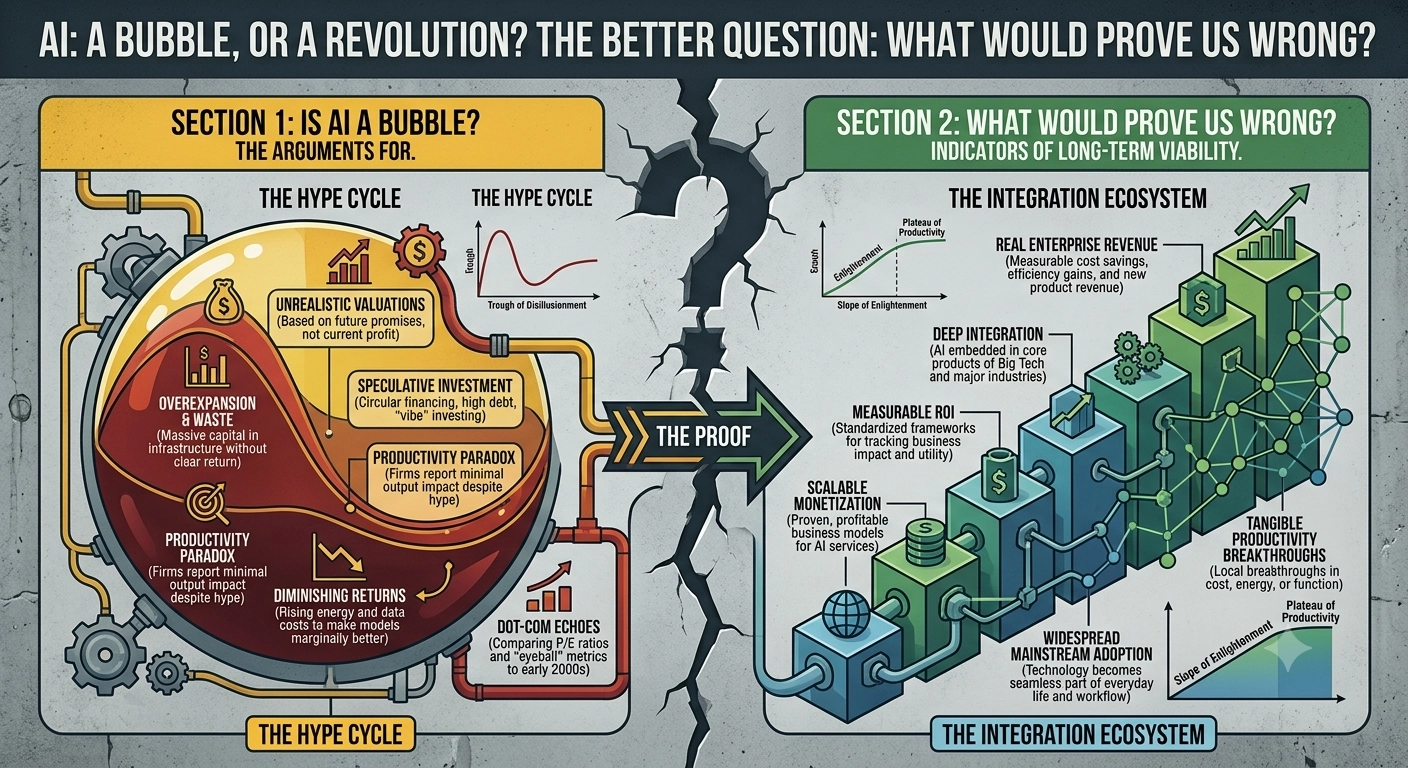
The debate over whether artificial intelligence is a bubble is usually framed too simply. One camp sees AI as the next electricity or internet. The other sees echoes of the dot-com boom: extraordinary valuations, huge capital expenditure and confident forecasts about markets that do not yet exist.
Both camps may be making the same mistake: turning a complicated probability problem into a compelling story.
My central conclusion: AI itself is very probably not a bubble. But parts of the AI investment ecosystem can simultaneously exhibit bubble-like valuations and capital allocation.
The first mistake: confusing technology with valuation
A technology can be genuinely transformative while investors still pay too much for the companies building it. The internet provides the obvious historical example. The dot-com crash did not demonstrate that the internet was useless. It demonstrated that technological importance and investment valuation are different propositions.
The same distinction should govern the AI debate. Evidence that AI can write software, analyze documents, discover patterns, automate workflows or improve industrial processes is evidence about capability. It is not automatically evidence that every dollar being invested in AI infrastructure will earn an adequate return.
A Popperian question: what would falsify the bullish thesis?
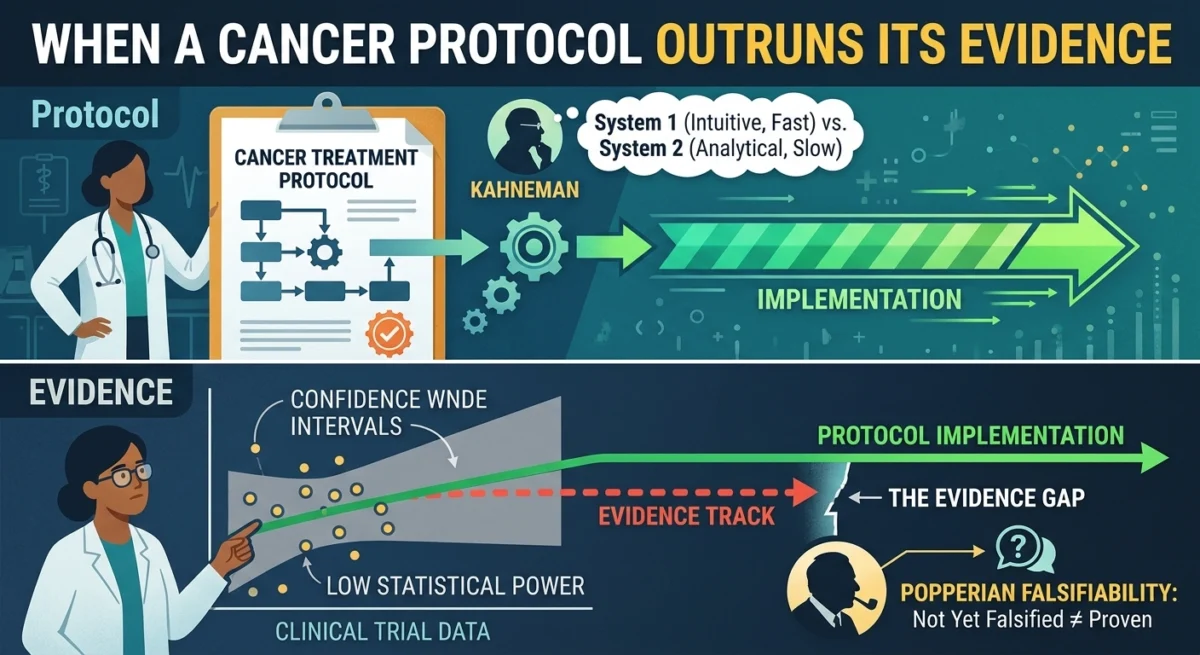
Karl Popper argued that strong explanations expose themselves to possible refutation. Instead of asking whether an AI narrative sounds persuasive, we should ask what observation would make us reject it.
The useful hypothesis is therefore not simply ‘AI works.’ A much stronger proposition is: future economic cash flows generated by AI will justify today’s extraordinary capital expenditure and valuations at acceptable returns on invested capital.
That proposition is testable. If AI investment keeps accelerating while monetization, productivity and free cash flow fail to follow, the bubble hypothesis becomes stronger. If enterprise productivity, sustainable AI revenue and cash generation rise alongside investment, it becomes weaker.
The shovel-maker problem
Imagine a gold rush. A company selling shovels reports record revenue because thousands of miners are rushing toward the goldfield. Those shovel sales prove that demand for mining equipment is real. They do not prove that the miners will discover enough gold to justify what they spent.
This is an important way to interpret booming demand for GPUs, data centers, memory, networking and power infrastructure. Supplier revenue confirms enormous AI infrastructure demand. The unresolved second-order question is whether the buyers of that infrastructure will earn adequate returns from it.
Kahneman and Tversky: beware the coherent story
Daniel Kahneman and Amos Tversky showed repeatedly that human judgment relies on heuristics. We often substitute an easier question for a difficult one without noticing.
The difficult question is: What is the probability distribution of future AI cash flows under competition, falling inference costs, technological change, regulation and uncertain adoption? The easier substitute is: Does the AI story sound revolutionary?
A narrative can be internally coherent – better models lead to lower costs, lower costs lead to more adoption, adoption creates new markets, robots expand AI into the physical world – without the entire chain being probable. Coherence is not calibration.
Representativeness bias cuts both ways
AI skeptics can see 1999 everywhere: ‘This looks like the dot-com boom, therefore it must crash.’ That is representativeness. But AI enthusiasts can make the mirror-image error: ‘AI looks like electricity or the internet, therefore today’s investment must eventually be justified.’
Historical analogy is useful for generating hypotheses, not proving them. The proper question is what measurable evidence distinguishes the competing explanations.
Take the outside view
Kahneman’s outside view asks us to look beyond the special story of the current case and examine the reference class. History contains many transformative technologies – railways, electricity, telecommunications and the internet – where enormous social value coexisted with overinvestment, bankruptcies or severe investor losses.
Technology can win. Consumers can win. Society can win. Many investors can still lose.
What should we measure?
| Evidence to watch | What it would suggest |
| Enterprise AI produces measurable productivity gains | Weakens the bubble thesis |
| AI revenue and cash flow rise with infrastructure spending | Weakens the bubble thesis |
| Useful AI consumption expands as inference costs fall | Supports durable adoption |
| Capital expenditure outruns monetization for years | Strengthens the bubble thesis |
| Data-center or accelerator utilization falls materially | Strengthens overcapacity concerns |
| Large AI infrastructure write-downs appear | Strong evidence of malinvestment |
| AI startups remain dependent on funding despite weak unit economics | Strengthens speculative-bubble concerns |
| Enterprises abandon large numbers of pilots | Challenges adoption narratives |
The paradox: AI can succeed and AI companies can disappoint
Suppose inference becomes dramatically cheaper. That would be an extraordinary technological success. Usage could explode. Yet falling costs and intense competition might commoditize many AI services and compress margins. Consumers could capture much of the economic surplus rather than producers.
This is why ‘AI will change the world’ and ‘today’s AI investments will earn exceptional returns’ must never be treated as the same forecast.
My probability map
| Hypothesis | Rough judgment |
| AI fails to create major economic value | 5-15% |
| AI becomes a major general-purpose technology | 85-95% |
| Some current AI assets are substantially overvalued | 55-70% |
| A major AI investment correction occurs this decade | 50-65% |
| AI infrastructure ultimately proves broadly useful | 75-90% |
These are judgmental ranges rather than statistically estimated probabilities. Their purpose is to make uncertainty explicit rather than hide it behind categorical language.
The deeper lesson
The most defensible position today is neither ‘AI is a bubble’ nor ‘AI is not a bubble.’ It is that a genuine technological revolution may be occurring at the same time as speculative excess in parts of the capital structure.
The dot-com lesson was not that the internet was fake. It was that correctly predicting the technology did not mean correctly predicting which companies would capture the value – or what price investors should pay for them.
The disciplined question is therefore not merely: Will AI change the world?
It is: Who will capture the economic value, how much cash will they generate, what assumptions are embedded in today’s price – and what evidence would prove those assumptions wrong?
That is where Kahneman, Tversky and Popper converge: distrust seductive narratives, make uncertainty visible, define competing hypotheses and actively search for evidence capable of proving your preferred explanation wrong.
Author’s note
This article is an analytical essay, not investment advice. Probability ranges are subjective assessments intended to structure uncertainty. The framework draws on Kahneman and Tversky’s work on judgment under uncertainty and Karl Popper’s philosophy of falsification.