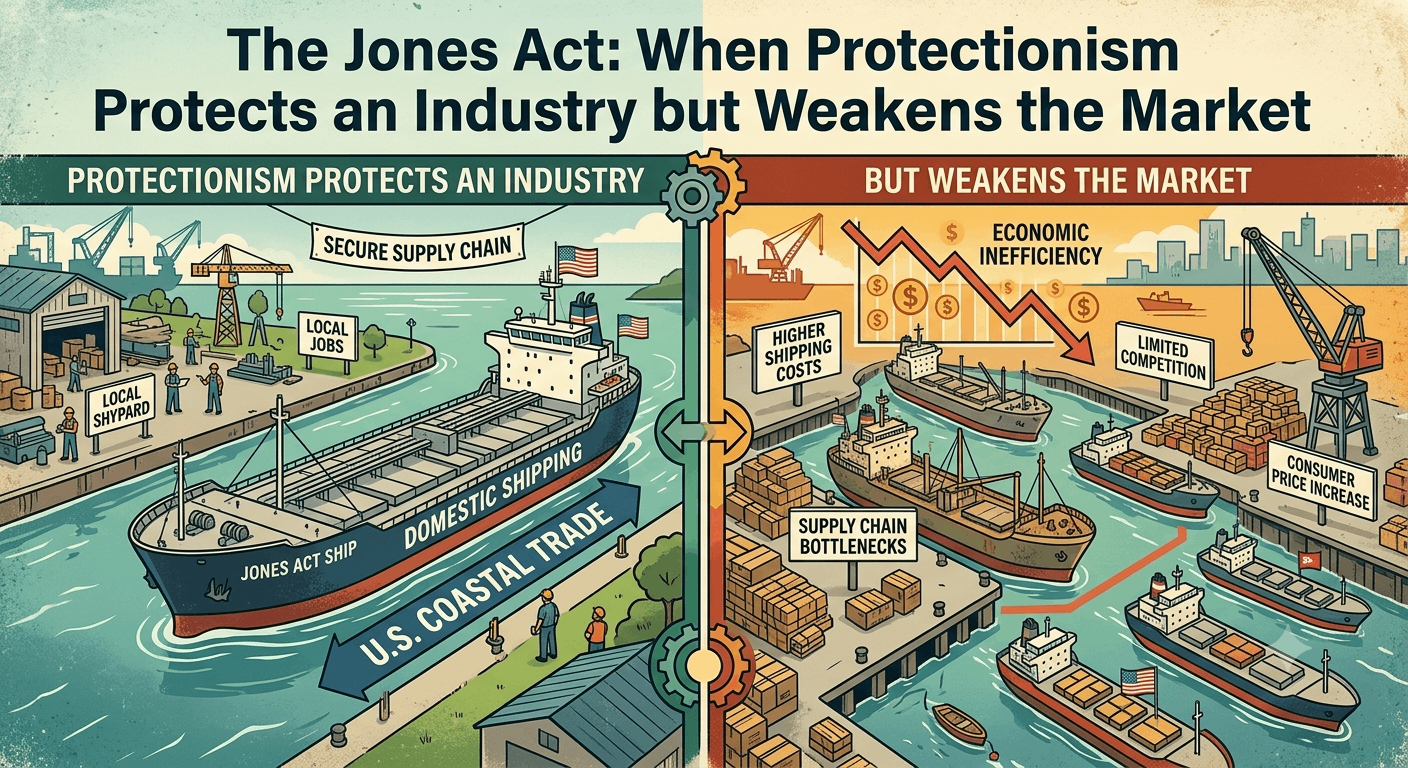
“Good intentions are not the same as good outcomes.”
The United States passed the Merchant Marine Act of 1920, commonly known as the Jones Act, more than a century ago.
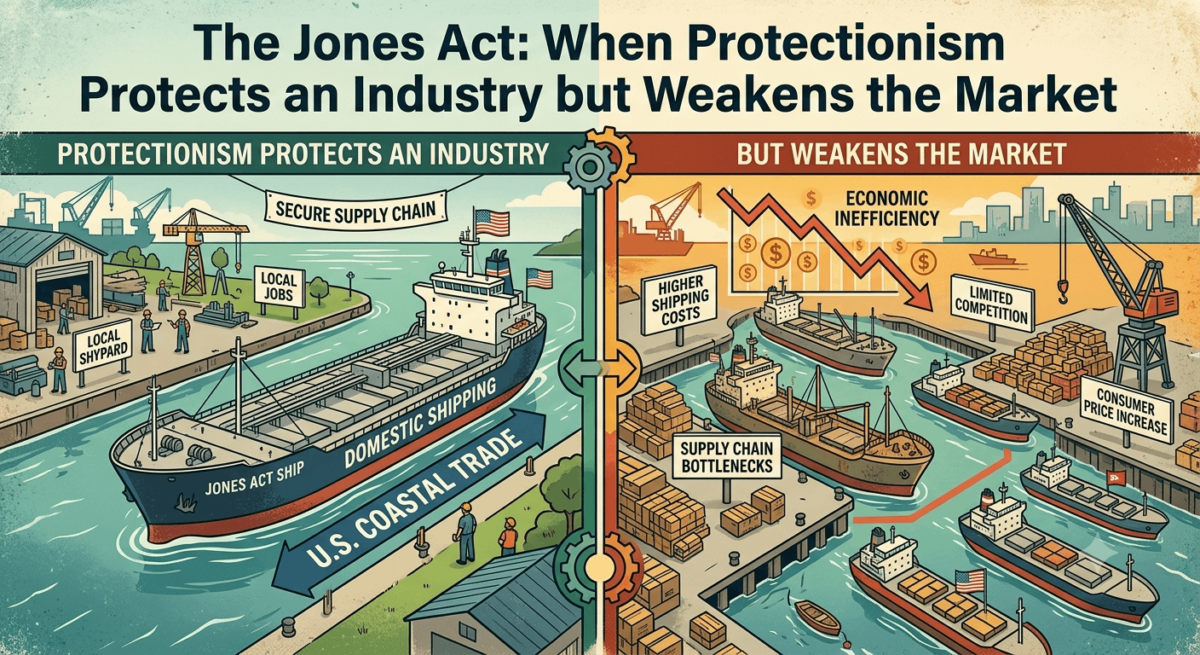
Its underlying objective sounds reasonable: maintain an American merchant marine, protect domestic shipbuilding capability, provide employment to American mariners and preserve maritime capacity that could be mobilised during war or national emergencies.
But good intentions are not the same as good outcomes.
A recent Mises Institute article by economist William L. Anderson, “Repeal the Jones Act,” raises an important question:
After more than 100 years, has the Jones Act actually produced the outcomes it was supposed to produce?
Anderson argues that it has not. Instead, he describes the legislation as an example of a much broader economic problem: benefits can be highly concentrated among a small group while costs are dispersed across millions of consumers. Mises Institute source
That mechanism deserves closer examination.
What Does the Jones Act Actually Require?
For cargo to be transported between two American ports, the vessel generally has to satisfy stringent domestic requirements.
It must be:
- U.S.-built,
- U.S.-flagged,
- predominantly U.S.-owned, and
- predominantly crewed by American citizens.
Cato Institute’s detailed examination of the legislation states that qualifying vessels must be at least 75% U.S.-owned and at least 75% U.S.-crewed, while their construction must satisfy the American-build requirement. Cato Institute analysis
These restrictions constitute what economists call cabotage protection.
The theory is straightforward. Protect American shipbuilders and shipping companies from foreign competition, and America should retain a strong domestic maritime industry.
But economics requires us to look beyond intentions. We must ask what incentives the regulation creates.
Protection Can Remove the Pressure to Become Competitive
Imagine that an American shipping company needs a vessel. In an open market, it could compare shipyards around the world on:
- capital cost,
- technology,
- delivery time,
- operating efficiency,
- fuel consumption,
- reliability, and
- lifecycle cost.
Under the Jones Act, choices for domestic shipping are dramatically restricted. This creates a captive market.
And therein lies the paradox.
A regulation intended to strengthen an industry can reduce the very competitive pressure that forces that industry to innovate.
The Cato Institute’s 2018 study argued that American-built coastal and feeder vessels could cost many times more than comparable foreign-built vessels at that time. It further argued that expensive vessels contributed to fewer purchases, an ageing fleet and reduced demand for domestic water transport. Cato Institute analysis
The precise cost differential will change with time and vessel type. But the mechanism matters more than any single number:
If regulation prevents customers from choosing lower-cost alternatives, inefficient suppliers receive less pressure to improve.
Protection may therefore preserve producers without necessarily improving productivity.
The Austrian Economics Problem: Prices Are Signals
From an Austrian School perspective, prices are not merely numbers attached to products. They communicate information.
A high price may signal:
- scarce labour,
- inefficient production,
- inappropriate capital allocation,
- insufficient competition,
- technological disadvantage, or
- genuinely higher quality.
Entrepreneurs respond to these signals. Consumers alter demand. Capital moves. Competitors innovate. This decentralised feedback mechanism is one of the fundamental coordination functions of markets.
Protectionism interferes with that process.
If legislation guarantees producers access to a captive market, the feedback loop becomes weaker.
Instead of asking, “How do we become competitive?” firms can increasingly ask, “How do we preserve the regulation that protects our market?”
This is where industrial policy can gradually turn into rent-seeking.
Concentrated Benefits Versus Dispersed Costs
The political durability of regulations such as the Jones Act can also be explained through a simple incentive asymmetry.
Group A: The beneficiaries
Shipyards, maritime companies and organised labour may obtain substantial and identifiable benefits from protection.
For them, preserving the legislation is worth lobbying, campaigning, political engagement and significant organisational effort.
Group B: Consumers
The costs may appear as tiny increments distributed throughout the economy:
- slightly higher freight costs,
- more expensive goods,
- alternative rail or road transportation,
- higher logistics costs,
- lost business opportunities, or
- less efficient supply chains.
For an individual household, tracing an additional few dollars in a product’s price back to maritime regulation is practically impossible.
Therefore, the person receiving a large concentrated benefit has a much stronger incentive to defend the regulation than millions of people individually bearing small portions of its cost.
Anderson’s Mises Institute article places this concentrated-benefit/dispersed-cost mechanism at the centre of its criticism of the Jones Act. Read “Repeal the Jones Act”
But There Is Another Side to the Argument
Criticism of the Jones Act should not lead us to dismiss its supporters without examining their hypothesis.
Supporters argue that shipping cannot be evaluated purely on immediate transportation cost. There is an option value to maintaining domestic capacity.
Members of the U.S. House Transportation and Infrastructure Committee argued in 2025 that the Jones Act supports American maritime employment while maintaining shipyards, mariners and vessels that could become strategically important during military conflicts, supply disruptions or natural disasters. House committee statement
The AFL-CIO similarly argues that the legislation maintains trained American mariners, labour standards and maritime capabilities required during wars or emergencies. AFL-CIO statement
This is not an economically meaningless argument. A country may rationally pay an insurance premium for strategic redundancy.
Are Americans buying useful resilience – or merely paying a protectionism premium?
Those are very different things.
Kahneman and Tversky: Why Reform Becomes Politically Difficult
Behavioural economics adds another layer.
Daniel Kahneman and Amos Tversky demonstrated that human beings do not evaluate gains and losses symmetrically. We suffer from loss aversion.
A visible loss frequently produces a much stronger emotional response than an equivalent but less visible gain.
Suppose reforming the Jones Act threatens 1,000 identifiable jobs. Those workers, companies and communities immediately perceive the potential loss.
Now suppose reform simultaneously reduces logistics costs across millions of transactions. Those gains are dispersed, uncertain, delayed and difficult to attribute directly to the reform.
Politically, the visible loss dominates the invisible gain.
There is also status-quo bias. Once an institution has existed for generations, continuing it feels less risky than changing it – even when continuing it carries substantial hidden costs.
The risks of changing policy are examined intensely, while the risks of continuing the existing policy are treated as normal.
The Popper Test: What Evidence Would Prove Either Side Wrong?
Karl Popper gives us perhaps the most useful way to approach the dispute.
Instead of asking, “Do I believe in protectionism or free trade?” ask: What observations would falsify each claim?
If supporters claim that the Jones Act strengthens American shipbuilding, then over sufficiently long periods we should expect observable evidence such as:
- improving shipbuilding productivity,
- expanding competitive shipbuilding capacity,
- modernisation of the domestic fleet,
- increasing availability of trained mariners, and
- narrowing cost disadvantages relative to international competitors.
If those indicators continue deteriorating despite protection, the hypothesis that protection itself creates competitiveness becomes progressively harder to defend.
Conversely, advocates of repeal also carry a burden of proof. If restrictions were substantially relaxed, we should examine whether:
- domestic freight costs fall,
- coastal shipping increases,
- supply chains become more efficient,
- consumer and industrial costs decline,
- without creating an unacceptable deterioration in strategic maritime capability.
This turns the argument from ideology into experimentation.
Why Not Test Reform Instead of Arguing About It?
Policy need not always be binary. It is possible to conduct something resembling an economic experiment.
The Cato analysis itself discusses intermediate reforms such as relaxing the U.S.-build requirement, providing permanent exemptions for highly shipping-dependent regions, and making Jones Act waivers more transparent and predictable. Cato Institute analysis
Such reforms could generate valuable empirical evidence. Compare before reform versus after reform.
Measure:
- freight rates,
- vessel investment,
- shipping volumes,
- employment,
- shipbuilding productivity,
- military readiness, and
- supply-chain resilience.
Then allow evidence to challenge both sides. That would be far more informative than simply repeating century-old arguments.
The Deeper Lesson Is Larger Than the Jones Act
The Jones Act provides a useful case study in economic policy because it illustrates a recurring pattern.
- Government identifies a strategically important sector.
- Protection is introduced.
- The protected industry adapts to the protection.
- Economic interests form around the regulation.
- Those beneficiaries become politically organised.
- Consumers experience dispersed costs that are difficult to identify.
- Decades later, the original justification for the policy becomes almost secondary to the institutional interests that have grown around it.
The policy then survives partly because it exists.
This is precisely why regulations should not merely have objectives. They should have measurable failure criteria.
If a policy created to make an industry competitive does not produce competitiveness after decades, policymakers should be willing to reconsider the mechanism.
A Market Economy Must Allow Failure Signals to Travel
There is a useful analogy with engineering. A system becomes dangerous when weak failure signals are suppressed.
Markets work similarly. Prices, shortages, declining demand and loss of market share are economic warning signals. They tell producers: something must change.
Protectionism can sometimes suppress those signals. When the warning signal disappears, the underlying weakness does not necessarily disappear with it. It may simply remain hidden for longer.
The Jones Act debate should therefore not ultimately be about whether American shipbuilders, unions or foreign competitors are “good” or “bad.”
Has the mechanism produced the outcome that was promised?
If the answer is no, preserving the mechanism simply because abandoning it feels risky is not resilience. It is institutional inertia.
Markets become stronger when failure generates learning. Economies become weaker when policy protects failure from producing feedback.
References
- William L. Anderson. “Repeal the Jones Act,” Mises Wire, Mises Institute, 8 October 2026. Anderson argues that the Act imposes dispersed economic costs while providing concentrated benefits to protected maritime interests. Source
- Colin Grabow, Inu Manak and Daniel J. Ikenson. “The Jones Act: A Burden America Can No Longer Bear,” Cato Institute Policy Analysis, 28 June 2018. The paper examines cabotage restrictions, domestic shipbuilding costs, shipping competition and proposed reforms. Source
- Cornell Legal Information Institute. 46 U.S. Code Subtitle V – Merchant Marine. Legal reference covering the U.S. statutory framework governing the merchant marine. Source
- U.S. House Committee on Transportation and Infrastructure. “Republicans and Democrats Agree: We Must Defend the Jones Act,” 26 March 2025. This provides the national-security, employment and maritime-resilience case made by supporters of the Act. Source
- AFL-CIO. “Support for the Jones Act,” 21 October 2017. This presents organised labour’s argument concerning maritime employment, labour standards, disaster response and national security. Source