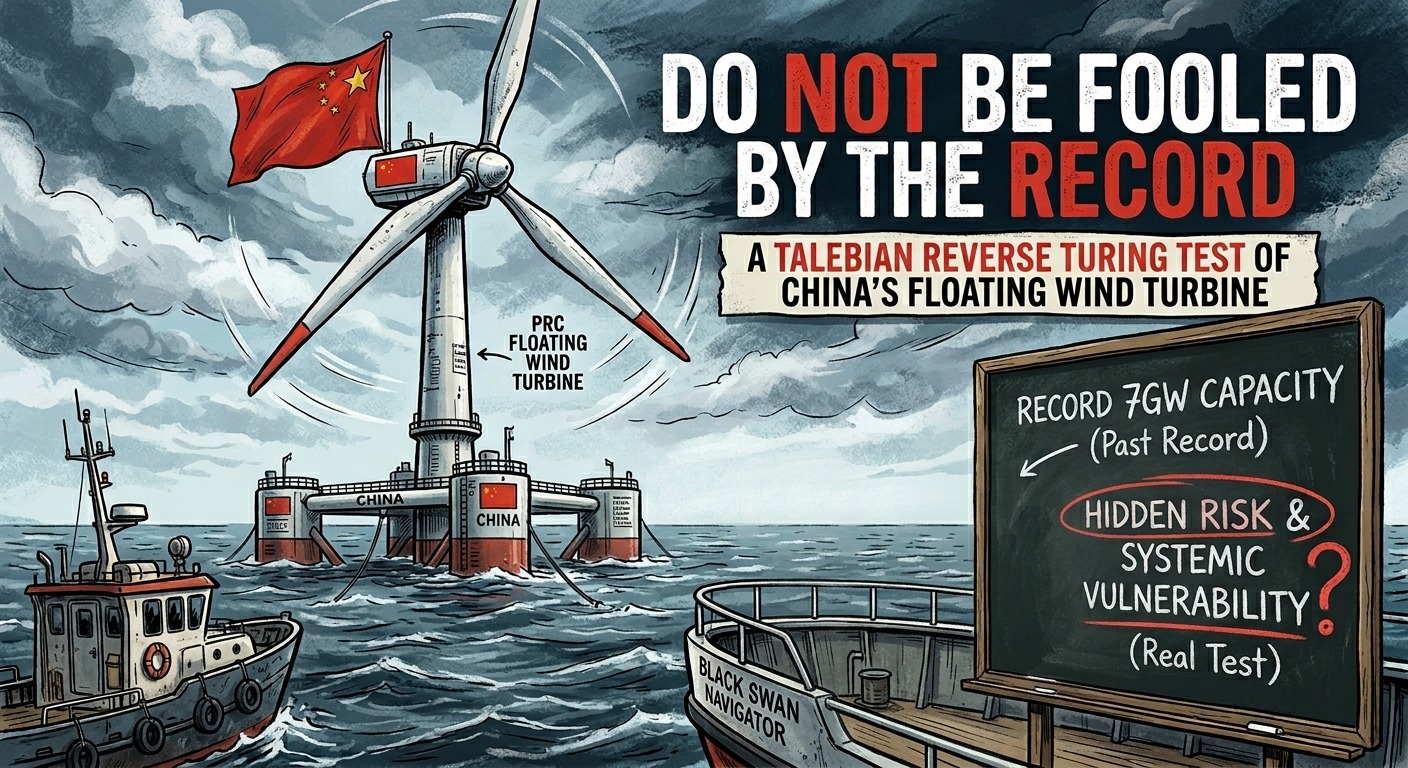
China has reportedly installed the “Three Gorges Pilot”, described as the world’s largest single-unit floating offshore wind turbine, off Yangjiang in Guangdong province. The machine is reported to have a 16 MW capacity, a 252-metre rotor diameter, a semi-submersible floating platform, a mooring system, and a 66 kV dynamic subsea cable. It is expected to generate around 44.65 million kWh per year, which some reports translate into enough electricity for roughly 4,200 U.S.-style homes annually. (Live Science)
At first glance, this sounds like a clean-energy victory headline. A giant turbine. Floating in deep water. Generating power. Bigger than previous machines. A possible pathway to offshore renewable energy at scale.
But if we apply Nassim Nicholas Taleb’s Reverse Turing Test, the story becomes more interesting and more useful.
Taleb’s Reverse Turing Test is a way of separating real knowledge from impressive-sounding rhetoric. In Fooled by Randomness, Taleb argues that rhetoric can often be generated randomly and still sound intelligent, while genuine scientific or technical knowledge cannot be produced by empty wordplay. His point is that babble can sound profound, but real knowledge has structure, consequences, testability, and contact with reality. (Internet Archive)
So the right question is not merely:
“Is this turbine impressive?”
It clearly is.
The better question is:
“Which parts of this story are operationally real, and which parts are narrative decoration?”
That is where the Reverse Turing Test becomes useful for engineers, project managers, investors, policymakers, and business leaders.
The Engineering Reality Behind the Headline
The real technical point of the article is not simply that China built a large wind turbine. The deeper point is that this is a floating offshore wind system.
Conventional offshore wind turbines are usually fixed to the seabed. That works when the water is shallow enough and the seabed foundation can be economically constructed. But as offshore wind moves into deeper waters, fixed-bottom foundations become more difficult, more expensive, and sometimes impractical.
A floating wind turbine changes the foundation problem. Instead of being rigidly fixed to the seabed, the turbine sits on a floating platform, held in position by mooring lines and anchors. This allows wind energy development in deeper waters, where stronger and more consistent wind resources may be available.
That is the real engineering promise.
But this promise comes with new risks. A floating wind turbine is not simply a land turbine placed on water. It is an integrated system of:
- turbine,
- tower,
- floating platform,
- mooring system,
- anchors,
- dynamic electrical cable,
- offshore substation or connection infrastructure,
- marine installation logistics,
- maintenance vessels,
- grid evacuation,
- storm survival systems,
- and long-term inspection regimes.
The Live Science article mentions that the Three Gorges Pilot uses a semi-submersible floating platform, an advanced mooring system with suction anchors, anchor chains, polyester lines, and a 66 kV dynamic subsea cable designed to withstand motion in offshore waters. (Live Science)
Those details matter. They are not marketing fluff. They are the engineering organs of the project.
A floating turbine fails not only when the turbine blades fail. It can also fail if the mooring line degrades, the anchor slips, the dynamic cable fatigues, the floating platform cracks, the power electronics fail, maintenance access becomes impossible, or grid evacuation becomes constrained.
So a serious reading of the article must move beyond the record-breaking capacity and ask:
Can the whole system survive as a working system?
What Passes the Reverse Turing Test?
Some parts of the article pass Taleb’s test because they are specific, measurable, and operational.
For example, the claim that the turbine has a 16 MW capacity is meaningful. Capacity is measurable. It can be compared. It can be audited. The claim that the rotor diameter is 252 metres is also meaningful. The rotor size affects swept area, energy capture, structural loads, blade design, and logistics. (Live Science)
The mention of a semi-submersible floating platform also passes the test because it tells us the basic architecture of the system. The mention of suction anchors, chains, and high-strength polyester mooring lines tells us how the floating structure is held in position. The mention of a 66 kV dynamic subsea cable tells us how electrical power is exported from a moving floating body. (Live Science)
These are not empty phrases. They can be inspected, tested, modelled, simulated, installed, monitored, and repaired.
A sentence like:
“The system uses a 16 MW turbine mounted on a semi-submersible platform with a dynamic subsea cable and mooring system.”
has engineering content.
A sentence like:
“This could transform the future of clean energy.”
may be true, but it is much weaker. It could be written about solar, hydrogen, nuclear fusion, battery storage, tidal power, smart grids, green ammonia, or almost any fashionable energy technology.
That is the Reverse Turing Test in action.
If the same sentence can be attached to many different technologies without changing much, it is probably rhetoric. If the sentence reveals specific mechanisms, risks, operating conditions, and measurable outputs, it is closer to real knowledge.
The “4,200 Homes” Problem
The article states that the turbine can generate enough electricity to power around 4,200 homes annually. (Live Science)
This is not necessarily false. But it is a communication device, not a complete engineering metric.
Which homes?
U.S. homes? Chinese homes? Indian homes? Urban apartments? Rural homes? Air-conditioned homes? Electrified households with electric heating? Households with rooftop solar? Industrial loads? Commercial loads?
A “number of homes powered” figure is useful for public communication, but it hides assumptions about average household electricity consumption. It makes the project emotionally understandable, but it does not tell us whether the project is reliable, economical, maintainable, insurable, or grid-useful.
A more engineering-relevant number is the capacity factor.
The turbine is reported to have a capacity of 16 MW and expected annual generation of 44.65 million kWh. (Live Science)
Maximum theoretical annual output would be:
16 MW × 8,760 hours = 140.16 million kWh per year
Expected annual output:
44.65 million kWh per year
So implied capacity factor:
44.65 / 140.16 = 31.8% approximately
That is more useful than “4,200 homes.”
It tells us that the turbine is expected to produce about one-third of its theoretical maximum annual output. That number can later be compared with actual generation, downtime, storm events, curtailment, maintenance outages, and long-term degradation.
So a Talebian reading would say:
Do not stop at the home-count number. Ask what capacity factor is assumed, what actual output is achieved, what downtime occurs, and what happens after the first severe storm season.
“World’s Largest” Is Not the Same as “Most Robust”
The phrase “world’s largest” is powerful. It is headline-friendly. It signals ambition, national capability, industrial confidence, and technological leadership.
But Taleb would immediately become suspicious of size as a proxy for truth.
The largest system is not automatically the most robust system. The largest turbine is not automatically the most economical turbine. The most spectacular prototype is not automatically the most scalable commercial solution.
In fact, very large systems may hide fragility.
Large floating offshore turbines face serious engineering and operational challenges:
- blade fatigue,
- tower loading,
- platform motion,
- mooring fatigue,
- anchor reliability,
- dynamic cable fatigue,
- corrosion,
- typhoon and extreme-wave exposure,
- offshore maintenance access,
- availability of specialized vessels,
- port infrastructure constraints,
- insurance cost,
- grid curtailment,
- and cost of repair after failure.
The Live Science article reports design claims related to extreme ocean conditions, including high waves and hurricane-force winds. (Live Science)
But design claim is not the same as survival evidence.
This is an important distinction.
A model may say the system can survive a certain wave height. A manufacturer may say the platform is designed for extreme winds. A simulation may say the cable can handle motion. But the sea does not care about the press release. The sea tests fatigue, corrosion, impact, installation quality, maintenance discipline, inspection intervals, and rare-event exposure.
So the real Talebian question is:
Will this turbine still be boringly operational after years of saltwater, storms, mooring loads, cable motion, and maintenance constraints?
That is the test.
Demonstration Is Not Commercial Proof
The project has been described as part of China Three Gorges Corporation’s floating wind demonstration programme. (Windtech International)
This is crucial.
A demonstration project proves something important, but limited. It proves that the developer can fabricate the system, assemble it, tow it, install it, connect it, and begin operation.
That is a serious achievement.
But it does not yet prove that the design is commercially mature.
A demonstration project does not automatically prove:
- competitive levelized cost of energy,
- long-term reliability,
- low maintenance burden,
- insurability,
- repeatability at wind-farm scale,
- private-sector bankability,
- predictable spare-parts supply,
- grid integration stability,
- survivability across multiple storm seasons,
- and low lifecycle cost.
This is where project leaders often confuse installation success with operational success.
The ribbon-cutting is not the result. The first power export is not the final result. Even the first year of generation is not enough. Offshore assets must prove themselves over years.
Taleb’s larger warning in Fooled by Randomness is that humans often see a successful outcome and then create a confident story around it. They mistake survival so far for proof of robustness. (Wikipedia)
That mistake is dangerous in engineering.
A technology that survives installation has survived one type of risk. It has not yet survived lifecycle risk.
The Dynamic Cable May Be More Important Than the Headline
The average reader may focus on turbine size. An engineer should pay close attention to the dynamic subsea cable.
In fixed-bottom offshore wind, the export cable still faces harsh conditions, but the turbine foundation itself is not moving in the same way as a floating platform. In floating wind, the electrical cable must tolerate motion, bending, fatigue, marine growth, current, wave action, and platform movement.
That makes the cable a critical risk point.
If the turbine blades are fine, the generator is fine, and the floating platform is fine, but the dynamic cable fails, then the turbine cannot export power. The machine becomes an impressive stranded asset until repaired.
So the Reverse Turing Test asks:
What is the fatigue life of the cable? What are the inspection intervals? What is the replacement strategy? What is the expected downtime if the cable fails? What is the cost of repair offshore?
Those questions are less glamorous than “world’s largest turbine,” but they are more operationally important.
The Real Due-Diligence Questions
A Talebian engineer, investor, or project owner should ask the following before becoming too excited:
- What is the actual capacity factor after one year, three years, and five years?
- How much downtime occurs after storm events?
- What are the inspection results of the mooring lines?
- What is the fatigue performance of the dynamic cable?
- How often does the turbine require offshore intervention?
- Can maintenance be done using available vessels, or does it require rare specialized marine assets?
- What is the real cost per kWh after including installation, marine logistics, insurance, maintenance, and repairs?
- Is the project commercially viable without heavy state support?
- Can the design be replicated at wind-farm scale, not just as a single unit?
- What happens during typhoons, grid curtailment, cable faults, and long periods of rough sea?
These questions are not cynical. They are responsible.
They convert admiration into due diligence.
The Difference Between a Journalist’s Story and an Operator’s Reality
A journalist sees:
“World’s largest floating wind turbine installed.”
An operator sees:
“A moving offshore power plant must now survive structural, electrical, marine, weather, maintenance, and grid risks over years.”
A journalist asks:
“How many homes can it power?”
An operator asks:
“What is the availability, capacity factor, maintenance cost, cable fatigue profile, mooring integrity, storm recovery time, and lifecycle economics?”
A journalist sees the launch.
An operator sees the next ten years.
This is not to insult journalism. Public communication needs simple hooks. But engineers and project owners cannot run projects on hooks. They need mechanisms, failure modes, numbers, responsibility, and consequences.
That is exactly why Taleb’s Reverse Turing Test is valuable.
It teaches us to ask whether a claim has operational content or merely narrative attractiveness.
The Wider Lesson for All Projects
This article is not only about China or wind energy. It is a lesson for every project.
Whether one is building a floating wind turbine, a training academy, an EV charging hub, a Section 8 company, a CSR water-conservation project, a software product, or a manufacturing quality initiative, the same rule applies:
Do not confuse impressive language with operational truth.
Every project has its own version of “world’s largest.”
In business, it may be:
“We will create a world-class academy.”
In CSR, it may be:
“We will transform rural communities.”
In software, it may be:
“We will create an AI-driven risk-management platform.”
In energy, it may be:
“We will build a future-ready renewable infrastructure ecosystem.”
These sentences may sound good. But Taleb would ask:
Can this be translated into actual work?
Who is responsible?
What is the first pilot?
What is the budget?
What can fail?
What evidence will prove us wrong?
Who has skin in the game?
What happens after the launch?
What happens when reality attacks?
If these questions cannot be answered, the project is still rhetoric.
A Practical Reverse Turing Test for Project Leaders
Before approving any project, use the following filter:
| Question | Why it matters |
| What exactly is being built or delivered? | Removes vague ambition |
| What is the smallest pilot? | Prevents overcommitment |
| What measurable output is expected? | Converts narrative into evidence |
| What assumptions must be true? | Exposes hidden fragility |
| What can go wrong technically, commercially, legally, and operationally? | Forces risk thinking |
| Who owns each risk? | Prevents vague accountability |
| What is the kill criterion? | Prevents ego-driven continuation |
| What happens after launch? | Separates event success from lifecycle success |
| Who loses if the project fails? | Tests skin in the game |
| Could the proposal have been written by a jargon generator? | Detects empty language |
This is not pessimism. This is disciplined realism.
Final Reflection
China’s floating wind turbine is an impressive engineering milestone. It shows serious industrial capability. It demonstrates progress in floating offshore wind. It suggests that deep-water renewable energy may become more technically feasible. The details — 16 MW capacity, 252-metre rotor, semi-submersible platform, mooring system, and dynamic subsea cable — are real engineering facts, not empty slogans. (Live Science)
But the correct lesson is not blind celebration.
The correct lesson is disciplined curiosity.
A Talebian reading says:
“This is a serious engineering achievement, but the real test is not the record. The real test is whether the system survives years of saltwater, storms, fatigue, cable motion, maintenance constraints, grid integration, insurance scrutiny, and economic comparison with alternatives.”
The ocean is the final examiner.
The turbine has passed the installation test. It has not yet passed the time test.
And that is the larger lesson for all projects:
Do not be fooled by launch-day success. Ask what must keep working after the ceremony ends, the article is forgotten, and reality begins its daily attack.
Note: This article does not argue that China’s floating wind turbine is unimportant. On the contrary, it treats it as a serious engineering milestone. The purpose is to apply Nassim Nicholas Taleb’s Reverse Turing Test: to separate measurable engineering reality from headline-friendly narrative, and to ask what must survive after installation, publicity, and first power generation.
References
- Live Science. “China installs world’s largest single-unit floating wind turbine in deep water test — generates power for 4,200 homes.” Published May 2026.
Used for the article’s core reported facts: 16 MW turbine, Three Gorges Pilot name, Guangdong/Yangjiang location, 252 m rotor diameter, semi-submersible floating platform, mooring system, 66 kV dynamic subsea cable, annual generation estimate of 44.65 million kWh, and the “4,200 homes” comparison. (Live Science) - Windtech International. “Three Gorges Pilot 16 MW floating turbine installed off Guangdong.” Published May 6, 2026.
Used to support that the turbine was installed off Yangjiang, Guangdong, by China Three Gorges Corporation as part of a floating wind demonstration programme, and that it comprises a 16 MW turbine, semi-submersible floating platform, mooring system, 252 m rotor diameter, and expected annual output of around 44.65 million kWh. (Windtech International) - OffshoreWind.biz. “China Three Gorges installs ‘world’s largest’ single-unit floating wind platform offshore Yangjiang.” Published May 6, 2026.
Used as an industry-source cross-check for the “world’s largest” floating wind platform claim and wider context that Chinese companies are competing to develop large-capacity floating offshore wind systems. (Offshore Wind) - Taleb, Nassim Nicholas. Fooled by Randomness: The Hidden Role of Chance in Life and in the Markets. Random House, 2001.
Used for the conceptual lens of the article: randomness, narrative fallacy, overconfidence in visible success, and the idea that impressive explanations can hide fragile reasoning. - Taleb, Nassim Nicholas. The Black Swan: The Impact of the Highly Improbable. Random House, 2007.
Used for the broader idea that rare events, extreme outcomes, and model limitations matter deeply in systems exposed to uncertainty. - Taleb, Nassim Nicholas. Antifragile: Things That Gain from Disorder. Random House, 2012.
Used for the distinction between systems that merely look strong and systems that actually survive volatility, stress, randomness, and disorder. - International Energy Agency. Offshore Wind Outlook 2019. IEA, 2019.
Useful background reference for why offshore wind, especially deep-water and floating wind, matters for future renewable energy development. - DNV. Floating Wind: The Power to Commercialize. DNV, 2023.
Useful background reference for the commercial and technical challenges of floating offshore wind, including cost reduction, scaling, mooring, dynamic cables, and operations and maintenance. - Carbon Trust. Floating Offshore Wind: Market and Technology Review. Carbon Trust, 2015.
Useful background reference for floating wind platform types, technical barriers, and the gap between demonstration projects and commercial-scale deployment. - Bureau of Ocean Energy Management. Floating Offshore Wind Energy: Technology Overview. BOEM, U.S. Department of the Interior.
Useful background reference for floating offshore wind concepts, including floating foundations, mooring systems, dynamic cables, and deeper-water deployment.