The claim
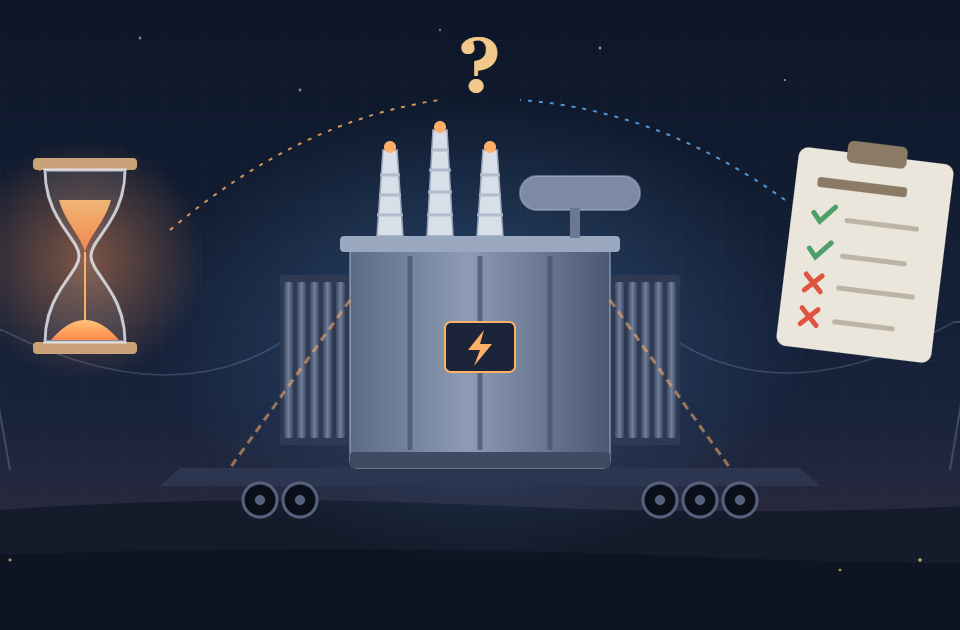
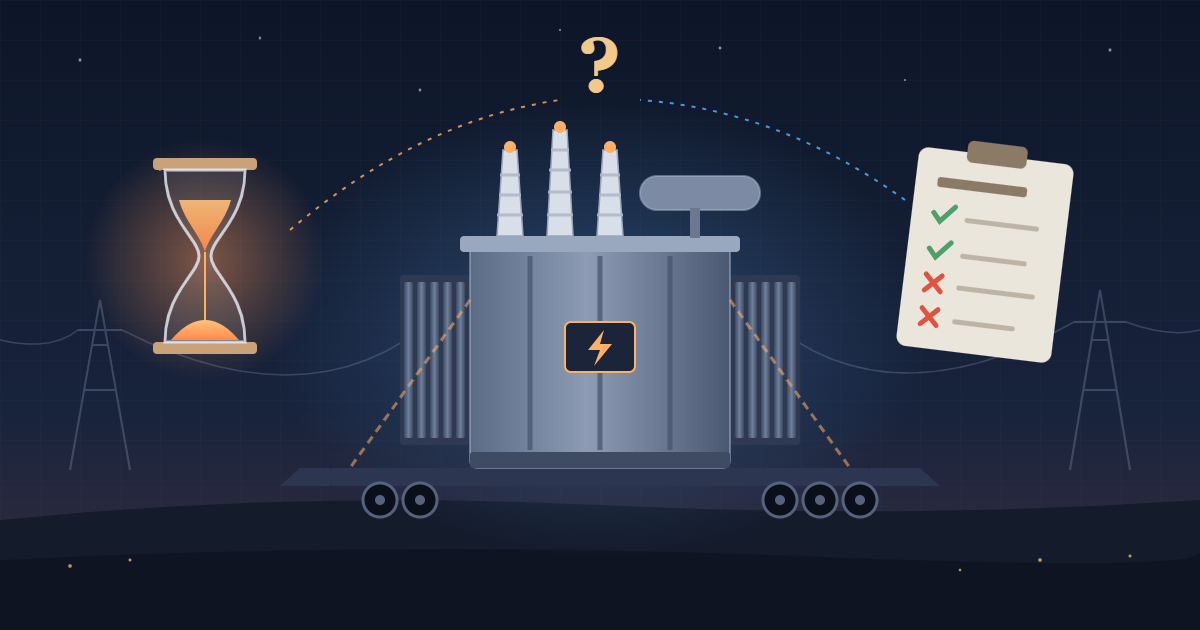
In early November, Fortune republished an essay from The Conversation with a memorable headline: America’s grid upgrade depends on a 400-ton machine whose design dates from the 1800s. The machine is the large power transformer. The essay’s argument has become conventional wisdom in the power sector. Demand for transformers has exploded. Factories cannot keep up. Data centers, solar farms and new gas plants are stuck waiting for a box of copper and steel.
There is a minority view, and it is worth hearing. Some people in the trade say there is no real shortage, only a buying problem. In this view, utilities and engineering firms limit themselves to a short list of approved suppliers, insist on custom designs and order late, and then call the result a shortage.
Both stories cannot be fully true. As in earlier posts on this blog, I will not try to prove either one. I will set out what each predicts and then check the evidence.
What a transformer is, and why it is hard to make
A transformer steps voltage up or down so that power can travel long distances efficiently and then be used safely. The big ones come in two main types. Generator step-up (GSU) units sit at power plants and raise voltage onto the transmission grid. Substation power transformers bring it back down. Smaller distribution transformers are the cans on poles and the green pad-mounted boxes in neighbourhoods.
Large units are not mass-produced. A researcher at Idaho National Laboratory told IEEE Spectrum that a factory might make about 50 of them a year, and that each one is effectively bespoke. Their cores are made from grain-oriented electrical steel (GOES), a specialist material made by only a handful of mills worldwide. According to the US Department of Energy, as reported by IEEE Spectrum, only one company makes it in the United States. Windings need large amounts of copper. Testing is slow, and shipping a 400-ton object needs special rail cars or road permits.
This matters for the argument. A product with few suppliers, long build times and custom specifications is exactly where a demand surge turns into a queue, whatever the buyers do.
The evidence for a genuine shortage
Most of the quantitative evidence comes from one source, the consultancy Wood Mackenzie. That is a weakness I return to below. Its August 2025 release, Untangling the US transformer supply chain crisis, made these claims:
- Demand: since 2019, US demand for power transformers is up about 116% and for distribution transformers about 41%. US electricity consumption has risen about 7% since 2020, after falling about 1% from 2010 to 2020.
- Deficit: in 2025, supply falls short of demand by roughly 30% for power transformers and 10% for distribution transformers.
- Imports: imports are expected to supply about 80% of US power transformers and about 50% of distribution transformers in 2025.
- Outlook: the company expects the constraints to “persist well into the 2030s.”
POWER magazine’s January 2026 review added more of the company’s survey data. GSU demand is up 274% since 2019. Average lead times in a mid-2025 survey were 128 weeks for power transformers and 144 weeks for GSUs, about two and a half years. Since 2019, unit prices have risen by about 77% for power transformers, 45% for GSUs, and up to 95% for some distribution classes. POWER also reported that more than half of US distribution transformers are past their expected service life.
There is evidence on the ground as well. IEEE Spectrum reported that officials in Clallam County, Washington, began turning down some new home-construction requests in 2022 because pad-mounted transformers were unavailable. It also reported that waits for 220 kV transformers in India rose from about 8 to 14 months, putting large volumes of solar capacity at risk. The shortage is not only an American story.
The case that it is self-inflicted
The clearest statement of the opposite view appears in the POWER article. Patrick Tarver runs Bolt Electrical, a firm that brokers transformers. He told the magazine flatly that “There is not a shortage.” He said standard substation units could be delivered in 12 to 14 months once drawings are approved, across all voltage classes. In his account, the real bottleneck is that utilities and engineering contractors will only buy from pre-qualified vendor lists, and so never ask suppliers like him.
This argument should be taken seriously, for three reasons.
- Customisation is a choice. Wood Mackenzie itself says utilities “must embrace standardization to unlock manufacturing efficiencies.” The US cybersecurity agency CISA has also recommended standard designs, according to the Fortune essay. If every utility specifies its own unit, factories lose economies of scale, and some of the queue is created by buyers.
- Panic ordering inflates measured demand. pv magazine reported, citing an engineer at Burns & McDonnell, that some developers now buy factory slots at a premium before their sites are even settled. When buyers order years early to protect themselves, orders run ahead of what the grid actually needs right now. Shortages can feed on themselves in this way.
- “Shortage” partly means “shortage at the price and spec I want.” Imports already fill most of the power-transformer market. Units can be had, but often from abroad, at higher cost, and with tariff exposure.
The weaknesses are just as clear. Tarver is one person, and he earns a margin he says is 12–15% on top of factory cost, so he has an interest in saying stock is available. POWER itself called his claims “difficult to validate.” Vendor qualification also exists for real reasons: a failed transformer can black out a city, and testing, cybersecurity rules and domestic-content requirements are not mere bureaucracy.
The bias audit
Several of the reasoning traps that Kahneman and Tversky described are at work here, on both sides.
One source, repeated many times. Almost every number in circulation, in Fortune, POWER, pv magazine and IEEE Spectrum, traces back to Wood Mackenzie. Repetition feels like confirmation. In fact, five articles quoting one survey give us one measurement, not five. While researching this piece I also found the figures drifting as they were passed along. Fortune says an order can take “more than three years,” but the POWER article it links to gives about two to two and a half years. Two outlets give two different sizes for the same Siemens Energy factory investment. Neither error is large, but both show how numbers harden as they travel.
Availability. A stalled data center or a town that cannot connect new homes makes a vivid story. Projects that bought a unit on time, or quietly refurbished an old one, do not make the news.
Motivated reasoning, on both sides. Consultancies sell supply-chain analysis, so a crisis is good for business. Brokers sell inventory, so “no shortage, just call me” is good for business. Neither motive makes a claim false, but each is a reason to look for independent checks.
Making the claims falsifiable
Following Popper, here is what each hypothesis predicts, and what we actually see.
| Prediction | If it is a real capacity shortage | If it is mainly a procurement problem | What the evidence shows |
|---|---|---|---|
| Prices | Rise sharply across sellers | Rise mainly for “approved” vendors; brokers cheaper | Broad increases of 45–95% since 2019 (WoodMac via POWER); no systematic data on broker pricing |
| Manufacturer behaviour | Firms commit large, multi-year capital to new plants | Little new capacity needed | Roughly $1.8–2 billion of announced North American investment, e.g. Hitachi Energy’s South Boston, Virginia plant due around 2028 (POWER, pv magazine) |
| Imports | Rise to fill the gap | Would not need to | About 80% of power-transformer supply imported (WoodMac) |
| Lead times for standard units | Long even for simple specs | Short for standard units, long only for custom ones | Mixed. Distribution availability has improved (POWER), and the broker cites 12–14 months for standard units, but this is unverified |
| Upstream inputs | Bottlenecks in steel, copper, labour | No upstream constraint | One US GOES producer; copper tariffs up to 50%; WoodMac cites labour shortages |
The capacity hypothesis passes most of its tests. Manufacturers do not commit billions of dollars to plants that take years to build because buyers are filling in forms badly. Prices have risen across the market, not just for a few favoured suppliers. Import dependence is very high.
The procurement hypothesis survives in one narrower form. Long lead times for standard units, and the share of the queue caused by custom specifications and early panic orders, are plausibly partly self-inflicted. That is the one test I could not settle with public data.
What remains uncertain
- Data age. Most lead-time and price figures come from 2025 surveys. With new plants opening from 2026 to 2028, conditions may already have changed for some classes, especially distribution transformers.
- Demand forecasts. Much of the demand surge depends on data-center build-out. As this blog argued in its recent piece on data centers and electricity bills, those forecasts carry wide error bars. If demand stalls, today’s new plants could become tomorrow’s overcapacity. A public-power official made that point to IEEE Spectrum when explaining why manufacturers hesitated to expand.
- Policy. Tariffs raise costs for both imported units and domestic units that use imported inputs. Changes to clean-energy incentives alter the outlook for GSU demand. Both can move faster than factories.
Conclusion
The claim that there is a transformer shortage holds up, but it needs qualifying. For large power transformers and GSUs, the evidence points to a real capacity gap. Demand has more than doubled, prices are up sharply across the market, most supply is imported, a key raw material has a single domestic source, and manufacturers are spending billions on new plants. These are not the signs of a market that merely needs better purchasing managers.
The sceptics are right that the shortage is made worse by how the industry buys: custom designs, closed vendor lists and defensive early orders. Standardisation, which both Wood Mackenzie and CISA recommend, is the cheapest lever available because it needs no new factory.
A more accurate headline would be this: a real shortage, amplified by the way the industry buys. The best evidence for or against that verdict over the next two years will be simple to watch. If lead times for standard designs fall sharply as the new plants open while custom units stay slow, procurement was a bigger part of the story than the consultants admitted. If both stay long, the shortage was real all along.
Sources
- Wood Mackenzie, “Power transformers and distribution transformers will face supply deficits of 30% and 10% in 2025,” press release, 14 August 2025. https://www.woodmac.com/press-releases/power-transformers-and-distribution-transformers-will-face-supply-deficits-of-30-and-10-in-2025
- Sonal C. Patel, “Transformers in 2026: Shortage, Scramble, or Self-Inflicted Crisis?”, POWER magazine, 2 January 2026. https://powermag.com/transformers-in-2026-shortage-scramble-or-self-inflicted-crisis/
- Jasmine Garland (via The Conversation), “America’s grid upgrade hinges on a 400-ton machine designed in the 1800s,” Fortune, 4 November 2026. https://fortune.com/2026/11/04/power-transformer-shortage-grid-400-ton-electrical-steel-one-us-mill/
- Ryan Kennedy, “U.S. transformer market faces severe supply constraints as lead times extend to four years,” pv magazine USA, 11 May 2026. https://pv-magazine-usa.com/2026/05/11/u-s-transformer-market-faces-severe-supply-constraints-as-lead-times-extend-to-four-years/
- Andrew Moseman, “This Essential Element of the Power Grid Is in Critically Short Supply,” IEEE Spectrum, December 2024. https://spectrum.ieee.org/transformer-shortage