Not all industrial accidents are catastrophic explosions.
Some appear routine.
Contained.
Manageable.
Until they injure people.
And then we realize:
The risk was always there — just not fully understood.
🔍 A Case Worth Reflecting On
At a thermal power plant in Koradi, Maharashtra, a boiler (Unit-10) tripped during operation.
Following shutdown, a maintenance activity was initiated:
- Removal of accumulated ash
- High-pressure water jet cleaning
- Access through a peeping hole at ~13 meters height
During the operation, hot ash was suddenly ejected, leading to burn injuries to eight personnel.
Fortunately, the injuries were not fatal.
But the incident raises an important question:
❗ Was This Really Unpredictable?
Let’s step back.
- A boiler had recently tripped
- Internal conditions were not fully stabilized
- Cleaning was initiated under pressure
- Workers were positioned near an active hazard zone
The real question is not:
“Why did hot ash come out?”
But:
“Why was it possible for hot ash to come out during cleaning?”
⚙️ This is Where FMEA Should Have Intervened
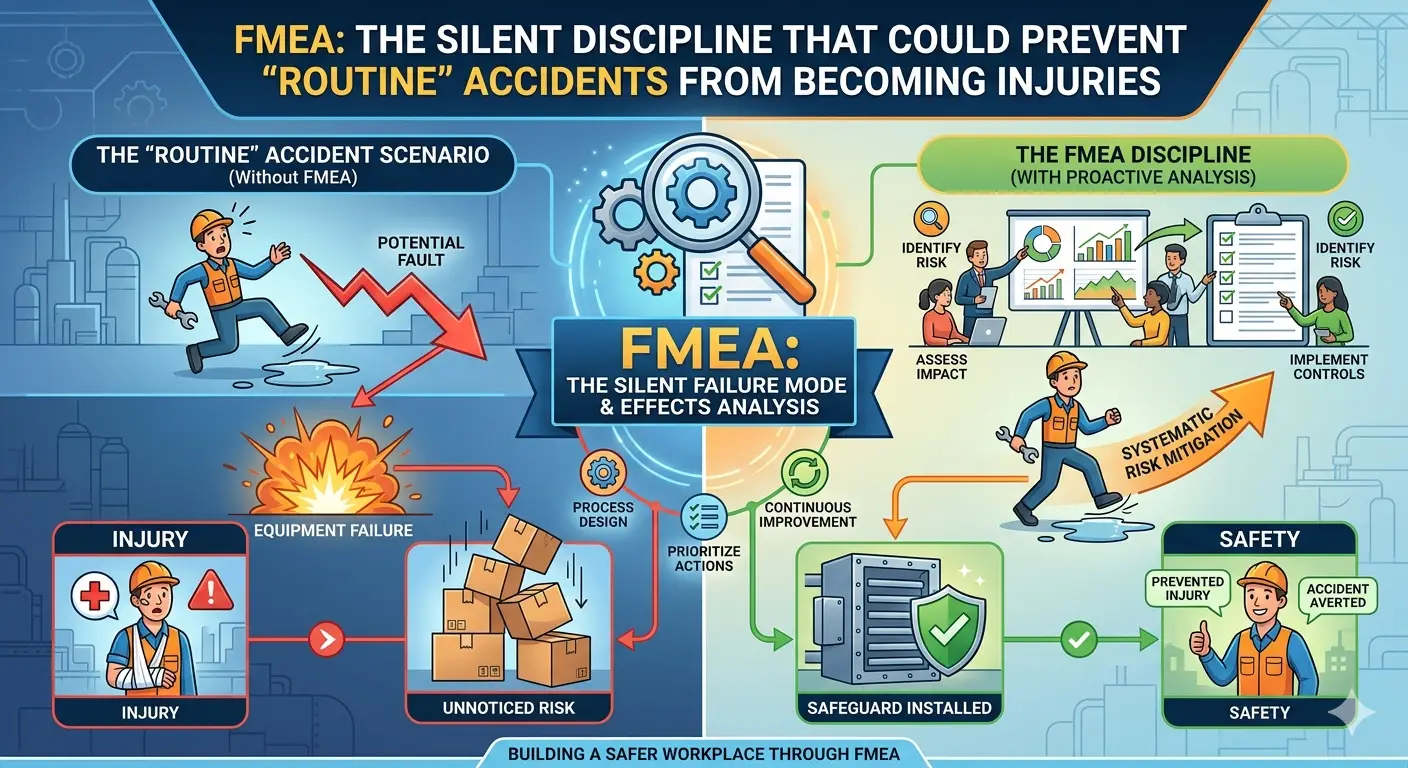
Failure Mode & Effects Analysis (FMEA) is designed exactly for such situations.
Not after the event —
But before the activity begins.
FMEA would have asked:
- What are the risks during ash removal post-trip?
- Can residual heat or pressure cause material ejection?
- What if internal ash is not fully cooled?
- What happens if pressure pockets remain trapped?
- What are the consequences at operator position?
🔗 Viewing the Incident Through an FMEA Lens
1. Residual Heat / Ash Instability
- Failure Mode: Hot ash retained inside boiler
- Effect: Sudden ejection during disturbance
- Missed Control: Cooling verification before maintenance
2. High-Pressure Water Jet Interaction
- Failure Mode: Pressure impact dislodging unstable ash
- Effect: Rapid outward expulsion
- Missed Control: Controlled pressure limits / staged cleaning
3. Inadequate Isolation / Safe Condition Confirmation
- Failure Mode: Cleaning started before full stabilization
- Effect: Unsafe internal conditions
- Missed Control: Maintenance readiness checklist (interlock-based)
4. Exposure at Peeping Hole
- Failure Mode: Personnel directly exposed to discharge path
- Effect: Burn injuries
- Missed Control: Physical barriers / remote operation
🔄 The Pattern We Often Miss
This was not a random event.
It was a combination of predictable risks:
- Thermal risk
- Pressure disturbance
- Human proximity
- Lack of enforced safe conditions
All of which are exactly what FMEA is meant to identify.
⚠️ Why Do Such Incidents Still Occur?
Because in many organizations:
- FMEA is limited to production processes
- Maintenance activities are not rigorously analyzed
- Post-trip / abnormal scenarios are not covered
- Learnings are not standardized across units
So we end up with:
Procedures — but not full risk anticipation
🔁 What a Strong System Would Do Differently
A mature FMEA-driven system would ensure:
- Mandatory cooling / stabilization verification before intervention
- Defined safe windows for maintenance activity
- Interlocks or permits preventing premature access
- Risk classification of maintenance tasks, not just operations
- Standardized learnings across similar units
🧠 The Real Shift
We often think of FMEA as a design or production tool.
But incidents like this remind us:
Risk does not exist only in operation.
It exists in transition, shutdown, and maintenance.
🔐 Final Thought
The Koradi incident did not happen because risks were unknown.
It happened because risks were not systematically anticipated and controlled.
That is the gap FMEA is meant to close.
Because in high-energy systems like thermal power plants:
Even routine activities can become hazardous —
if risk is not actively engineered out.