An Austrian Analysis of Margin Fragility in Capital-Intensive Green Infrastructure
Abstract
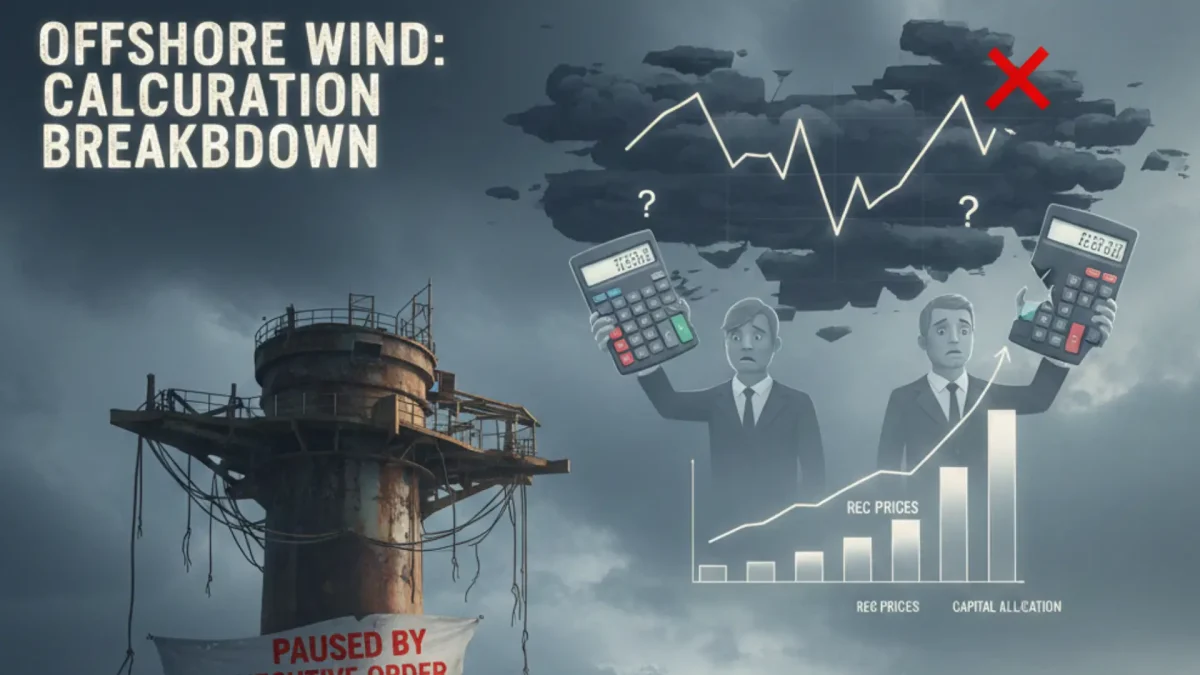
Large-scale offshore wind development exhibits extreme sensitivity to inflation, tariffs, geopolitical instability, and supply-chain disruption. This paper argues that these vulnerabilities are not incidental but arise from a deeper problem identified by the Austrian School: the breakdown of economic calculation under political intervention. Drawing on the work of Ludwig von Mises, Friedrich Hayek, and Murray Rothbard, the paper analyzes how fixed-price contracting, regulatory uncertainty, and politically distorted price signals systematically erode margins in capital-intensive energy infrastructure. Offshore wind serves as a contemporary case study of malinvestment, regime uncertainty, and the socialization of risk in modern political capitalism.
1. Economic Calculation and Capital Intensity
Ludwig von Mises famously argued that rational economic calculation is impossible without genuine market prices formed through voluntary exchange.¹
While offshore wind development occurs within nominally private markets, the price system governing it is deeply politicized through subsidies, mandates, tariffs, and regulatory discretion.
Offshore wind projects require:
- Massive upfront capital investment
- Long construction timelines
- Highly specialized, non-redeployable assets
- Forecasts extending decades into the future
These characteristics magnify the consequences of any distortion in price signals. As Mises emphasized, errors in capital allocation grow larger as production becomes more roundabout and capital-intensive.²
2. Fixed Prices in a World of Floating Costs
A central feature of politically sponsored infrastructure is the prevalence of fixed-price or milestone-based contracts. These are attractive to public authorities because they create the illusion of cost certainty.
From an Austrian perspective, this structure is dangerous:
- Input prices (steel, fuel, labor, capital) float
- Output prices are administratively constrained
- Political risk is asymmetric and unpriced
Mises warned that when prices are fixed by non-market forces, they no longer serve as guides to rational allocation.³ The result is not stability, but suppressed volatility that eventually reappears as losses.
3. Inflation as Capital Consumption
Inflation plays a uniquely destructive role in capital-intensive projects.
Assume:
- A project with a 10% expected operating margin
- A cost base equal to 90% of revenue
A 5% unanticipated cost increase:
- Raises total costs by 4.5% of revenue
- Cuts margins nearly in half
At higher inflation levels, profitability disappears entirely.
Mises described inflation as a process of capital consumption disguised as prosperity,⁴ and this dynamic is especially pronounced when revenues are contractually fixed while costs rise. What appears as “unexpected inflation” is, in fact, the inevitable result of monetary intervention interacting with long production structures.
4. Hayekian Knowledge Problems and Supply Chains
Friedrich Hayek emphasized that economic order emerges from decentralized knowledge embedded in prices.⁵ Offshore wind supply chains, however, are increasingly centralized and politicized:
- Limited numbers of approved suppliers
- Local-content rules overriding comparative advantage
- Tariffs disrupting global price coordination
These interventions suppress the information function of prices. When supply chains fail, the resulting delays are not merely logistical problems but manifestations of the knowledge problem Hayek identified: no planner can anticipate all future contingencies in a complex system.
Delays of weeks or months can destroy entire project margins because capital goods—such as installation vessels—continue to incur costs even when idle. This is not market failure; it is policy-induced blindness.
5. Geopolitical Risk and Regime Uncertainty
Robert Higgs, building on Austrian foundations, introduced the concept of regime uncertainty—the idea that unpredictable political intervention suppresses investment and distorts entrepreneurial planning.⁶
Offshore wind is uniquely exposed to regime uncertainty because:
- Projects span multiple political cycles
- Permits can be revoked or reinterpreted
- “National security” and trade policy can override contracts
These risks are difficult to insure or price. As a result, firms either underprice risk (leading to losses) or withdraw from investment entirely. In either case, capital allocation suffers.
6. Malinvestment in Politicized Energy Markets
Murray Rothbard extended Mises’s business-cycle theory by emphasizing that state-driven credit expansion and intervention channel resources into lines of production that would not survive in a free market.⁷
Offshore wind investment frequently depends on:
- Subsidized demand
- Guaranteed offtake
- Preferential financing
- Regulatory exclusion of alternatives
Such conditions encourage malinvestment—projects that appear profitable only under continued political support. When inflation, tariffs, or political opposition emerge, margins collapse because the projects were never economically robust to begin with.
7. Risk Socialization and Private Losses
A defining feature of modern political capitalism is asymmetric risk allocation:
- Political authorities control rules
- Private firms bear downside risk
- Costs are shifted through contracts rather than eliminated
Fixed-price contracts, local-content mandates, and shifting regulations transfer uncertainty to private actors without granting them corresponding control. Rothbard described such arrangements as neither genuinely capitalist nor socialist, but hybrid systems that preserve political power while privatizing losses.⁸
8. Defensive Measures and Their Limits
Firms attempt to defend margins through:
- Cost indexation clauses
- Shared delay-risk provisions
- Geographic diversification
- Balance-sheet conservatism
- Selective hedging
While these measures can reduce exposure, they do not restore economic calculation. They are second-best responses to systemic distortion. As Hayek observed, interventions often create the need for further interventions, entrenching complexity rather than resolving it.⁹
9. Conclusion: The Austrian Diagnosis
The fragility of offshore wind margins is not a mystery. It is the predictable outcome of:
- Capital intensity
- Fixed prices amid floating costs
- Monetary inflation
- Trade barriers
- Regime uncertainty
Mises, Hayek, and Rothbard all warned that when political objectives override market prices, entrepreneurial calculation deteriorates. Offshore wind illustrates this principle vividly: profits vanish not because technology fails, but because the price system is prevented from performing its coordinating function.
Until energy markets are governed by stable property rights, free pricing, and genuine consumer demand, capital-intensive green infrastructure will remain prone to cycles of enthusiasm, disruption, and loss.
References (Mises Institute style)
- Mises, Ludwig von. Economic Calculation in the Socialist Commonwealth. 1920.
- Mises, Ludwig von. Human Action. Yale University Press, 1949.
- Mises, Ludwig von. Human Action, ch. 26.
- Mises, Ludwig von. The Theory of Money and Credit. 1912.
- Hayek, F. A. The Use of Knowledge in Society. American Economic Review, 1945.
- Higgs, Robert. Crisis and Leviathan. Oxford University Press, 1987.
- Rothbard, Murray N. America’s Great Depression. Ludwig von Mises Institute, 2000 [1963].
- Rothbard, Murray N. Power and Market. Institute for Humane Studies, 1970.
- Hayek, F. A. Law, Legislation and Liberty, Vol. 1. University of Chicago Press, 1973.