This article draws from Austrian production theory and modern FMEA practice.
In manufacturing, we often talk about tools as if they are the answer.
Lean. Six Sigma. TPM. Control Plans. SPC. Layered Process Audits. FMEA.
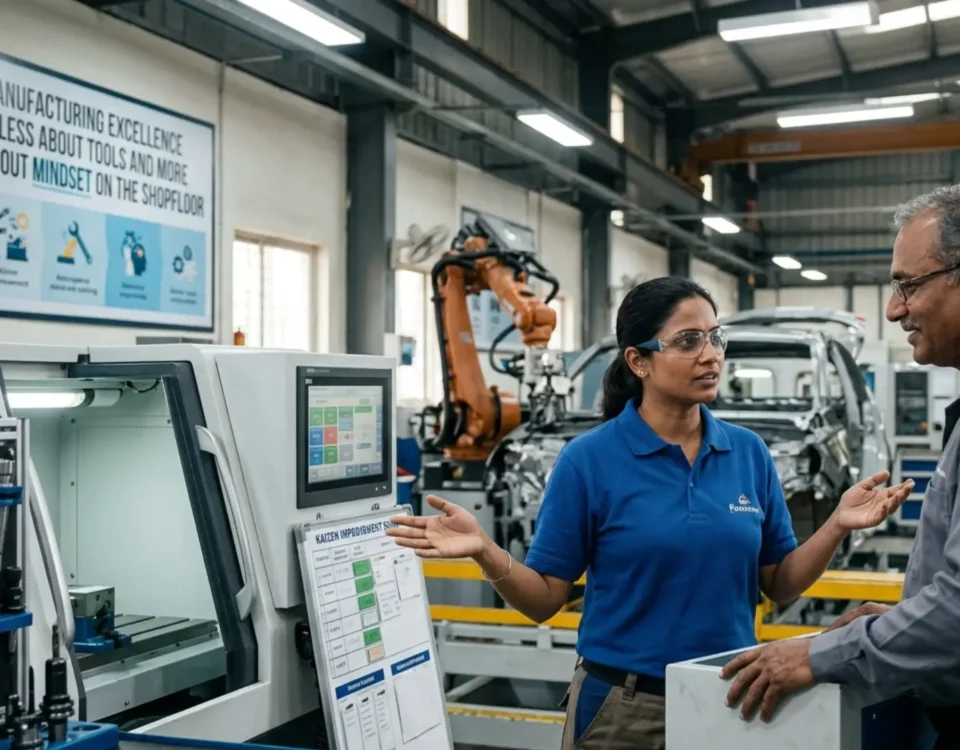
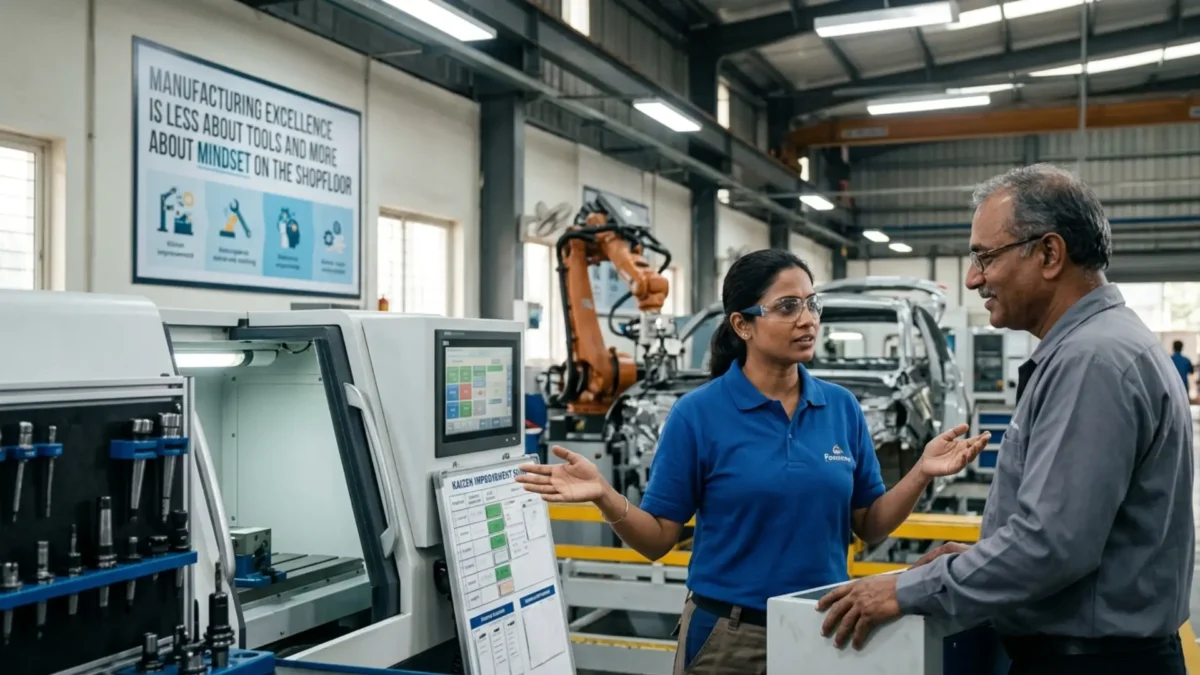
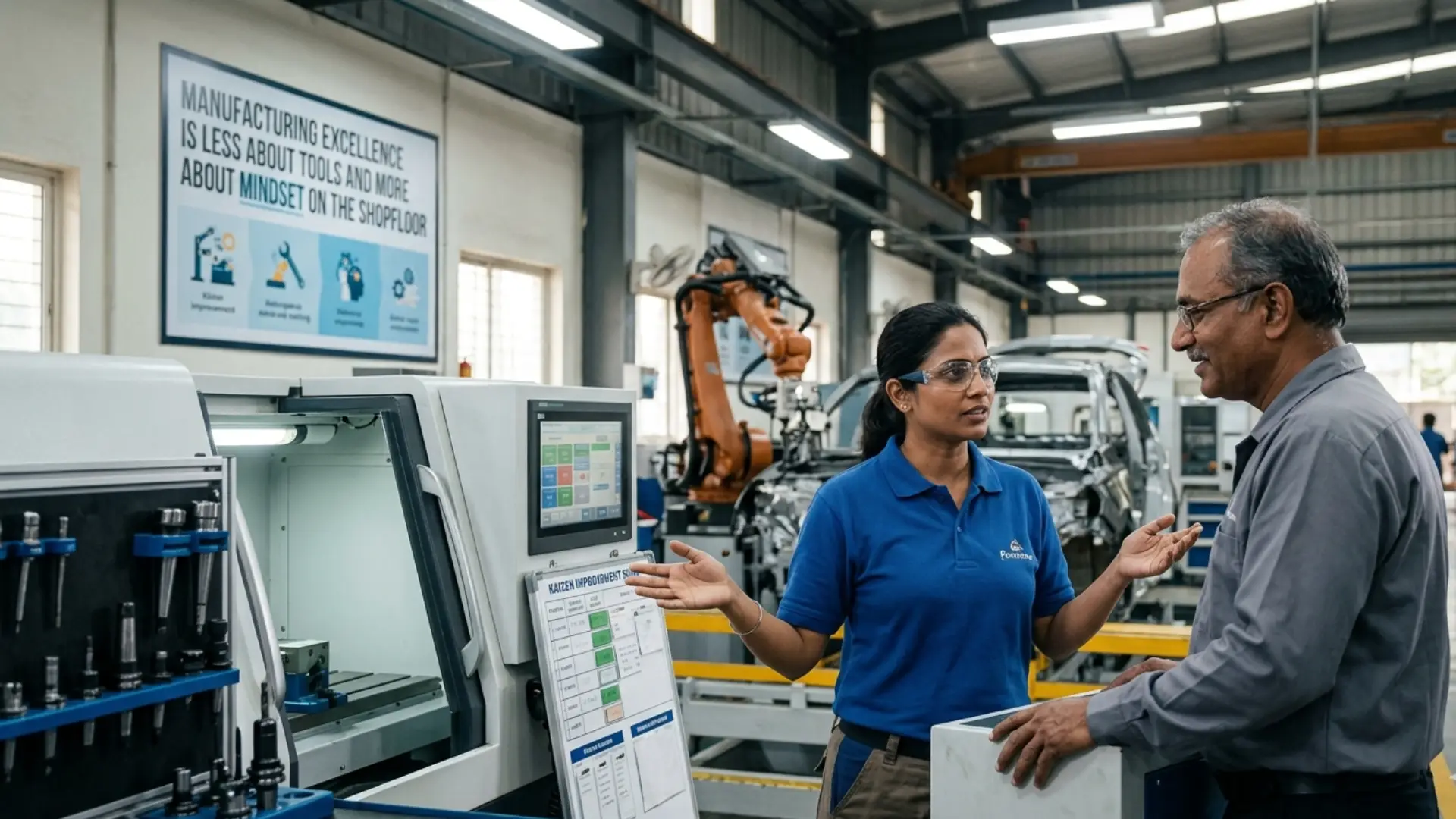
Each of these matters. Each can be powerful. But over the years, I’ve come to believe that Manufacturing Excellence is less about tools and more about mindset on the shopfloor.
The biggest breakthroughs I’ve seen did not come from introducing a new template, dashboard, or methodology. They came when teams gained clarity—clarity on what matters, what can go wrong, what good looks like, and who owns the response.
And just as importantly, they came when that clarity translated into ownership—not abstract accountability on a slide, but real ownership at the point of work.
That is where excellence starts.
Tools Do Not Create Excellence by Themselves
Manufacturing organizations often fall into a familiar trap: they adopt best-practice tools and assume performance will follow.
The logic seems sound:
- Install a stronger quality system.
- Roll out structured problem-solving.
- Improve documentation.
- Standardize risk reviews.
- Add more visual controls.
And yet, many plants still struggle with:
- recurring defects,
- repeat customer complaints,
- chronic firefighting,
- unstable processes,
- poor action closure,
- and a culture where issues are “known” but not truly owned.
Why?
Because tools do not create behavior on their own.
A plant can have excellent forms and weak discipline.
It can have sophisticated metrics and poor accountability.
It can have robust systems and still fail at the point of execution.
That is why I believe the real differentiator is not the presence of tools, but the mindset with which they are used.
The Shopfloor Is Where Reality Lives
Executives, quality leaders, and plant managers can create systems, expectations, and structure. But the truth of manufacturing always reveals itself on the shopfloor.
This is where:
- standards are either followed or bypassed,
- controls are either effective or ceremonial,
- abnormalities are either escalated or normalized,
- risk is either prevented or passed downstream.
The shopfloor is where process discipline becomes real—or doesn’t.
That is why clarity matters so much.
When operators, supervisors, and support teams have clarity:
- they understand the process intent,
- they recognize failure modes earlier,
- they know what “normal” looks like,
- they can distinguish signal from noise,
- and they are more likely to act before a defect becomes a customer issue.
And when they have ownership:
- they stop assuming “someone else will fix it,”
- they escalate faster,
- they challenge weak controls,
- they close actions more reliably,
- and they begin to think preventively rather than reactively.
This is the foundation of excellence.
FMEA Is a Perfect Example of the Difference Between a Tool and a Mindset
Few tools illustrate this better than FMEA (Failure Modes and Effects Analysis).
Most organizations have FMEAs.
Far fewer organizations actually live their FMEAs.
That distinction matters.
When FMEA is treated as:
- a customer requirement,
- a launch deliverable,
- a quality department artifact,
- or an audit checkbox,
…it becomes paperwork.
The file exists.
The risk remains.
But when FMEA is used properly, it becomes something far more powerful:
- a structured way to think about process risk,
- a mechanism to surface hidden assumptions,
- a forum to expose weak controls,
- and a discipline that creates alignment between design intent, process reality, and operator behavior.
In that sense, FMEA is not just a quality tool. It is a cultural instrument.
It reveals whether an organization truly understands:
- how the process can fail,
- what failure looks like at the process step,
- which controls are genuinely preventive,
- and whether anyone truly owns the risk.
The Executive Role in FMEA: Sponsor the Discipline, Not Just the Document
This is where leadership becomes decisive.
Too often, executives ask:
- “Is the FMEA complete?”
- “Has the customer requirement been met?”
- “Is the document updated?”
These are not unimportant questions. But they are not enough.
The stronger leadership questions are:
- Do we truly understand the real failure modes at the process step?
- Which risks are still dependent on operator heroics rather than robust controls?
- Who owns the action for risk reduction?
- What physically changed on the line because of this analysis?
- How do we know the control is working under actual production conditions?
- What have recent escapes taught us about the assumptions in our FMEA?
That is the difference between managing compliance and building capability.
The executive’s role in FMEA is not to sponsor the form.
It is to sponsor the discipline of preventive thinking.
In practical terms, that means leaders must ensure that FMEA is connected to:
- standard work,
- control plans,
- process parameters,
- operator training,
- mistake-proofing,
- layered audits,
- reaction plans,
- and escalation routines.
If the FMEA changes but the line does not, then the FMEA has not created value.
Why Clarity and Ownership Outperform Complexity
One of the most common mistakes in manufacturing transformation is assuming that more sophistication equals better performance.
More dashboards.
More layers.
More software.
More review gates.
More forms.
Sometimes these help. Often they add burden without adding understanding.
In my experience, simple systems with strong ownership outperform complex systems with weak ownership.
A line with:
- clear standards,
- visible abnormalities,
- disciplined escalation,
- strong supervisor engagement,
- and action closure at the source,
will usually outperform a line with better software but weaker daily discipline.
This is not an argument against tools.
It is an argument about sequence.
First:
- build clarity,
- define ownership,
- strengthen behavior,
- normalize preventive thinking.
Then:
- use tools to reinforce, standardize, and scale.
Without that sequence, tools often become theater.
Manufacturing Excellence Is Built in Daily Decisions
The culture of a plant is not built during annual strategy sessions.
It is built in daily decisions such as:
- whether a deviation is tolerated,
- whether a defect is contained immediately,
- whether a weak control is challenged,
- whether operators feel safe to raise a concern,
- whether leaders go to the gemba before asking for slides,
- whether actions are closed because they matter—not because a meeting is scheduled.
This is why mindset matters so much.
A shopfloor culture that values:
- curiosity over blame,
- prevention over reaction,
- discipline over improvisation,
- ownership over excuses,
- and learning over compliance,
will extract far more value from every manufacturing tool it uses.
The reverse is also true.
A weak culture can neutralize even the best systems.
What Great Leaders Do Differently
The best manufacturing leaders I’ve seen do a few things consistently:
1. They make problems visible
They do not hide instability behind metrics.
They create an environment where abnormalities are surfaced early.
2. They insist on process-level truth
They want to understand what is actually happening at the station, not what the presentation says.
3. They connect risk to action
They do not stop at analysis. They ask what changed in the process, in the standard, in the control, or in the behavior.
4. They build ownership at the point of work
They do not centralize all thinking into staff functions.
They elevate operator and supervisor engagement.
5. They treat tools as enablers, not substitutes
They understand that Lean, FMEA, SPC, TPM, and audits are only effective when they reinforce the right habits.
This is leadership in operational excellence.
A More Honest Way to Think About Manufacturing Excellence
Perhaps the most honest way to say it is this:
Tools can organize excellence.
They cannot manufacture it.
Excellence is manufactured through:
- disciplined thinking,
- consistent standards,
- visible accountability,
- practical leadership,
- and a shopfloor culture that sees risk early and acts decisively.
That is why I continue to believe:
Manufacturing Excellence is less about tools and more about mindset on the shopfloor.
And that is why FMEA, despite being seen as a technical quality tool, is actually a revealing test of leadership maturity.
Because in the end:
- the template does not reduce risk,
- the spreadsheet does not prevent defects,
- the score does not create control.
People do.
With clarity.
With ownership.
With discipline.
At the point of work.
That is where excellence begins.
References
- Mises, L. von. Human Action: A Treatise on Economics — Chapter VIII, “The Effects of the Division of Labor.” Mises Institute. https://mises.org/online-book/human-action/chapter-viii-human-society/5-effects-division-labor (Mises Institute)
- Bylund, P. L. (2011). The Firm and the Division of Labor. Mises Institute. https://mises.org/mises-daily/firm-and-division-labor (Mises Institute)
- Ng, D. (2021). Entrepreneurial Empowerment: You Are Only as Good as Your Employees. Quarterly Journal of Austrian Economics, Mises Institute. https://mises.org/quarterly-journal-austrian-economics/entrepreneurial-empowerment-you-are-only-good-your-employees (Mises Institute)
- AIAG. (2019). New AIAG & VDA FMEA Handbook and Trainings Available! https://blog.aiag.org/new-aiag-vda-fmea-handbook-and-trainings-available (blog.aiag.org)
- AIAG. (2022). AIAG & VDA FMEA Handbook (1st ed., 2nd printing product page). https://www.aiag.org/expertise-areas/corporate-responsibility/chemical-management (AIAG)
- Huang, H.-M., & Hedberg Jr., T. (2019). Proposed Expansion of Quality Information Framework (QIF) Standard Schema with Potential Failure Mode and Effects Analysis (FMEA) Information Model (NIST AMS 300-7). National Institute of Standards and Technology. https://doi.org/10.6028/NIST.AMS.300-7 (NIST)
- As Ludwig von Mises argued in Human Action, mechanization is “the fruit of the division of labor” rather than its root cause—a useful reminder that productivity gains begin with human coordination, specialization, and disciplined execution before tools can scale them. (Mises Institute)
- This is consistent with the structured intent of the AIAG & VDA FMEA methodology, which emphasizes a process-oriented and action-driven approach rather than mere documentation. (blog.aiag.org)