The claim
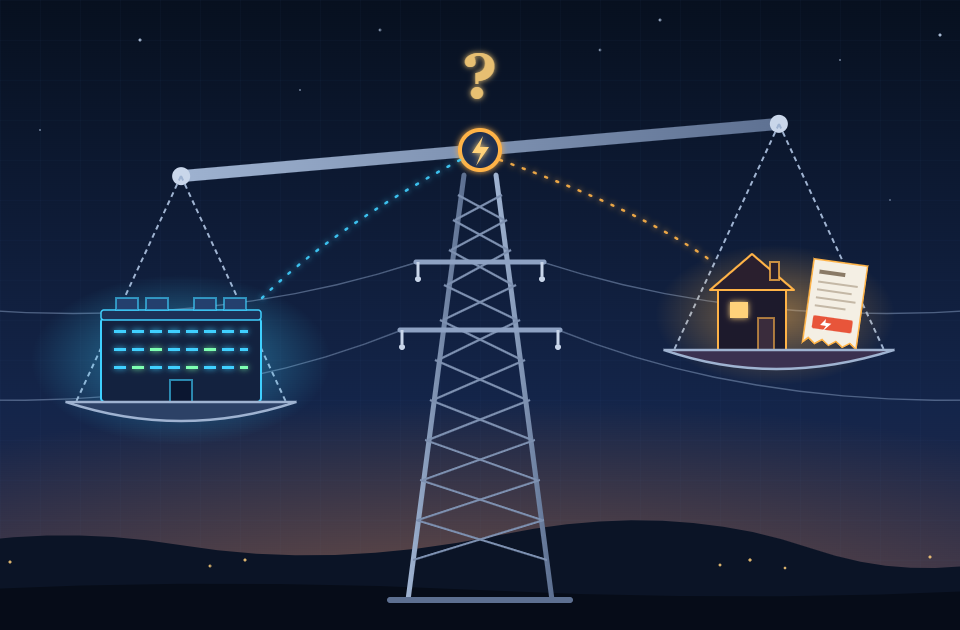
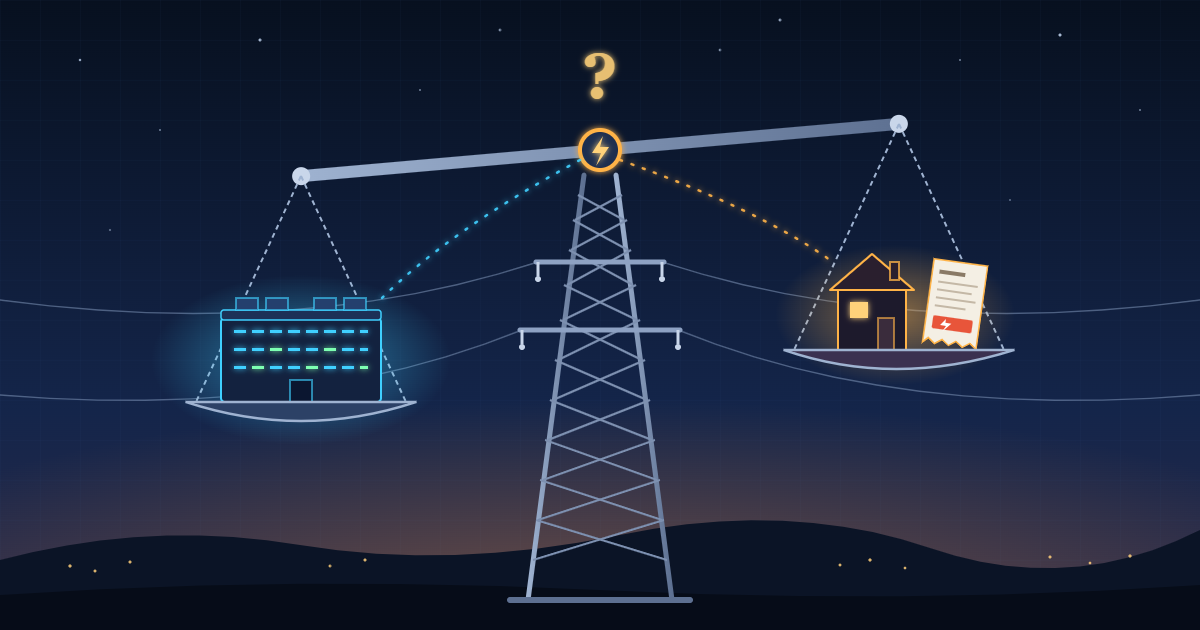
It has become one of the most common explanations of the year: “AI data centers are driving up your electricity bill.” It turns up in local zoning fights, in campaign speeches and in a steady run of headlines about record power demand.
The story is simple. Data centers use enormous amounts of electricity. Demand rises faster than supply. Prices go up. Households pay the difference.
It sounds obviously true, and that is exactly why it deserves testing. As in earlier posts on this blog, the aim here is not to prove the claim but to try to break it: first by asking why it feels so convincing, then by setting out in advance what evidence would refute it, and only then by looking at the data.
Part 1: Why the claim feels true
Availability: vivid numbers crowd out base rates
Headlines like “wholesale prices up 267% near data centers” or “PJM capacity costs hit record” are memorable. Kahneman and Tversky showed that we judge how common or important something is by how easily examples come to mind. A dramatic local spike is easy to recall. A national average that barely moved after inflation is not.
WYSIATI: one cause fills the frame
Kahneman’s “What You See Is All There Is” describes how we build a confident story from whatever information is in front of us. Bills have risen. Data centers are new and visible. But retail electricity prices also carry transmission and distribution upgrades, wildfire costs, storm recovery, natural gas prices and regulatory decisions. When one visible cause is in view, we tend not to ask about the others.
Three conflations hiding in one sentence
The claim usually mixes three distinctions without saying so:
| Distinction | Why it matters |
|---|---|
| Wholesale vs retail | Wholesale energy is only part of a retail bill; networks and fixed costs make up much of the rest. |
| Average vs local | A national average can stay flat while a few hot spots see sharp increases. |
| Past vs future | What data centers did to prices up to 2024 may differ from what the current buildout will do. |
A claim that does not say which of these it means cannot really be tested. So the next step is to make it specific.
Part 2: Making the claim falsifiable
Following Popper, we write down predictions that could fail:
H: Data center growth has raised, and is raising, what U.S. electricity customers pay.
If H is true, we should see:
- P1 (retail, historical): States with more data center growth saw higher retail price increases over the past decade.
- P2 (wholesale): Models of the power system show data center load raising wholesale energy prices.
- P3 (capacity costs): In organized markets, data center load accounts for a meaningful share of rising capacity charges that flow to customers.
- P4 (local hot spots): Price increases are concentrated where data centers cluster.
P1 is the severe test for the historical claim. P2 to P4 matter most for the forward-looking one.
Part 3: The evidence
P1. Retail prices, 2015 to 2024: ❌ failed, at least so far
The most direct test comes from a 2026 working paper by Asa Watten, John Bistline and Geoffrey Blanford at the Electric Power Research Institute (EPRI). Using FERC and EIA data for 2015 to 2024, and an instrumental-variable design meant to separate cause from siting choices, they estimate that a doubling of data center capacity reduced residential retail prices by about 3.5% for a fixed level of demand. They estimate that data center load growth from 2019 to 2024 lowered average residential prices by roughly 6%.
The mechanism is not mysterious. Much of a utility’s cost is fixed: wires, substations, existing plants. When a large, steady customer arrives and pays its share, those fixed costs are spread over more kilowatt-hours. Watten told Fortune that electricity markets “are different than a lot of markets that they interact with,” since prices largely reflect cost recovery.
The Lawrence Berkeley National Laboratory and Brattle 2026 update on retail price trends points the same way. Average national rates have broadly tracked inflation in recent years. Price increases vary widely by state, with transmission and distribution spending a major driver where rates rose. Brattle’s earlier analysis found that state-level load growth has tended to push retail prices down, not up.
EPRI’s own caution matters here: data centers may choose cheap-power regions, which is why the causal design matters. An instrumental-variable estimate depends on its assumptions, and it is one paper, not a settled consensus. Still, the historical version of the claim made a clear prediction and, on the best evidence available, it did not hold.
P2. Wholesale energy prices: ✅ passed, but smaller than the headlines
The Dallas Fed paper Processing Power by Owen Kay, Robert Reaser and Reid Taylor uses an hourly, plant-level dispatch model covering 23 U.S. regional markets. The revised October 2026 version estimates that data centers raised the national load-weighted wholesale price by 6.9% by 2025, with about 15% in northern Virginia, and that the national effect could reach 12.3% by 2028 under the authors’ preferred scenario. Effects in Florida and parts of the interior South were as low as about 1%.
Two points need care. First, the estimate has changed between drafts: earlier versions reported ranges of roughly 2–6% and 3–5%, so be cautious of anyone quoting a single figure with confidence. Second, this is wholesale. Coverage of the paper notes that energy makes up roughly half of a typical retail price, and that wholesale changes take time to reach household rates.
So the prediction passes, but the measured effect is single digits nationally today. That is real, but it is not the main reason for most of the bill increases people have seen.
P3. Capacity markets: ✅ passed, clearly, in PJM
The strongest evidence for the claim is in PJM, the grid operator serving 13 states and Washington, D.C. PJM’s capacity auction pays power plants to be available years ahead, and those costs flow into customer bills.
- The auction for the 2027/28 delivery year cleared at the region-wide price cap of about $333 per MW-day, the third year in a row of rising prices.
- PJM’s Independent Market Monitor, Monitoring Analytics, attributed roughly $6.5 billion of that auction’s costs to data center load, about $6.2 billion of it tied to data centers not yet built but forecast to arrive.
- For the 2028/29 auction held in July 2026, the Monitor attributed about $6.3 billion, or 38%, of $16.4 billion in charges to data centers.
This is a direct channel from data center forecasts to household bills, and the Monitor has proposed procuring capacity for data centers in a separate auction for that reason. It is also the channel EPRI’s 2015–2024 data could not capture, because it barely existed then.
P4. Local hot spots: ✅ passed
Fortune, citing EIA data, reports that residential prices in Virginia, the state with the most data centers, rose more than 13% in a year. The Dallas Fed’s regional results show the same concentration. Where data centers cluster and the grid is constrained, the effect is visible.
Part 4: Reconciling the evidence
At first the results look contradictory: prices fell, and prices rose. They make sense once the three conflations are separated.
- Past vs future. Until about 2024, data centers mostly joined grids with spare capacity and helped spread fixed costs. The current buildout is different in scale. The EIA’s November 2026 outlook projects record U.S. electricity demand, and forecasts residential prices of about 18.2 cents/kWh in 2026 and 18.7 cents in 2027, up from about 17.2 cents in 2025.
- Built vs forecast. Much of the PJM cost is for load that may or may not arrive. Watten made the key point to Fortune: if the grid builds for data center demand that never shows up, “that could be a clear story” of data centers raising prices in a way they did not before. The risk is the AI bubble question in another form.
- Equipment, not only energy. Transformer lead times of three years or more, and steep price increases for grid equipment, raise the cost of every new connection whoever the customer is. Data centers make that scarcity worse, but they did not create it.
What we don’t know
- Cost allocation. Whether data centers pay their full share of new transmission and capacity depends on state regulators and tariff design. That is a policy choice, not a law of physics.
- Model dependence. The Dallas Fed results depend on assumptions about renewable buildout and transmission. Its authors note that slower wind and solar additions would make price effects larger, and that easing transmission constraints would reduce them.
- Attribution. Attributing auction costs to one type of customer requires a counterfactual of what prices would have been. Different methods give different numbers.
- Demand realism. Utility load forecasts have been revised up sharply, and some of that demand may be double-counted across utilities competing for the same projects.
Verdict
As a statement about the past decade, the claim fails its severe test. The best causal evidence suggests data centers slightly lowered average retail rates through 2024.
As a statement about now and the near future, it is partly corroborated, with strong local variation. Wholesale effects are real but single digits nationally. The clearest channel to households runs through capacity markets like PJM’s, where billions in costs are being charged for data centers that do not exist yet.
A more defensible version of the claim would be: “In constrained regions, especially PJM, the rush to serve forecast data center demand is now adding meaningfully to bills. Whether that becomes a lasting national effect depends on whether the demand arrives, and who is made to pay for the infrastructure built for it.”
That is less catchy, but it can be tested, and that is the point.
Sources
- Fortune: “Data centers were actually making electricity costs cheaper, but the $7 trillion buildout… is threatening the trend” (July 26, 2026). https://fortune.com/2026/07/26/data-centers-electricity-costs-cheaper-7billion-buildout-ai-demand/
- EPRI working paper (Watten, Bistline, Blanford), “Have Data Centers Raised Your Electric Bill?” (June 2026). https://esca.epri.com/_astro/2026-jun-have-data-centers-raised-your-electric-bill.CVr2j5ls.pdf
- Columbia Center on Global Energy Policy: “Data centers lowered electric bills in some places, for now.” https://www.energypolicy.columbia.edu/data-centers-lowered-electric-bills-in-some-places-for-now/
- Dallas Fed Working Paper 2606, Kay, Reaser & Taylor, “Processing Power: The Effect of Data Centers on Wholesale Electricity Markets” (rev. Oct 2026). https://www.dallasfed.org/research/papers/2026/wp2606 and https://ideas.repec.org/p/fip/feddwp/102959.html
- Stacker/KRDO: “How data center demand is reshaping electricity costs across the US” (Nov 9, 2026). https://krdo.com/stacker-business-economy/2026/11/09/how-data-center-demand-is-reshaping-electricity-costs-across-the-us/
- Brattle: “Electricity Price Trends: 2026 Update to the Lawrence Berkeley/Brattle Study.” https://www.brattle.com/insights-events/publications/electricity-price-trends-2026-update-to-the-lawrence-berkeley-brattle-study/
- Berkeley Lab, Retail Price Trends 2026 edition (July update). https://eta-publications.lbl.gov/sites/default/files/2026-07/retail_price_trends_2026_edition_julyupdate.pdf
- Utility Dive: PJM capacity auction and data centers. https://www.utilitydive.com/news/data-centers-pjm-capacity-auction/808951/
- Power Engineering: “PJM capacity auction hits price cap again as region falls short of reliability target.” https://www.power-eng.com/business/pjm-capacity-auction-hits-price-cap-again-as-region-falls-short-of-reliability-target/
- BTW Media: “PJM monitor attributes US$6.3bn auction charges to data centres.” https://btw.media/en/pjm-monitor-attributes-us-6-3bn-auction-charges-to-data-centres
- EIA Short-Term Energy Outlook, November 2026. https://www.eia.gov/outlooks/steo/archives/nov26.pdf
- Fortune / The Conversation on the transformer shortage (Nov 4, 2026). https://fortune.com/2026/11/04/power-transformer-shortage-grid-400-ton-electrical-steel-one-us-mill/
- pv magazine USA: “U.S. transformer market faces severe supply constraints as lead times extend to four years” (May 11, 2026). https://pv-magazine-usa.com/2026/05/11/u-s-transformer-market-faces-severe-supply-constraints-as-lead-times-extend-to-four-years/
- Kahneman, D. Thinking, Fast and Slow (2011); Tversky, A. & Kahneman, D., “Availability: A heuristic for judging frequency and probability,” Cognitive Psychology (1973); Popper, K. Conjectures and Refutations (1963).