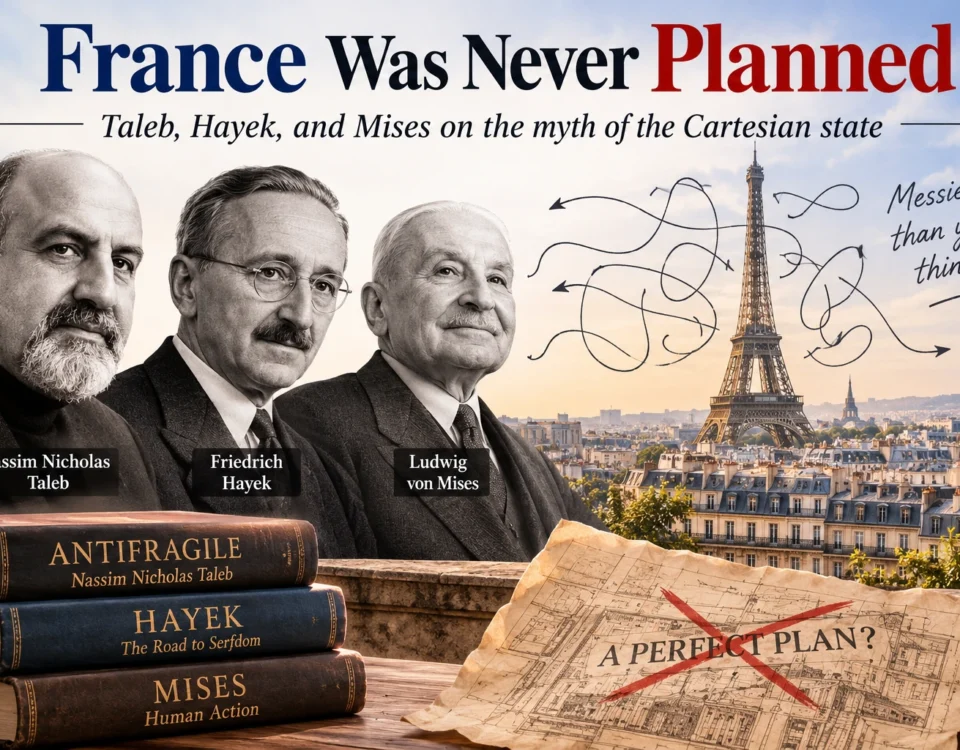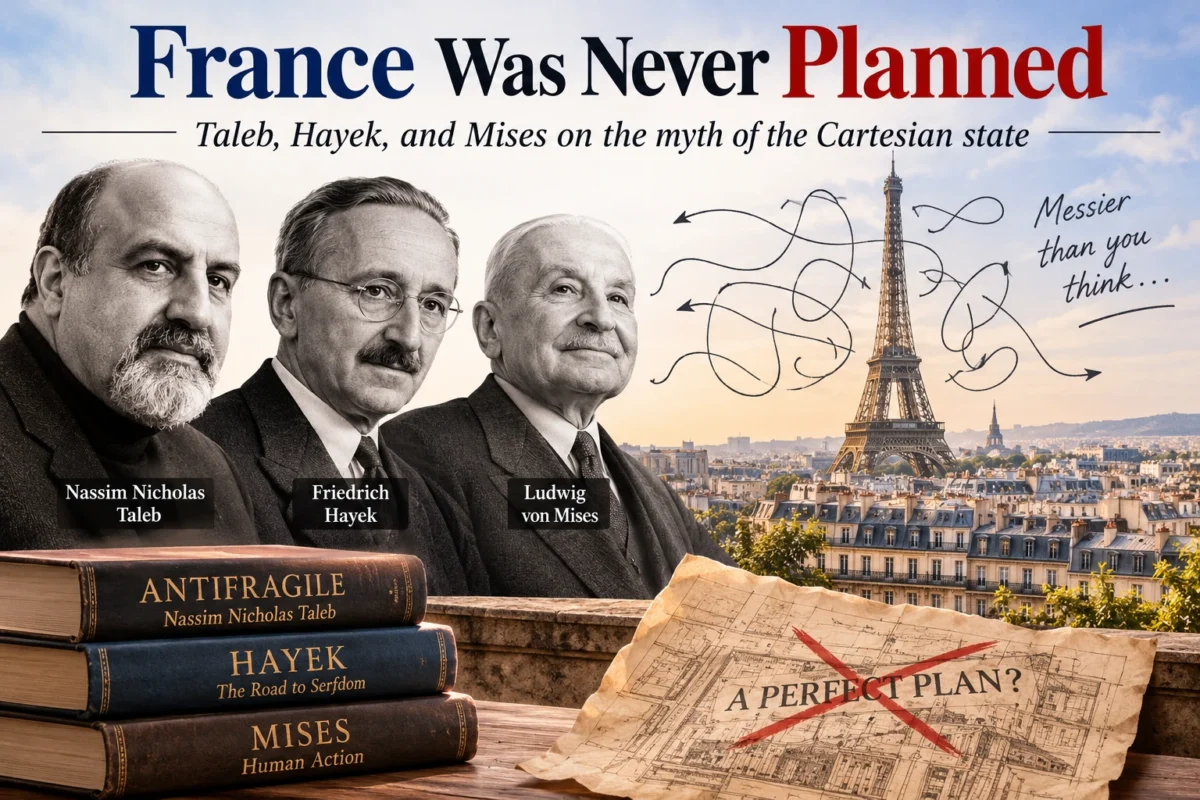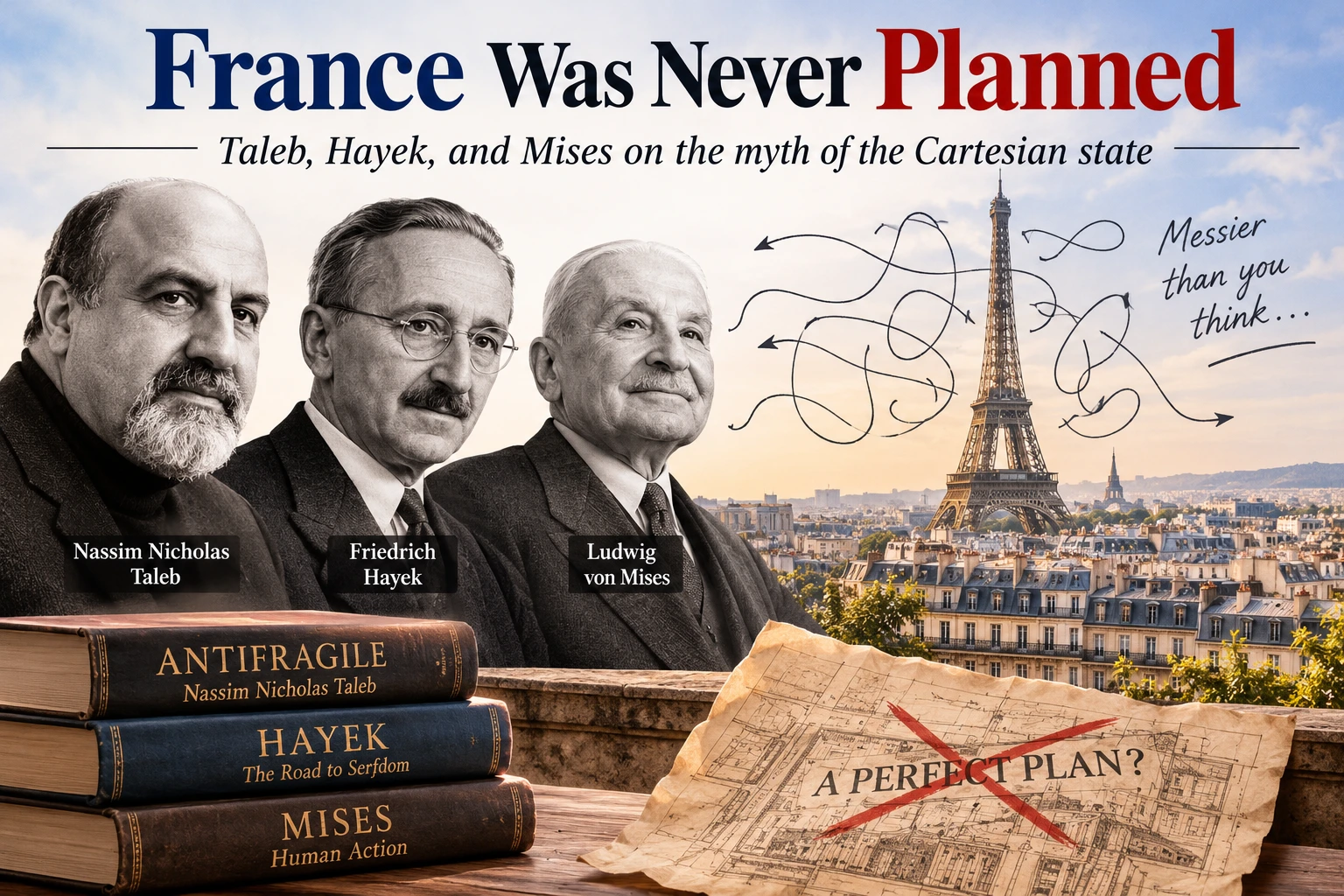
Taleb, Hayek, and Mises on the myth of the Cartesian state
Ask people why France works, and you’ll usually hear some version of the same answer. France is the rational country, the land of Descartes. Louis XIV built the absolute monarchy, Colbert planned the economy, Napoleon wrote the code, and Haussmann redesigned Paris. France, in other words, is what you get when clever people at the center draw up a plan and carry it out.
In Antifragile, Nassim Nicholas Taleb has a short section called “France Is Messier than You Think” that takes this story apart. I’ve been reading it alongside two economists who made the same argument in more rigorous form decades earlier: Friedrich Hayek and Ludwig von Mises. Read together, they reach a surprising conclusion. Taleb is largely right, and the Austrians explain why he is right. They also show where his argument goes too far.
Taleb’s case: the state that couldn’t see its own country
Taleb starts by naming the narrative he wants to debunk: that France works well because it is “a Cartesian rationalizing-rationalist top-down state.” He suggests the French were lucky that this was, for most of their history, a failed aim.
His evidence, drawn largely from Graham Robb’s The Discovery of France, is striking.
The French didn’t speak French. In the 1860s a large share of the population couldn’t speak the national language at all, and many more spoke it only as a second language. (Taleb says that only one in five people could speak French; the official 1863 survey suggests roughly the reverse, that about a fifth couldn’t. The point survives the correction: daily life ran on local languages and dialects.) In 1904, Frédéric Mistral won the Nobel Prize in Literature for writing in Provençal, a regional language of the south.
Nothing held the country together. Taleb notes that there was nothing ethnic or linguistic to bind the place. France was “just the property of a king and a weak aristocracy.” Roads were awful, much of the country was hard to reach, and tax
collection was a dangerous job. Paris, he says, “discovered” some of its own provinces after it had already mapped colonies in North Africa.
Rioting was a national institution. Citing the historian Jean Nicolas, Taleb jokes that rioting is “the true French national sport.” The joke has a serious point: the population constantly pushed back against the state.
Even Paris was ungovernable. Louis XIV moved the government to Versailles partly to escape the Parisian crowd. The city became controllable only in the 1860s, when Baron Haussmann tore down tenements and narrow streets to build wide avenues that police could use to manage crowds.
Real centralization came late and didn’t last long. By Taleb’s account, France was truly integrated only after World War II, through long programs of roads, railways, public schools and television begun under De Gaulle. He says it was complete by the late 1970s, at which point decentralization began. On this timeline, the famous centralized French state lasted about two or three decades.
His conclusion is cautious. France may have benefited from its brief period of strong central government, but perhaps mainly because the large state “spurred growth and did not overstay its welcome.”
Hayek: “Cartesian” was always the problem
What struck me most is that Taleb’s key word, Cartesian, belongs to Hayek’s vocabulary.
In The Counter-Revolution of Science and Law, Legislation and Liberty, Hayek divided Western social thought into two traditions:
- A French rationalist tradition, running from Descartes through Rousseau, Saint-Simon and Comte to the engineers of the École Polytechnique. Its premise is that society can and should be designed by reason, much as an engineer designs a bridge. Hayek called this constructivist rationalism, and later the “fatal conceit.”
- A British evolutionary tradition, running through Hume, Adam Smith and Adam Ferguson. Its premise is that the institutions that work best are, in Ferguson’s phrase, “the result of human action, but not the execution of any human design.”
Taleb’s twist is that France’s self-image belongs to the first tradition while its actual history belongs to the second. The country most devoted to rational design mostly ran on orders nobody designed.
The 400 cheeses are an argument
Taleb mentions in passing that France has about four hundred kinds of cheese, comparing them to its patchwork of languages. He uses it for color. Hayek would treat it as evidence.
Nobody in Paris designed Roquefort or Provençal. Each one grew over centuries from people adapting to a particular place, and each stores knowledge that exists nowhere else: which mold thrives in which cave, which words a given trade or valley needs. This is the central idea of Hayek’s 1945 essay “The Use of Knowledge in Society.” The knowledge a society runs on is not concentrated in any one head. It is dispersed, local and often unspoken, the “knowledge of the particular circumstances of time and place.” No central planner can collect it, because most of it can’t be written down and sent to the capital.
Seen this way, the dialects and cheeses are not quaint leftovers of a backward country. They are what spontaneous order looks like. Standardizing them, through one national curriculum or one national plan, destroys information.
Reach is not knowledge
Taleb’s history shows a state that couldn’t see or reach its own territory. Hayek would add that roads, railways and television didn’t fix the deeper problem. They extended what Paris could do, not what Paris could know. A center that can act everywhere while understanding very little is exactly what Hayek feared.
Haussmann as designed order
Hayek distinguished cosmos, a grown order, from taxis, a made order. Haussmann’s Paris is the textbook example of taxis imposed on cosmos: a dense medieval city that grew organically was demolished and rebuilt partly to serve a goal of the state, controlling crowds. The boulevards are beautiful. Hayek’s question would be whose purposes the redesign served, and what local life was cleared away to build it.
Accidental federalism
In a 1939 essay, “The Economic Conditions of Interstate Federalism,” Hayek argued that splitting power among many jurisdictions limits the state. When people and capital can move away from bad government, governments have to compete. Old France, with a capital that barely controlled its provinces, was a federal system in practice, if not in name.
Mises: why planners keep fixing what isn’t broken
Hayek explains why spontaneous orders work. Mises explains why central states misbehave.
Colbert and the calculation problem
Colbert is the model of mercantilism: royal monopolies, subsidized state factories, tariffs, and detailed rules on how goods had to be made. In 1920 Mises set out the economic calculation problem: without real market prices, planners have no rational way to know which uses of resources create value and which waste it. On a Misesian reading, France prospered despite Colbertism, in the large parts of the economy the state couldn’t reach.
“If it ain’t broke, fix it”
Taleb describes modern French culture as ultra-interventionist: “if it ain’t broke, fix it.” Mises described the mechanism behind that attitude in A Critique of Interventionism. Every intervention has unintended consequences. The government can then repeal it or pile another intervention on top to deal with the side effects.
Mises argued that it usually chooses the second, so the “middle of the road” steadily drifts toward more control.
Bureaucracy can’t tolerate a mess
In Bureaucracy (1944), Mises explained that private businesses get constant feedback from profit and loss, while government agencies have none. Without that test, a bureaucracy can only manage through rules, procedures and uniformity.
That is why central administrations fight municipal messiness, as Taleb describes. They aren’t necessarily malicious. A mess is simply something a bureaucracy can’t measure.
Schools, languages, and power
Mises grew up in the multilingual Austro-Hungarian Empire and wrote a great deal about language and nationality. In Nation, State, and Economy (1919) and Liberalism (1927), he argued that compulsory state schooling turns language into a political battleground in mixed regions, because whoever runs the schools shapes the next generation. A liberal state with limited power can let many languages coexist. An interventionist state forces them to fight for control.
Jules Ferry’s French-only schools and the decline of Provençal fit Mises’s warning closely.
Where the Austrians would correct Taleb
This is where combining these thinkers pays off. Hayek and Mises agree with Taleb’s conclusion, but they would push back on three points.
1. Messy isn’t the same as free
Taleb treats Old Regime messiness as good in itself. But much of that mess came from privilege, not markets. Old France was criss-crossed by internal tolls and customs barriers (péages and octrois), so goods paid duties just moving between provinces. Guilds controlled who could practice a trade. Local lords held monopolies and feudal rights.
Classical liberals, from Turgot in the 1770s to Mises in the twentieth century, wanted all of this abolished. When it was swept away, the change came from the center: the Revolution abolished guilds through the d’Allarde and Le Chapelier laws of 1791, and internal tariffs were removed, creating a single national market.
Hayek’s ideal, the rule of law, requires general rules that apply equally everywhere. That is a form of uniformity. So the useful line is not between messy and centralized. It is between:
- general rules that let a spontaneous order flourish, and
- commands that direct particular outcomes.
Uniform law can free people. Central planning restricts them. Taleb’s framing blurs the two.
2. France’s plans were not socialism
Taleb puts France’s “Five Year Plans” in scare quotes for good reason. Jean Monnet’s postwar planning office practiced indicative planning. It set targets and steered investment, but private property, prices and markets kept operating.
Mises’s calculation argument applies fully only where prices are abolished. France’s postwar boom doesn’t show that planning works. It shows that a market economy with its price system intact can survive a fair amount of state steering. Hayek, of course, would still warn about where that steering tends to lead.
3. History can’t settle it alone
Taleb argues from history. Mises would object on methodological grounds. In Theory and History, he held that economic laws are known through reasoning about human action and that history is too complex to prove or disprove them. Historical facts have to be interpreted through theory. For Mises, Taleb’s conclusion is right but rests on the wrong kind of evidence. Hayek was more flexible, but he too would distrust a case built mainly on one country’s story.
The takeaway
| Taleb says | Hayek adds | Mises adds |
| France worked because it was messy | The mess was spontaneous order, holding local knowledge no center could gather | France prospered despite Colbert’s mercantilism, not because of it |
| The Cartesian myth is false | That myth is constructivist rationalism, the “fatal conceit” | Bureaucracy has no profit-and-loss test, so uniformity is all it can manage |
| The central state’s reach came late | Reach without knowledge is dangerous | State schooling turns language into a political battleground |
| The big state didn’t overstay | Federalism and competing jurisdictions keep states in check | Interventions multiply, so “not overstaying” is the exception |
| Correction | The real contrast is general rules vs. commands. Uniform law can liberate. | Much Old Regime mess was privilege, and it took central reform to remove it |
The more I read these passages, the less I see France as a planned country that happens to be messy. It looks like a messy country whose planners took credit for what had grown on its own. Hayek and Mises would say the same, with one caveat
Taleb skips: some of the greatest gains for French freedom came when the center tore down local privileges. The enemy isn’t order, or even uniformity. It’s the belief that someone at the center knows enough to design the rest.
Further reading
- Nassim Nicholas Taleb, Antifragile (2012)
- Graham Robb, The Discovery of France (2007)
- Eugen Weber, Peasants into Frenchmen (1976)
- F. A. Hayek, “The Use of Knowledge in Society” (1945)
- F. A. Hayek, The Counter-Revolution of Science (1952)
- Ludwig von Mises, Bureaucracy (1944)
Ludwig von Mises, Nation, State, and Economy (1919)