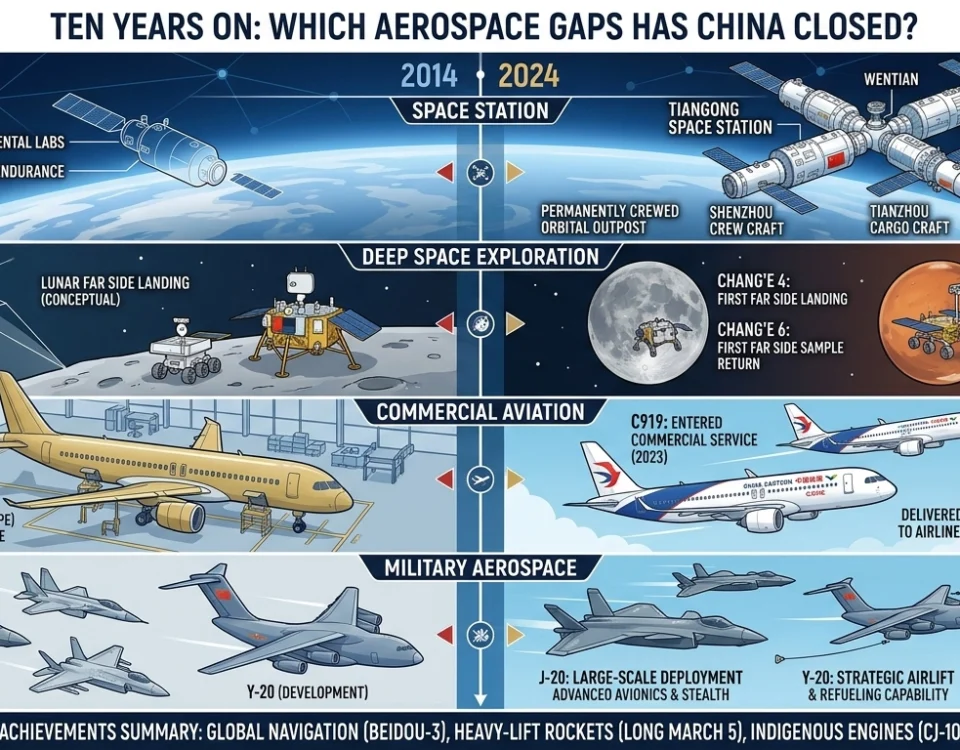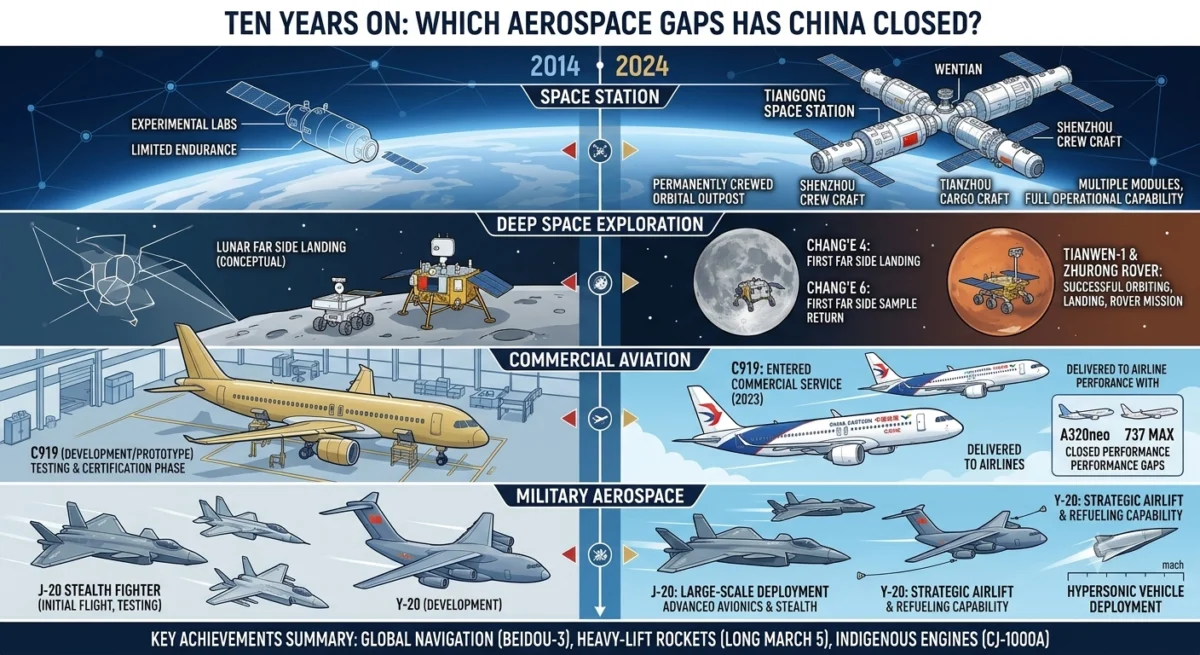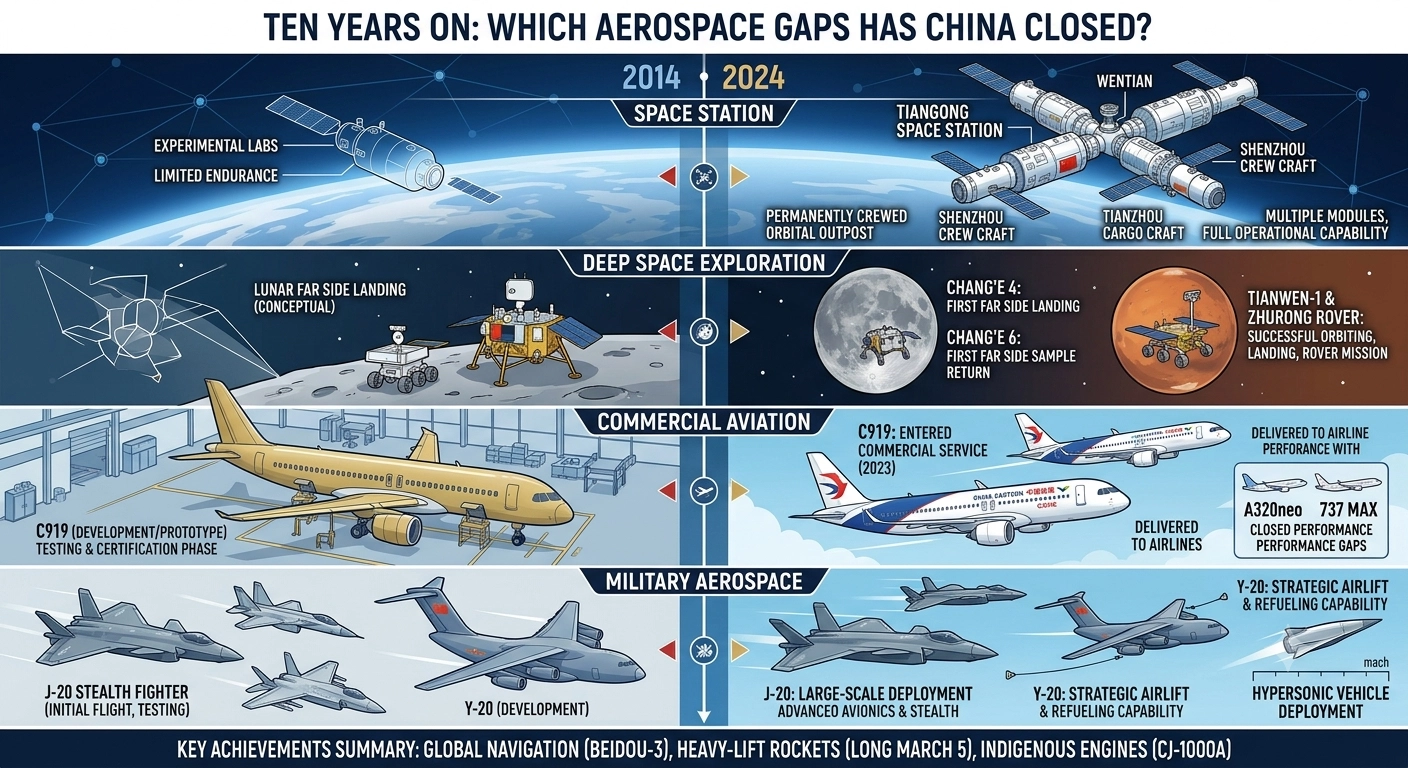
In 2015, PLA strategists listed the air and space technologies China lacked. A decade later, China has fielded most of them, but three gaps remain: advanced chips, a stealth bomber and proven missile defence.
Disclaimer: China’s government does not publish detailed, verifiable data on its military aerospace programmes, so Chinese official sources are not available to support the claims in this article. The main reference is the US Department of Defense’s annual report to Congress, Military and Security Developments Involving the People’s Republic of China (the “Pentagon report”), backed by independent satellite trackers, analysts and news reports. Where a claim rests only on a Chinese state announcement, it is marked as such. These are assessments, not confirmed facts, and they reflect the views of their authors. This article is the author’s personal analysis and does not represent the position of any government.
The 2015 blueprint
In 2015, a team led by Tian Anping, an Air Force professor at the PLA’s Air Force Engineering University, published China’s Aerospace Security Strategic Concept with the PLA’s own publishing house. The US Air University’s China Aerospace Studies Institute translated it into English in 2023.
The book was unusually frank about China’s weaknesses. It named these as the main technology gaps:
- Aircraft engines, which it called a long-standing “bottleneck” that China could not solve on its own.
- Advanced materials and key electronics, including high-end chips and chip manufacturing.
- An “incomplete” satellite network that was easy to spot, track and jam.
- Air defences too weak for stealth aircraft, hypersonic weapons and targets in near space (roughly 20–100 km up).
- Split management, with each service running its own programmes and no single command for air and space.
The book also set out a shopping list: hypersonic weapons, anti-satellite weapons, early-warning satellites, space planes, rapid launch, a stealth bomber, tankers and layered missile defence. The rest of this article checks that list against where China stands in late 2026.
Gaps China has closed
Most of the book’s weapons wish list is now in service, according to the Pentagon’s December 2025 report and independent trackers.
| 2015 gap or goal | Where China stands now |
| Hypersonic and near-space strike | The Pentagon says China has “the world’s leading hypersonic missile arsenal”, including the DF-17, YJ-21 and the DF-26 and DF-27 families. A weapon that goes partly into orbit before striking was at least partly shown in a 2021 test. |
| Anti-satellite weapons | The Pentagon judges that the PLA “almost certainly” plans to attack satellites from the ground and from space in a war with the US. It also reports a large stock of jammers and lasers that can blind satellites. |
| An “incomplete” satellite network | About 1,650 Chinese satellites are in orbit (October 2026), up from a few hundred in 2015. The Guowang and Qianfan networks have about 220–260 satellites each, with roughly 27,000 planned. China launched 93 times in 2025. |
| Missile early-warning satellites | Geostationary early-warning satellites (reported as Huoyan-1, launched 2017–2021) are believed to be in service. Analysts expect China to be able to launch on warning by about 2030. |
| A single air and space command | The PLA Aerospace Force was created on 19 April 2024 and reports directly to the Central Military Commission. It now runs military satellites and launch sites. |
| Tankers and heavy transport | The Y-20 transport and YY-20A tanker are in service and flew in the September 2025 Beijing parade. |
| Stealth fighters | The J-20 is in mass production. A sixth-generation prototype, the J-36, has been flying since December 2024. |
Gaps mostly closed
In four areas China has made real progress, but the evidence is partial or rests on Chinese claims.
| 2015 gap | Where China stands now |
| Aircraft engines (the book’s biggest worry) | The state engine maker AECC says the WS-15 is in serial production and “all technical bottlenecks” are solved (Chinese state claim). J-20s have flown with the WS-15 since 2023–24. How many aircraft use it, and how reliable it is, is unconfirmed. |
| Space plane | China’s Shenlong space plane began its fourth mission in February 2026; earlier flights lasted about 270 days. China says little about what it does. |
| Fast, cheap launch to replace lost satellites | China became the second country to recover an orbital rocket booster: Long March 10B in July 2026 (caught in a net at sea) and Zhuque-3 in August 2026 (landed on a pad). No booster has yet flown twice. |
| Refuelling and servicing satellites in orbit | In 2025, Shijian-25 appears to have docked with Shijian-21 in high orbit to test refuelling, which would be a world first. China has not confirmed it. The same skills could be used to approach and disable other satellites. |
Gaps still open
Three of the book’s gaps are clearly still open, and one more cannot be judged from public evidence.
| 2015 gap | Where China stands now |
| Advanced chips | SMIC’s newest “5 nm-class” process (in Huawei’s Kirin 9030) works out to about 6 nm in density, according to a March 2026 TechInsights teardown. Without access to EUV lithography, the most advanced chip-making machines, yields are low and costs high. This remains China’s clearest dependence on foreign technology. |
| Stealth bomber (H-20) | Ten years after it was announced, there is no confirmed first flight. China’s front-line bomber is still the H-6, based on a 1950s Soviet design. |
| Mid-course missile defence | China has tested ground-based interceptors that hit missiles above the atmosphere several times since 2010, and showed the HQ-29 at the 2025 parade. It has not shown that they can stop many incoming missiles at once. |
| Space-based interceptors and beam weapons | The book called for them, but there is no public evidence that any have been deployed. |
The softer gaps the book named, such as scientific talent, basic research and how defence money is spent, are hard to measure from outside. China’s official defence budget roughly doubled between 2015 and 2025, to about ¥1.78 trillion.
What it means fior democracies
The 2015 book read like a plan, and China has carried out most of it. Its chapters on deterrence and offensive operations now describe forces that exist.
- Protect satellites first. China now has satellites that can approach and dock with others, plus large numbers of jammers and lasers. Democracies need satellites that are harder to disable, more spares in orbit, and better tracking of what is near them.
- Fewer pressure points remain. China no longer depends on Russia or the West for fighter engines. The main pressure point left is advanced chips and the machines to make them, where allied export controls still matter.
- Watch the next milestones. A confirmed H-20 flight, a rocket booster flown twice, or a proven defence against many missiles at once would show China closing its last major gaps.
Sources
Primary reference (Pentagon)
- US Department of Defense, Military and Security Developments Involving the People’sRepublic of China 2025, December 2025
- Andrew Erickson, highlights of the 2025 Pentagon report
- Tian Anping, Zhang Jianye et al., China’s Aerospace Security Strategic Concept, PLA Press; English translation by the China Aerospace Studies Institute, January 2023
Supporting open sources
- Shenyang WS-15 – Wikipedia; Aviation Week on J-20 with WS-15
- 19FortyFive on the H-20 (2026)
- Tongxin Jishu Shiyan – WikipediaSpace.com on Shenlong’s fourth mission
- Breaking Defense on Shijian refuelling
- KeepTrack satellite count
- Zhuque-3 – Wikipedia; Caixin on booster recovery
- Defense News on the Aerospace Force
- Air & Space Forces Magazine on the 2025 parade
- SCMP on J-36 test flights
- Analysis of SMIC’s N+3 process
- Bulletin of the Atomic Scientists on China’s missile defence