Why a good story needs a stress test
The teardown story mostly holds up — but its sharpest claims are either overstated, mis-attributed, or worded so they cannot fail. That matters, because a narrative this clean is exactly the kind our minds accept too easily.
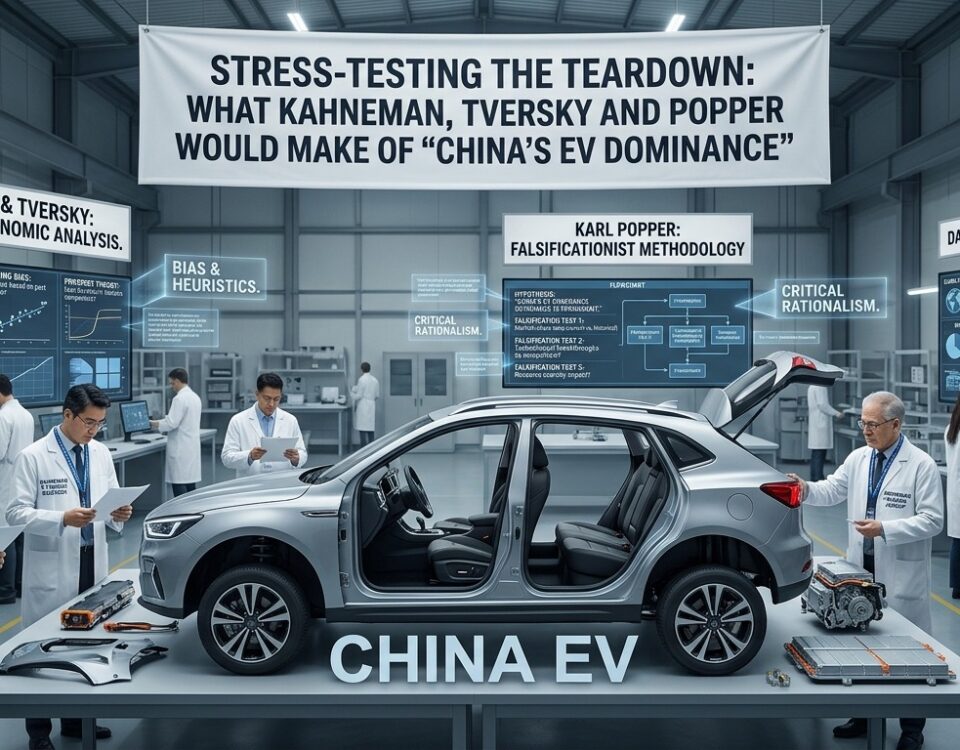
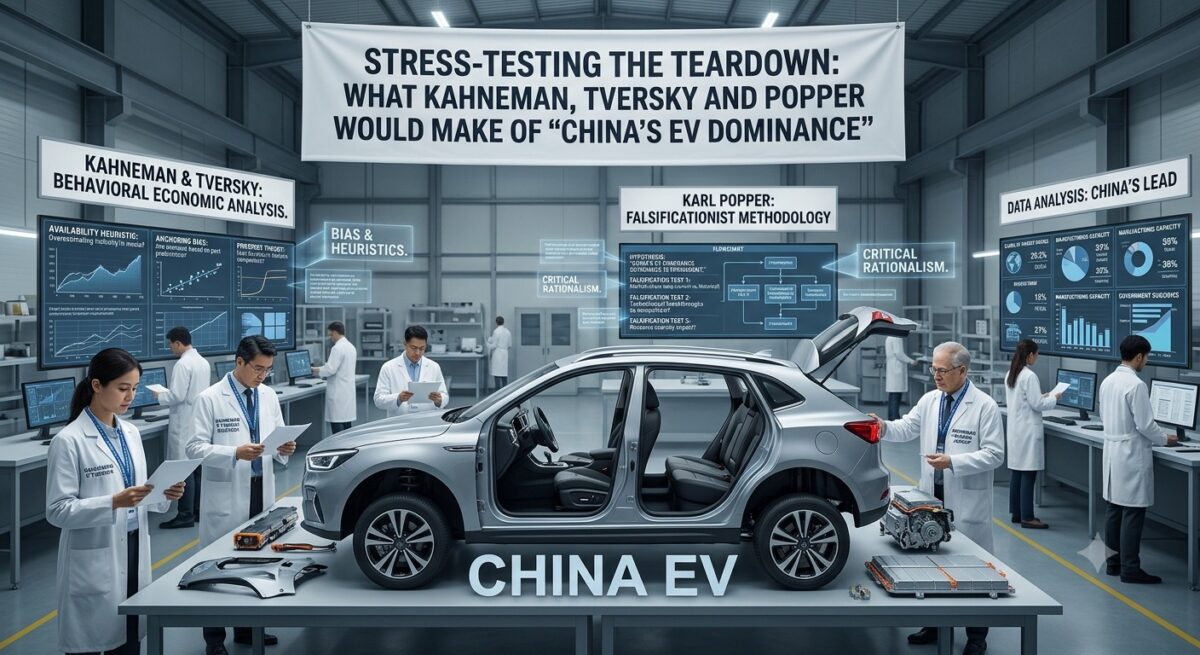
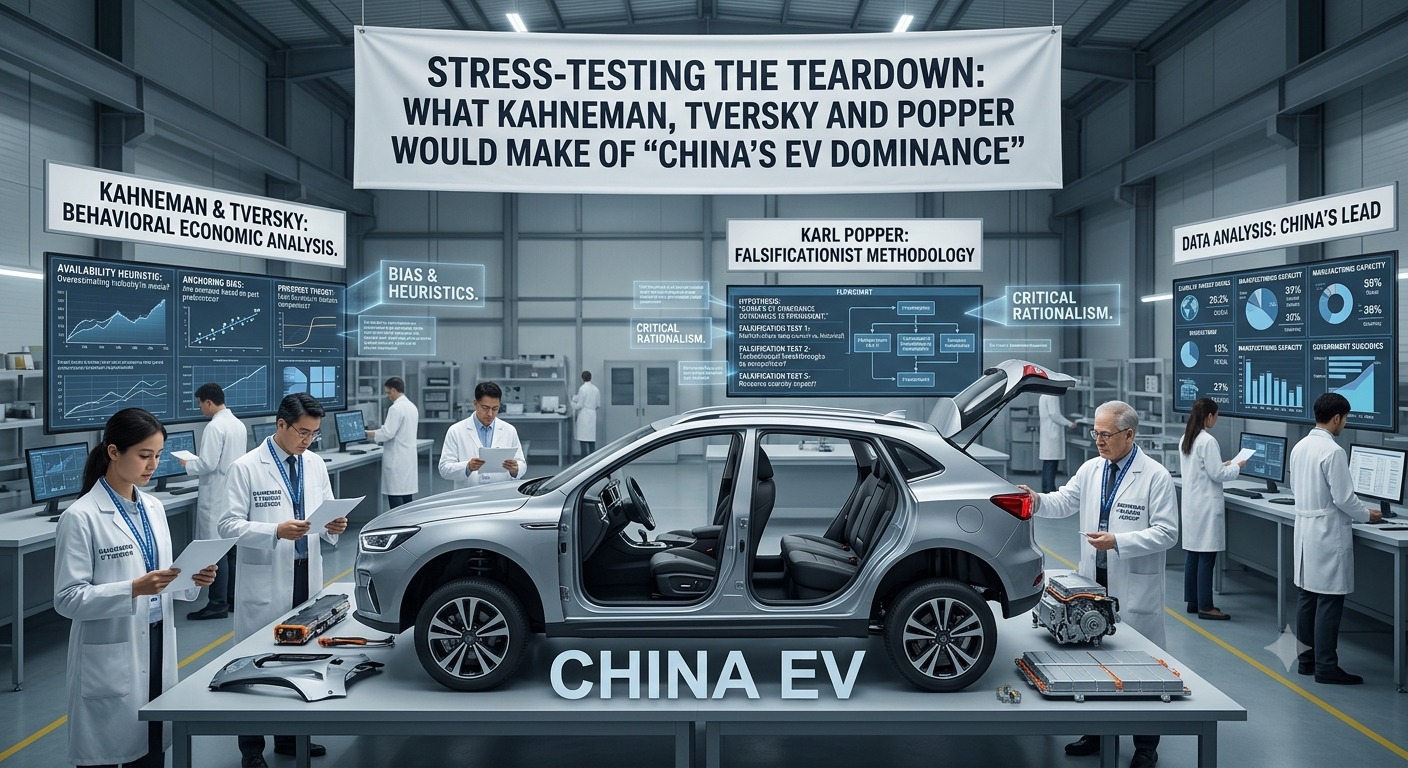
The 10 October article Stripped Bare: How the Nikkei BP Teardown Exposed China’s EV Dominance argues that BYD’s 25–35% cost lead comes from engineering — integration, structural packaging and supply-chain ownership — not from subsidies, cheap labour or currency. This follow-up puts that thesis on trial with two toolkits.
- Kahneman and Tversky ask: which mental shortcuts made the story feel truer than the evidence warrants?
- Karl Popper asks: what observation would prove each claim wrong — and has anyone looked?
A claim that survives a serious attempt to refute it earns trust. A claim that cannot be refuted earns none.
The claims on trial
The original article makes seven claims that can be checked against evidence outside the teardown itself.
C1 — Size of the gap. BYD builds EVs about 15% cheaper than Tesla and 25–35% cheaper than European or Japanese legacy makers.
C2 — Cause of the gap. The advantage comes from engineering and supply-chain structure, not subsidies; it is “not sustained solely by export subsidies.”
C3 — Vertical integration. Apart from glass and tyres, BYD makes nearly everything in-house.
C4 — 8-in-1 powertrain. Eight power and control units share one housing, cutting enclosures, cabling and assembly steps.
C5 — Cell-to-body. Blade (LFP) cells bond into the structure; the pack lid is the cabin floor, saving mass and cost.
C6 — Commonality. The same silicon and actuators run in the premium Seal and the budget Dolphin.
C7 — Trade-offs. Nikkei BP’s analysis “confirmed” repairability, insurance and serviceability penalties
Lens 1: Kahneman and Tversky — why the story feels truer than it is
The biggest bias is substitution: the article answers “how is the car built?” and presents it as the answer to “why is the car cheaper?” Those are different questions. A sticker price reflects cost, financing, input prices, subsidies and margin strategy; a teardown can only see the first.
Kahneman and Tversky showed that System 1 — fast, intuitive thinking — judges a story by its coherence, not by the quality or completeness of its evidence. Seven of their findings map directly onto the piece.
| Bias | Where it shows up | Corrective question |
| Substitution | “How is it engineered?” answers “why is it cheaper?” | What else sits between unit cost and retail price? |
| WYSIATI (what you see is all there is) | A teardown reveals parts, not grants, cheap loans or subsidised steel and cells — yet the article says the physical evidence points elsewhere than subsidies | What could this method never detect? |
| Bias | Where it shows up | Corrective question |
| Narrative fallacy | A tidy arc: engineering genius beats complacent incumbents | Would the story still feel complete if one cause were removed? |
| Halo / authority | Nikkei BP’s prestige carries the insurance and write-off claims, attributed to Nikkei without a citation | Who actually said this, and where? |
| Anchoring | “25% to 35%” plants 35% in the reader’s mind | What is the central estimate, and versus which rival? |
| Base-rate neglect | Write-offs from structural packs are framed as a BYD trait | How often does this happen to every EV with a structural pack? |
| Framing as either/or | “Engineering, not subsidies” | Could both be true at once — and in what proportion? |
None of this makes the article wrong. It means the reader’s confidence was set by the story’s fluency, and needs resetting against evidence.
Lens 2: Popper — trying to break each claim
Of seven claims, two are corroborated, three survive in weaker form, one is mis-attributed and one is untested. Popper’s rule is simple: state what observation would refute a claim, then go looking for it. Claims that dodge every possible refutation are not strong — they are empty.
| Claim | What would falsify it | What the evidence shows | Verdict |
| C1 Size of the gap | Independent cost models finding a gap well under 25% | UBS’s 2023 Seal teardown: about 15% cheaper than a China-built Model 3 and a lasting ~25% edge over legacy makers even after tariffs. The “more than 30%” figure was against one car, the VW ID.3. | Corroborated at ~25%; 35% is a ceiling, not a centre |
| C2 Not subsidies | Subsidies large enough to explain most of the gap | Kiel Institute: direct aid to BYD rose from €220m (2020) to €2.1bn (2022), 1.1% to 3.5% of revenue — plus indirect help via cheaper battery inputs and buyer incentives. | Survives for direct aid; indirect effects untested. “Not solely” cannot fail as worded |
| C3 Nearly all in-house | A teardown finding a large share of bought-in parts | UBS found 75% of Seal components made in-house — about double the global average — with some chips from Qualcomm. | Falsified as worded; direction corroborated |
| C4 8-in-1 powertrain | Discrete units and long harnesses found in the car | Nikkei BP flagged BYD’s centralised control electronics as industry-leading and found in-house power modules comparable to Infineon’s. | Corroborated; cost saving not quantified |
| C5 Cell-to-body | Pack built as a separate bolted module | Nikkei highlighted the Blade battery’s structural integration. Mass and stiffness gains are BYD’s figures, not measured here. | Structure corroborated; benefits untested |
| C6 Seal–Dolphin commonality | Different part numbers on shared functions | No public source found for identical silicon across both models. | Untested |
| C7 Nikkei “confirmed” trade-offs | No such finding in Nikkei’s work | No Nikkei source found for insurance or write-off claims. Structural-pack write-offs were flagged across EVs, Tesla first; BYD partnered Thatcham Research on repairability in Dec 2025. | Mis-attributed; risk is real but industry-wide |
C2 deserves the closest look. “Not sustained solely by subsidies” is safe because almost nothing has a single cause — so it tells us little. The bold, testable version is: strip out subsidies and BYD still holds a double-digit cost lead. On direct aid that version passes: 3.5% of revenue cannot close a 25% gap. On indirect support — subsidised cells, steel and cheap capital — nobody has run the test yet.
What survives
The core survives refutation: BYD holds a roughly 25% structural cost edge over legacy makers, driven mainly by vertical integration, in-house batteries and power electronics, and integrated architecture. Direct subsidies are real but too small to explain it.
A more honest version of the original thesis would read:
| BYD’s cost lead is about 25% versus legacy rivals and 15% versus Tesla. Most of it comes from making three-quarters of the car in-house and integrating batteries and electronics into fewer, larger units. State support — direct and indirect — adds to it, by an amount no teardown can measure. |
That sentence is less thrilling. It is also harder to knock down, which is the point.
What engineering teams should take from it
Copy the corroborated architecture, but engineer out its failure modes before you ship it. Integration moves cost out of the bill of materials and into new risks: one fault takes out more function, one crash damages more structure, one shared part fails across more models.
Those risks are the input to the Design FMEA in the Appendix, which covers six areas drawn only from claims that survived the tests above: the integrated power unit (C4), the cell-to-body pack (C5), LFP cells (C5), shared components (C6, treated as a design choice to test), in-house power semiconductors (C3, C4) and compressed development cycles. Unverified claims, such as Nikkei-attributed insurance findings, were used only as general industry risks, not as BYD-specific facts.
Appendix — Design FMEA: Integrated EV Architecture
20 failure modes. RPN = Severity × Occurrence × Detection (each rated 1–10). Action Priority is a simplified screen inspired by AIAG-VDA: severity first, then occurrence, then detection. Ratings are illustrative starting values for a cross-functional team to calibrate against its own test, field and warranty data. Any Severity 9–10 item needs an action regardless of RPN.
| ID | System / Item | Failure Mode | Effect | S | Cause | O | Current Controls (Prevention / Detection) |
D | RPN | AP | Recommended Action | Basis |
|---|---|---|---|---|---|---|---|---|---|---|---|---|
| DF-01 | Integrated power unit (8-in-1) | Power module over-temperature during combined high load and DC fast charge | Torque derating, loss of propulsion at speed | 8 | Shared heat sink/coolant loop sized for average, not coincident, heat loads | 4 | P: Thermal simulation of single-load cases D: Coolant and junction temperature sensors with derate logic |
4 | 128 | Medium | Model coincident worst-case loads (hill climb + hot soak + fast charge); size coolant flow for combined case; add junction-temperature estimator test on HIL | C4 (corroborated) |
| DF-02 | Integrated power unit (8-in-1) | Fault in OBC or DC-DC section disables whole integrated unit | Vehicle immobilised; customer stranded | 7 | Shared control board and power rails; no fault isolation between sub-functions | 4 | P: Design review of shared rails D: Diagnostic trouble codes at fault |
5 | 140 | Medium | Partition supply rails and add fault containment so a charging-section fault does not drop traction; define limp-home mode | C4 (corroborated) |
| DF-03 | Integrated power unit (8-in-1) | Isolated sub-function fault requires full unit replacement | High warranty cost, long downtime, poor TCO | 5 | Single sealed casting; sub-functions not field-replaceable | 5 | P: None specific D: Workshop diagnostics |
3 | 75 | Low | Design field-replaceable sub-modules (OBC, DC-DC boards) with service access; publish repair procedure and parts list | C4 trade-off (industry risk) |
| DF-04 | Integrated power unit (8-in-1) | EMI couples into co-located VCU/BMS signal lines | Corrupted sensor data, false faults, unintended torque request | 9 | Close physical proximity of HV switching and LV control boards in one housing | 3 | P: EMC design rules D: Component-level EMC test (CISPR 25 / ISO 11452) |
5 | 135 | Medium | Add vehicle-level EMC test at full integrated load; plausibility checks on torque path; ISO 26262 safety analysis of torque function | C4 (corroborated) |
| DF-05 | Integrated power unit (8-in-1) | Coolant leak into electronics compartment | Loss of isolation, HV shutdown, shock hazard | 10 | Coolant channels adjacent to HV boards; seal degradation | 2 | P: Seal material qualification D: Isolation monitoring device |
4 | 80 | Medium | Physically separate coolant and electronics zones; add leak-path drain; pressure-decay test at end of line | C4 (corroborated) |
| DF-06 | Cell-to-body pack | Floor/pack deformation intrudes into cell volume | Cell short circuit, thermal runaway after crash | 10 | Pack lid doubles as floor, reducing the separate crush zone | 3 | P: Crash CAE; sill and cross-member design D: Full-vehicle crash tests (pole, side, underbody) |
3 | 90 | Medium | Add underbody impact and pole tests at worst cell positions; verify minimum cell-to-sill clearance; post-crash HV disconnect validation | C5 (corroborated) |
| DF-07 | Cell-to-body pack | Minor kerb/debris strike damages pack lid with hidden cell damage | Latent thermal risk or insurance write-off of repairable car | 9 | No access to inspect cells; no damage-assessment data for third parties | 4 | P: Underbody shield D: Visual inspection only |
6 | 216 | High | Add impact-detection sensing or post-event cell health check; provide insurer/repairer diagnostic data access and assessment procedure | C5 + C7 (risk is industry-wide) |
| DF-08 | Cell-to-body pack | Leak at floor-to-pack bonded interface | Water in pack (isolation fault) or cabin | 8 | Bond-line voids; sealant ageing; body flex | 3 | P: Sealant spec and bead control D: Water-wade and IP67 tests at component level |
4 | 96 | Low | Add vehicle-level wading and pressure-wash tests after durability ageing; in-line bead vision inspection | C5 (corroborated) |
| DF-09 | Cell-to-body pack | Structural adhesive degrades under thermal and humidity cycling | Loss of torsional stiffness, NVH, cell movement | 7 | Adhesive not validated for combined thermal-humidity-fatigue | 3 | P: Adhesive datasheet D: Coupon tests |
6 | 126 | Medium | Run combined thermal-humidity-fatigue ageing on full body-in-white; stiffness check before and after | C5 (benefit untested) |
| ID | System / Item | Failure Mode | Effect | S | Cause | O | Current Controls (Prevention / Detection) |
D | RPN | AP | Recommended Action | Basis |
|---|---|---|---|---|---|---|---|---|---|---|---|---|
| DF-10 | Cell-to-body pack | Thermal event in pack reaches cabin through floor-lid | Occupant injury; insufficient escape time | 10 | Reduced barrier between cells and cabin | 2 | P: Fire-resistant materials; LFP chemistry D: Propagation test per GB 38031 / UN GTR 20 |
5 | 100 | Medium | Verify escape time with margin under worst-case trigger cell; add thermal barrier layer under carpet/floor trim | C5 (corroborated) |
| DF-11 | Cell-to-body pack | Pack cannot be separated from body for repair | Total loss of vehicles with repairable damage; higher premiums | 6 | Cell-to-body construction; no repair method defined | 5 | P: None specific D: Repair cost estimates at launch |
3 | 90 | Low | Define repair methods and sectioning points with insurer research bodies; design bolted replaceable sill and floor sections | C7 (industry-wide, mis-attributed in article) |
| DF-12 | LFP prismatic (blade-type) cells | SOC estimate drifts on flat LFP voltage curve | Unexpected range loss; stranded driver | 6 | Flat open-circuit voltage curve over mid-SOC range | 6 | P: Coulomb counting D: Periodic full-charge recalibration |
5 | 180 | Medium | Add model-based SOC estimation with drift bounds; prompt periodic full charge; validate range error across temperature | C5 (LFP corroborated) |
| DF-13 | LFP prismatic (blade-type) cells | Low-temperature capacity loss and lithium plating during cold fast charge | Reduced range, accelerated degradation | 7 | LFP low-temperature kinetics | 5 | P: Pack heating D: Cold-chamber tests |
4 | 140 | Low | Pre-condition pack before fast charge; limit charge current by cell temperature; validate at -20 C and -30 C | C5 (LFP corroborated) |
| DF-14 | Shared components across models | Design defect in a shared control board or valve | Multi-model, fleet-wide recall | 8 | One part number across many models and volumes | 3 | P: Design review D: Warranty monitoring |
5 | 120 | Medium | Raise validation level for shared parts to the most demanding model; early field-data monitoring across all platforms | C6 (untested; treat as design choice) |
| DF-15 | Shared components across models | Part sized for budget model under-rated for premium model loads | Premature wear-out on higher-power model | 7 | Shared spec derived from lowest-cost application | 4 | P: Spec review D: Durability tests on lead model only |
5 | 140 | Medium | Validate shared parts against the worst duty cycle of every model that uses them | C6 (untested; treat as design choice) |
| DF-16 | In-house power semiconductors / power module | Wire-bond or solder fatigue in power module | Inverter failure; loss of propulsion | 8 | Power-cycling thermal stress; new in-house process | 4 | P: AQG 324 qualification D: Power-cycling tests |
5 | 160 | Medium | Extend power-cycling tests to mission profile with margin; add on-board degradation monitoring (Vce / Rds-on drift) | C3, C4 (corroborated) |
| DF-17 | In-house power semiconductors / power module | Process excursion at single in-house fab affects all vehicles | Production stop or latent field defect across fleet | 7 | No second source for power modules | 3 | P: Process control plan D: Lot sampling |
6 | 126 | Medium | Lot traceability to VIN; qualify second source or dual line; tighten SPC on critical parameters | C3 (corroborated in direction) |
| DF-18 | Development & software process | Compressed design and production validation cuts test hours | Field failures that testing would have caught | 8 | 18-24 month programme timing | 5 | P: Accelerated test plans D: Gate reviews |
6 | 240 | High | Define minimum validation content that timing cannot cut; use field-data feedback loops and staged launch volumes | Article claim (industry reporting) |
| DF-19 | Development & software process | Over-the-air update causes regression in consolidated VCU/BMS controller | Loss of function or wrong battery limits across fleet | 8 | More functions in one controller; fast release cadence | 4 | P: Code review D: Software regression tests |
5 | 160 | Medium | HIL regression of full integrated controller before every release; staged OTA roll-out with rollback | C4 + development cadence |
| DF-20 | Integrated power unit (8-in-1) | Fretting/corrosion at fewer, higher-current connector interfaces | Hot joint, arcing, power loss | 7 | Vibration and thermal cycling at consolidated interfaces | 3 | P: Connector spec D: Vibration test |
5 | 105 | Medium | Add contact-resistance monitoring in durability tests; specify plating and locking for vibration profile | C4 (harness reduction) |
Summary
| Failure modes | High priority | Medium priority | Low priority | Severity 9–10 | Highest RPN |
| 20 | 2 | 14 | 4 | 5 | 240 (DF-18) |
Rating scales
| Rating | Severity (S) | Occurrence (O) | Detection (D) |
| 10 | Affects safe operation or regulatory compliance without warning (e.g. fire, loss of HV isolation) | Very high: new technology, no history; failure almost inevitable | Cannot detect / no test or control |
| 9 | Affects safety or compliance with warning | Very high | Very remote chance of detection |
| 8 | Loss of primary function (vehicle cannot drive) | High: repeated failures on similar designs | Remote |
| 7 | Degraded primary function (derated power, large range loss) | High | Very low |
| 6 | Loss of secondary function (comfort, convenience) | Moderate: occasional failures on similar designs | Low |
| 5 | Degraded secondary function; costly repair | Moderate | Moderate |
| 4 | Noticeable by most customers (noise, appearance) | Moderate-low | Moderately high |
| 3 | Noticeable by many customers | Low: isolated failures on similar designs | High |
| 2 | Noticeable by discerning customers | Very low | Very high |
| 1 | No discernible effect | Remote: failure eliminated by design | Almost certain detection (proven, automated) |
Generic scales for illustration. Use your organisation’s approved AIAG-VDA or internal tables for formal FMEAs.
Input validity: which article claims fed the FMEA
| Claim | Article statement | Evidence status | Used in FMEA as |
| C1 | BYD ~15% cheaper than Tesla, 25-35% below legacy makers | Corroborated at ~25% vs legacy; >30% was vs VW ID.3 only | Context only |
| C2 | Advantage is engineering, not subsidies | Direct subsidies 1.1-3.5% of BYD revenue (2020-22); indirect effects unmeasured | Not used (not a design input) |
| C3 | BYD makes nearly everything except glass and tyres | Overstated: ~75% of Seal components in-house | In-house semiconductor rows |
| C4 | 8-in-1 integrated power unit | Corroborated: centralised electronics and in-house power modules noted by Nikkei BP | Power-unit rows |
| C5 | Cell-to-body with Blade LFP cells | Structure corroborated; mass/stiffness benefits untested | Structural pack and LFP rows |
| C6 | Identical silicon in Seal and Dolphin | Untested; no public source found | Generic design-choice risk |
| C7 | Nikkei BP confirmed repair/insurance penalties | Mis-attributed; risk is real across structural-pack EVs | Generic industry risk only |
Sources
UBS — Will Chinese EVs win globally? (BYD Seal teardown) https://www.ubs.com/global/en/investment-bank/in-focus/2023/byd-teardown.html
Bloomberg via NADA — Rise of China’s EV makers threatens Western firms, UBS says https://nada.org/nada/nada-headlines/rise-chinas-ev-makers-threatens-western-firms-ubs-says-bloomberg
The Edge Malaysia — UBS teardown: 75% of Seal components made in-house https://ceomorningbrief.theedgemalaysia.com/article/2023/0631/World/15/681398
Yicai — BYD Seal cost edge over European EVs
Electrek — Kiel Institute: BYD received $3.7bn in direct subsidies https://electrek.co/2024/04/12/china-gave-byd-an-incredible-3-7-billion-to-win-the-ev-race/
Carscoops — Kiel Institute subsidy figures as share of revenue https://www.carscoops.com/?p=2991721
Notebookcheck — Nikkei BP tears down the BYD Seal
MyDrivers — Nikkei BP and Nagoya University on Seal power electronics https://news.mydrivers.com/1/947/947057.htm
Malay Mail / Reuters — Structural EV packs and insurance write-offs https://www.malaymail.com/news/life/2023/03/20/scratched-ev-battery-your-insurer-may-have-to-junk-the-whole-car/60642
Fleet World — BYD and Thatcham Research repairability partnership https://fleetworld.co.uk/byd-prioritises-repairability-to-lower-tco-costs-for-evs/
Kahneman, D. Thinking, Fast and Slow (2011); Tversky, A. & Kahneman, D. “Judgment under Uncertainty: Heuristics and Biases,” Science (1974).
Popper, K. The Logic of Scientific Discovery (1959); Conjectures and Refutations (1963).