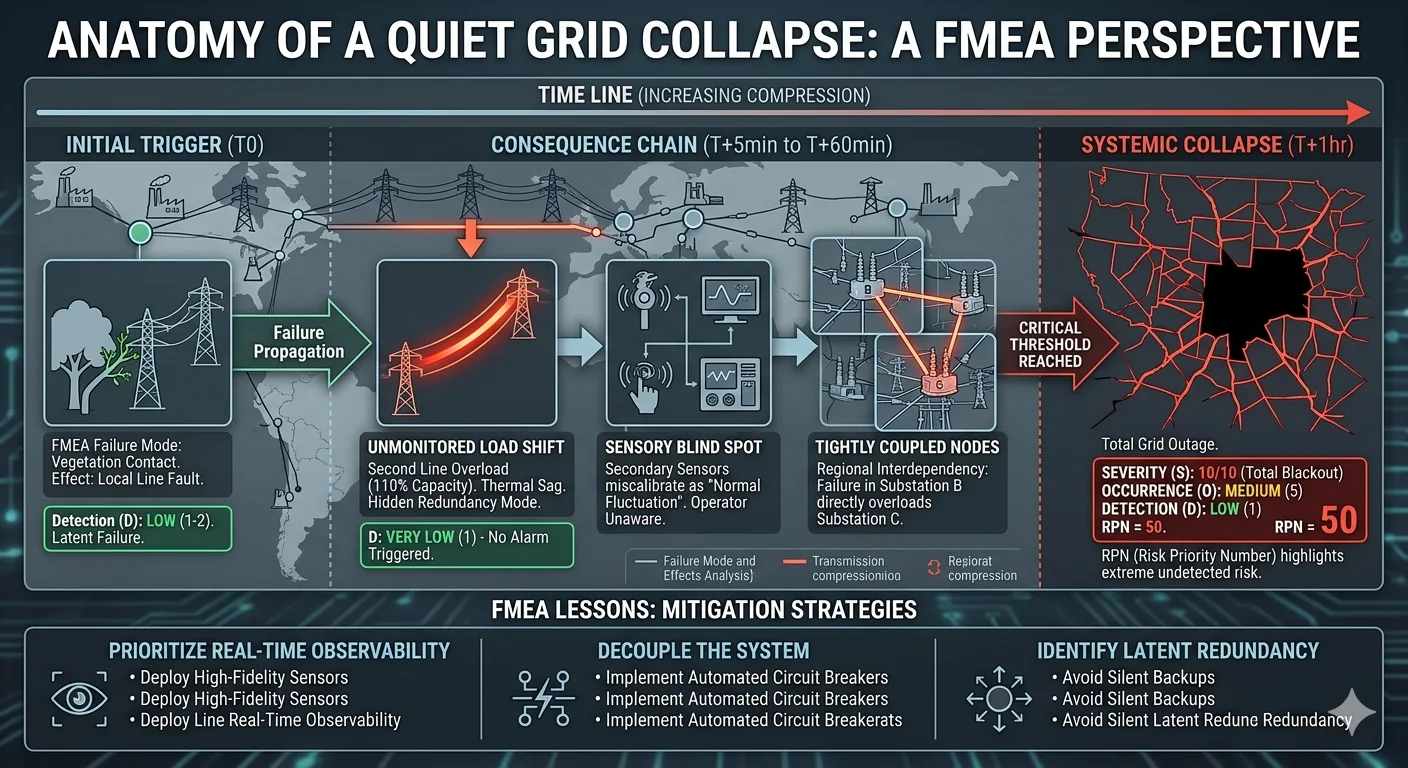
One year after the Iberian power disturbance, most discussions still revolve around what happened.
Very few ask the more important question:
Why did the system allow it to happen?
Because large-scale failures rarely come from a single fault.
They emerge from unseen interactions, weak signals, and unclosed risks—exactly the kind of patterns FMEA is designed to uncover.
The Hidden Nature of Modern Grid Failures
Today’s power systems are no longer simple, linear, and predictable.
They are:
- Converter-dominated
- Highly dynamic
- Dependent on real-time control
- Sensitive to harmonic and reactive power interactions
This means failures don’t always start as “events.”
They start as:
- Small oscillations
- Poor damping
- Reactive power imbalance
- Control interactions at specific frequencies
Left unmanaged, these evolve into instability.
The Missed Link: Where FMEA Thinking Should Have Acted
If we apply an FMEA lens, the critical gaps become visible:
1. Failure Modes Were Known — But Not Operationalized
Instabilities due to impedance interaction, harmonics, and weak grid conditions are not new.
But were they:
- Translated into clear detection methods?
- Linked to real-time thresholds?
- Connected to defined reaction plans?
In many cases, no.
2. Detection Was Present — But Not Actionable
Modern grids generate massive amounts of real-time data.
Yet:
- Monitoring systems remained observational, not decisional
- Operators lacked clear triggers
- No defined “IF → THEN” response logic existed
This is a classic FMEA gap:
Detection without reaction is not control.
3. Reactive Power Was Not Actively Controlled
Reactive power is often treated as a background parameter.
But in reality, it is a stability driver.
Without structured control:
- Voltage instability increases
- Oscillation damping reduces
- System sensitivity to disturbances rises
An FMEA-driven system would define:
- Critical reactive power limits
- Early warning indicators
- Immediate corrective actions (VAR support, inverter control adjustments, load balancing)
Without this, deviation becomes escalation.
4. Reaction Plans Were Not System-Level
Even where local controls existed, system-wide coordination was weak.
Key questions were unanswered:
- Who acts when thresholds are breached?
- How fast must action occur?
- What is the containment strategy?
In FMEA terms:
The reaction plan was incomplete, delayed, or undefined.
The Real Lesson: Monitoring ≠ Control
Many systems assume that visibility equals safety.
It doesn’t.
Unless monitoring is:
- Integrated into decision logic
- Linked to thresholds
- Supported by predefined actions
…it remains passive.
And passive systems fail under dynamic conditions.
Making Real-Time Systems “Alive” Through FMEA
To prevent future failures, monitoring must evolve into a living control system.
An FMEA-structured approach would ensure:
🔹 Clear Failure Definition
- Oscillatory instability
- Reactive power imbalance
- Harmonic amplification
🔹 Defined Detection Mechanisms
- Frequency-specific oscillation monitoring
- Reactive power deviation thresholds
- Impedance interaction indicators
🔹 Actionable Reaction Plans
- Automatic inverter tuning (e.g., virtual impedance adjustment)
- Fast VAR compensation
- Controlled load shedding or redistribution
🔹 Continuous Feedback Loop
- Events update the FMEA
- Controls evolve with system behavior
- Learnings are institutionalized
The Bigger Shift: From Static Analysis to Dynamic Risk Management
Traditional FMEA was built for:
- Components
- Processes
- Static systems
But modern grids demand:
- Dynamic FMEA thinking
- Continuous updates
- Real-time integration with control systems
Because in these environments:
Risk is not a snapshot. It is a moving target.
Final Thought
The Iberian disturbance was not just a technical failure.
It was a system thinking failure.
Not because risks were unknown—
but because they were not structured, connected, and acted upon in time.
FMEA, when treated as a living system, does more than document risk.
It ensures that when deviation begins—
the system already knows what to do.
A Question to Reflect
In your system today:
Are you monitoring stability…
or are you actively controlling it through defined risk-response logic?
Because in complex systems—
Delay is instability.
And instability is expensive.
📚 References
- European Network of Transmission System Operators for Electricity (ENTSO-E).
“System Disturbance Report – Continental Europe Synchronous Area (Iberian Incident Analysis).”
ENTSO-E, 2024.
(Covers root-cause analysis and system behavior during the Iberian disturbance) - International Energy Agency (IEA).
“Grid Integration of Variable Renewables: Power System Flexibility.”
Paris: IEA Publications, 2023.
(Discusses challenges of integrating inverter-based renewable energy sources) - CIGRÉ Working Group C4.49.
“Power System Stability with Inverter-Based Resources.”
CIGRÉ Technical Brochure, 2020.
(Detailed technical insights on stability challenges in converter-dominated grids) - IEEE Power & Energy Society.
“Impact of Inverter-Based Resources on Power System Dynamics.”
IEEE PES Reports, 2022.
(Explains harmonic interactions, impedance behavior, and control dynamics) - Kundur, Prabha.
Power System Stability and Control.
McGraw-Hill, 1994.
(Foundational reference on stability concepts, still widely applicable) - AIAG & VDA.
“Failure Mode and Effects Analysis (FMEA) Handbook.”
1st Edition, Automotive Industry Action Group & Verband der Automobilindustrie, 2019.
(Framework for structured risk identification, detection, and reaction planning) - IEC 62933 Series.
“Electrical Energy Storage (EES) Systems – Safety and Performance Standards.”
International Electrotechnical Commission, latest editions.
(Relevant for storage systems and grid interaction safety) - National Renewable Energy Laboratory (NREL).
“Grid-Forming Inverters: A Critical Asset for the Future Grid.”
NREL Technical Report, 2023.
(Covers grid-forming control and stability improvements) - Middlebrook, R. D.
“Input Filter Considerations in Design and Application of Switching Regulators.”
IEEE Industry Applications Society, 1976.
(Foundational work on impedance-based stability—basis for modern inverter interaction analysis) - Chaspière, Gilles.
“One Year On: What Caused the Iberian Power Disturbance?”
Substack, 2025.
(Narrative and analytical perspective on the Iberian grid event)