India’s electric vehicle (EV) transition is often framed as a success story of policy ambition, capital deployment, and accelerating adoption. But beneath the headline numbers lies a structural gap that threatens to slow the transition at scale:
the disconnect between EV charging infrastructure plans and the underlying grid readiness—especially along highway corridors.
A recent analysis by Deepak Chandran highlights a critical truth: the EV charging gap is not a failure of intent or funding—it is a failure of program design that overlooked the role of distribution utilities (DISCOMs). (LinkedIn)
The Commitment vs Reality Gap
India’s EV charging ambitions have been bold. Under schemes like PM E-DRIVE, the country committed to deploying over 72,000 fast chargers by March 2026.
But actual delivery tells a different story.
- Only around 10,000 fast chargers were deployed by the deadline
- That’s roughly 14% of the target achieved
- Most installations are concentrated in urban clusters, not highways (LinkedIn)
This mismatch is not trivial. It fundamentally limits intercity EV mobility, where reliable highway charging is essential.
Interestingly, while some data suggests highway charger counts have grown significantly in certain corridors, the network remains uneven and incomplete in terms of reliable coverage and grid support. (mint)
The Core Problem: Charging Was Planned, the Grid Was Assumed
The most important insight from the article is deceptively simple:
EV charging programs were designed as transportation initiatives.
The grid was treated as someone else’s problem.
In practice, this has led to a systemic misalignment:
- Charging stations can be procured and installed within weeks
- Grid connections (transformers, feeders, interconnections) can take months to years
- These two timelines were never aligned in policy design
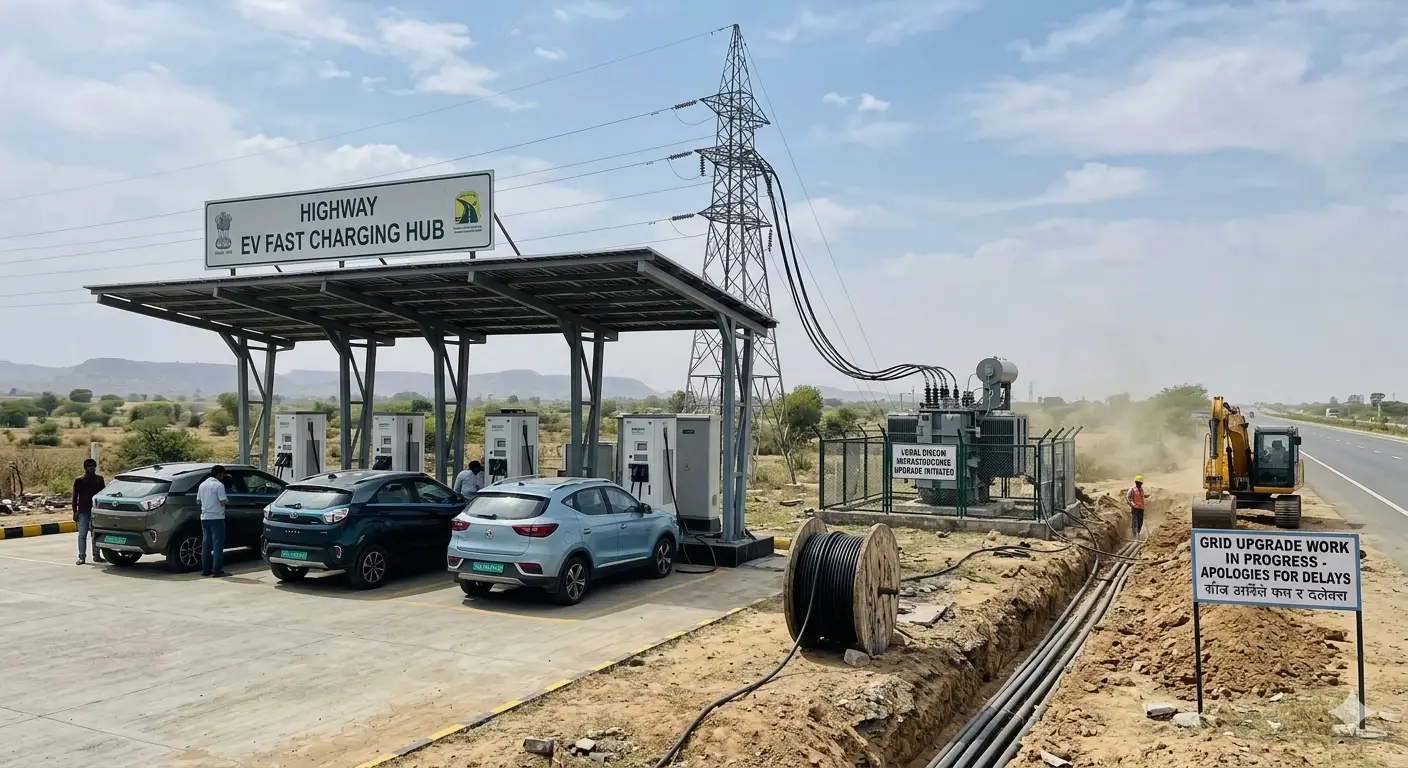
As a result, projects that are technically ready remain non-operational, waiting for DISCOM approvals, transformer availability, or local grid upgrades. (LinkedIn)
Why Highways Are the Weakest Link
Urban charging works because the grid already exists. Highways are a completely different problem.
Key challenges include:
- No existing medium/low-voltage infrastructure in many highway locations
- Limited transformer capacity to support high-power DC fast charging
- Lack of standardized DISCOM processes across states
- Poor grid reliability and response times outside cities (The Financial Express)
In India, a charging operator identifying a perfect highway site (say on NH44 or NH48) may find:
- Land available
- Demand viable
- Charger hardware ready
But no viable grid connection.
This creates a paradox:
The charger is the easiest part of the project. The grid is the hardest.
DISCOMs: The Missing Center of EV Policy
At the heart of the issue lies a structural gap:
DISCOMs are not integrated into EV charging programs as primary stakeholders.
Instead, they operate as:
- Approval authorities
- Infrastructure providers
- Independent entities with separate timelines and incentives
This creates fragmentation:
| Stake Holder | Objective | Timeline |
| Transport policy | Deploy chargers | Fast |
| Charging operators | Install hardware | Weeks |
| DISCOMs | Provide grid connection | Weeks |
Without coordination, execution breaks down at the interfaces.
The Infrastructure Reality: Scale ≠ Usability
Even beyond deployment gaps, India’s charging ecosystem faces a deeper issue:
availability does not equal reliability.
- Public charging stations grew from ~5,000 (2022) to 29,000+ by 2025
- Yet real-world usability remains inconsistent
- Many chargers are non-functional, unavailable, or underpowered (Exicom)
Similarly, the broader ecosystem shows:
- Only 1 charger per ~235 EVs
- Significant grid limitations in Tier-2/3 cities
- Up to 60% of proposed sites rejected due to grid constraints (LinkedIn)
This reinforces the core argument:
the bottleneck is not charger supply—it is system readiness.
Why This Is a Design Problem, Not a Technology Problem
One of the most compelling points in the LinkedIn article is that:
“The charging hardware is not the problem. It never was.” (LinkedIn)
The real issue lies in how programs are structured:
1. Split Budgets
Charging hardware and grid infrastructure are funded separately.
2. Misaligned Timelines
Policy assumes simultaneous delivery—but execution is sequential and uncoordinated.
3. Institutional Silos
Transport ministries, energy departments, and DISCOMs operate independently.
4. No Grid-First Planning
Deployment is driven by geography and demand—not grid readiness.
What Needs to Change: A Grid-First EV Strategy
The solution is not more subsidies or more chargers.
It is better system design.
1. Plan Charging Around Grid Readiness
- Prioritize locations where grid capacity exists
- Phase expansion based on infrastructure maturity, not geography
2. Integrate DISCOMs into Policy Design
- Make utilities co-owners of EV programs
- Align incentives, timelines, and accountability
3. Fund Grid Infrastructure Explicitly
- Include transformers, feeders, and interconnections in program budgets
- Treat grid upgrades as core infrastructure, not external dependencies
4. Adopt Corridor-Based Infrastructure Planning
- Develop “power-ready highway corridors”
- Pre-build grid capacity before charger deployment
5. Build Coordinated Execution Frameworks
- Single-window clearances
- Standardized interconnection timelines
- Cross-agency coordination mechanisms
A Broader Lesson for the Energy Transition
The DISCOM–charging gap is not just an EV problem.
It is a template for what can go wrong in the energy transition.
We are increasingly seeing a pattern:
- Renewable energy → grid bottlenecks
- EV charging → distribution bottlenecks
- HVDC systems → weak-grid constraints
Across sectors, the lesson is the same:
Infrastructure transitions fail when system dependencies are treated as assumptions instead of design constraints.
Conclusion: The Map Was Drawn. The Grid Was Not Built.
India’s EV transition is real, funded, and accelerating.
But without solving the DISCOM–charging gap, it risks hitting a structural ceiling—especially for long-distance mobility.
The next phase of EV infrastructure must move:
- From charger-first → grid-first planning
- From deployment metrics → operational readiness
- From policy silos → system integration
Because in the end:
You don’t electrify mobility by installing chargers.
You electrify mobility by building the grid that powers them.
References
- Chandran, D. (2026). Policy Drew the Map. Infrastructure Did Not Follow: The EV Charging Commitment Gap in the USA and India. LinkedIn. (LinkedIn)
- Exicom (2026). India DC Fast Charging Reliability Report 2026. (Exicom)
- Chandel, A. S. (2026). India’s EV Charging Crisis: 3 Gaps, 3 Fixes, and One Blind Spot. (LinkedIn)
- Financial Express (2025). Power parks: The way forward for highway charging. (The Financial Express)
- Mint (2026). Rise of EV charging stations on Indian highways. (mint)